Today's animal friend · 29 August 2026
The Moonlit Maze Beneath the Grass: Meet the European Rabbit
A twitchy nose, a flash of white tail, and a warren full of secrets: discover why this familiar-looking rabbit has an extraordinary story.
A twitchy nose, a flash of white tail, and a warren full of secrets: discover why this familiar-looking rabbit has an extraordinary story.
A white-tail wink at twilight
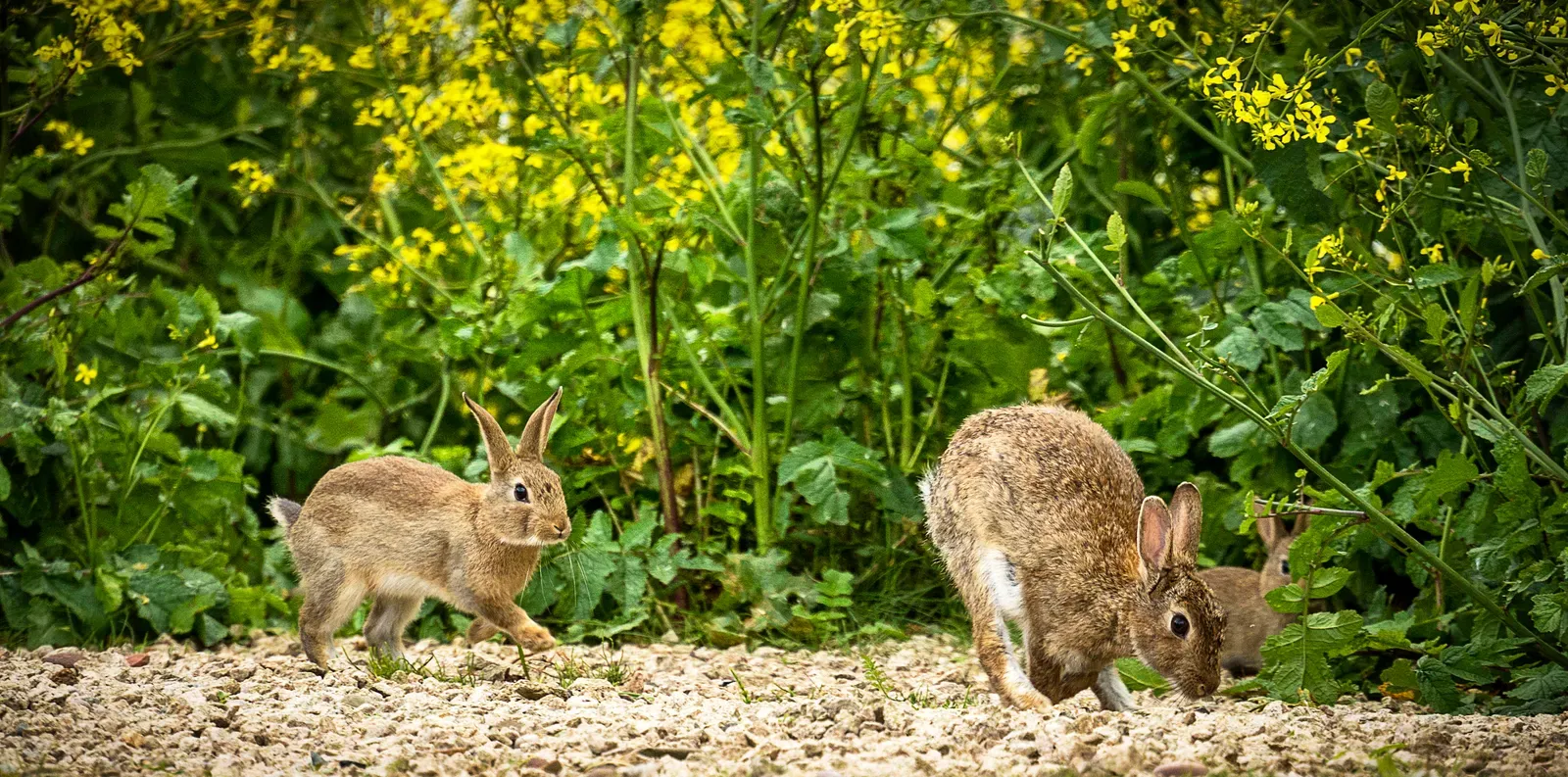
Imagine you are walking beside a grassy field as the daylight turns peachy grey. The grass whispers in a small breeze. Then—boing!—a rabbit slips from the edge of some scrub. Its nose wiggles as if it is sniffing a million tiny messages at once. A little white tail flashes, and poof: it is gone again.
This is the European rabbit, or Oryctolagus cuniculus. It is a mammal in the rabbit family, Leporidae, and it is the wild ancestor of domestic rabbits. European rabbits are most active around twilight and at night, when the air is cooler and shadows give them a bit of cover. That makes spotting one feel like finding a moving comma in the evening grass.
A wild adult is roughly the length of a school ruler plus a bit, and can weigh about as much as a large bag of flour. But its true size is not the most amazing thing. Beneath the rabbit’s feet may be an entire hidden neighbourhood, with passageways, rooms, neighbours, and more than one escape route. No tiny hard hats required.
Evidence: IUCN Red List of Threatened Species: Oryctolagus cuniculus (European Rabbit) — Red List Assessment; Animal Diversity Web, University of Michigan Museum of Zoology: Oryctolagus cuniculus (European rabbit); Wikipedia: European rabbit
Where does a rabbit sleep? Underground, of course!
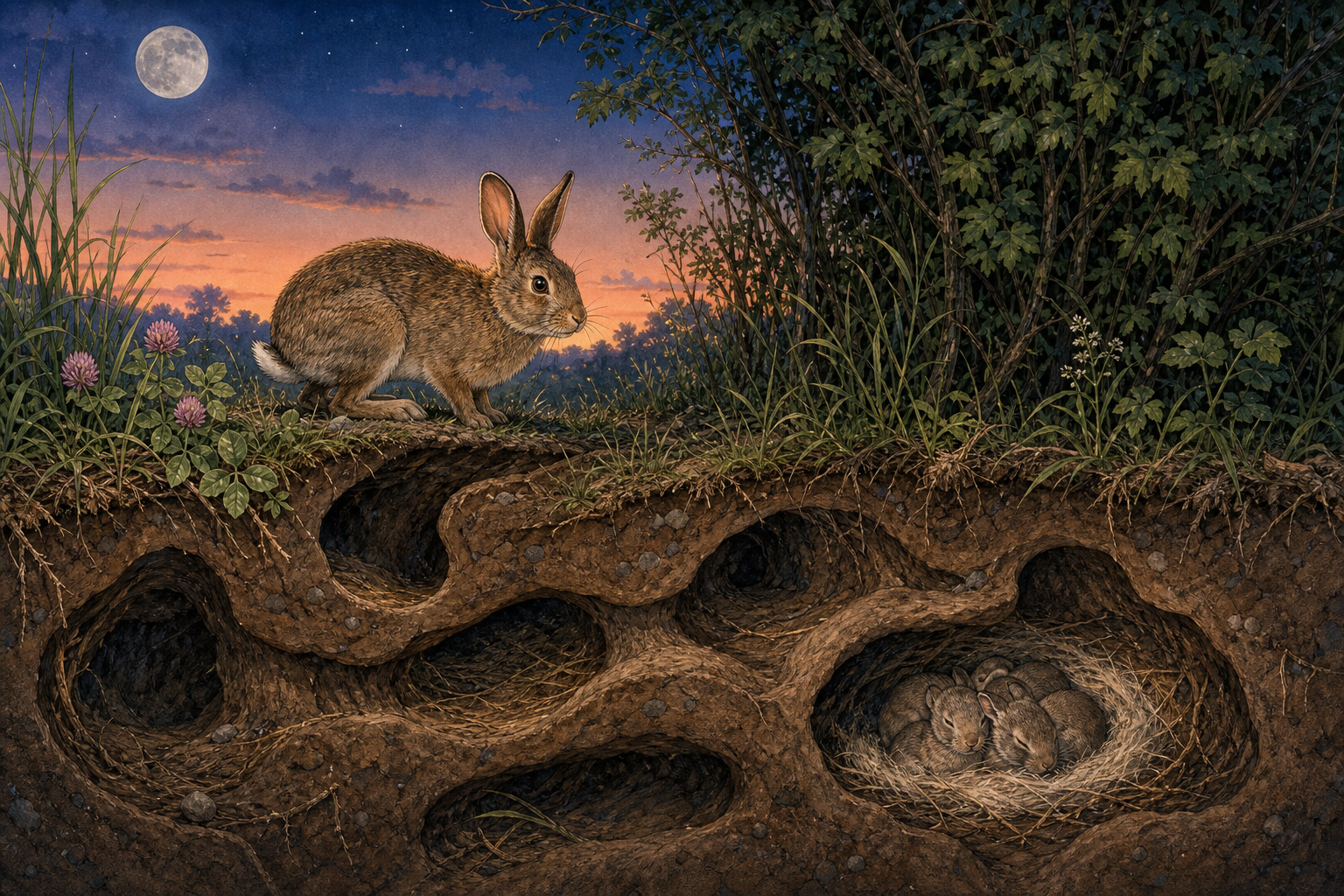
European rabbits are champion diggers. When the soil is soft enough and there is food nearby, they make connected burrows called a warren. A warren is not just one hole: it is a maze of tunnels and underground chambers shared by a group of rabbits. Think of it as an apartment building hidden under a meadow, except the corridors are dirt and every resident has excellent whiskers.
These rabbits live in mixed groups, rather than each rabbit living entirely alone. Their shared home helps explain why a grassy place with brushy cover can be so useful. Rabbits need places to feed, places to hide, and soil where they can burrow. They are found around grassland, scrubland, woodland edges, and farmland. In some parts of Europe, they also use parks, gardens, and other green corners near people.
The species originally comes from the Iberian Peninsula—Spain and Portugal—and southwestern France. Yet people introduced European rabbits to many other places long ago. Now they live wild on every continent except Asia and Antarctica. One rabbit species, many different chapters of the same big travel story.
Evidence: IUCN Red List of Threatened Species: Oryctolagus cuniculus (European Rabbit) — Red List Assessment; Animal Diversity Web, University of Michigan Museum of Zoology: Oryctolagus cuniculus (European rabbit); Wikipedia: European rabbit
What is on a rabbit’s dinner menu? Plants, plants, and more plants
If you packed a European rabbit’s lunchbox, it would be very green. This animal is an herbivore, eating grasses and leaves, and also bark and roots. Clover can be part of its browsing too. A rabbit may seem to be simply sitting still in a field, but it is actually choosing bites from a leafy buffet.
Eating plants takes special digestive teamwork. European rabbits practise coprophagy, which means they re-eat certain soft droppings so their bodies can take in more nourishment from tough plant food. It may sound odd to us, but for a rabbit it is a normal and important part of digestion. Nature is full of clever solutions—even the slightly squelchy-sounding ones.
A rabbit’s nibbling matters beyond its own tummy. In its native Iberian range, rabbits are a key prey animal for many predators. So when rabbit numbers change, other animals can feel that change too. A small creature munching grass can be part of a much larger living web.
Evidence: IUCN Red List of Threatened Species: Oryctolagus cuniculus (European Rabbit) — Red List Assessment; Animal Diversity Web, University of Michigan Museum of Zoology: Oryctolagus cuniculus (European rabbit); Wikipedia: European rabbit
The cosiest nursery in the warren
Here is one of the tenderest rabbit facts: baby European rabbits are called kits, and they are born underground with their eyes closed and without fur. Their mother prepares a snug nest and lines it with soft fur pulled from her own body. It is like making a tiny blanket from the warmest material she has.
The kits are born needing lots of care. Their underground nest helps keep them warm and hidden while they are very young. European rabbits can breed through much of the year, and a warren can become a busy place. Still, growing up wild is not easy: many young rabbits do not survive their first year.
That is worth remembering whenever a rabbit dashes away from us. It is not a toy with ears or a cartoon character late for tea. It is a watchful wild individual, finding food, listening for danger, returning to its shelter, and—if it is a mother—caring for kits in a carefully made nest.
Evidence: Animal Diversity Web, University of Michigan Museum of Zoology: Oryctolagus cuniculus (European rabbit); Wikipedia: European rabbit; IUCN Red List of Threatened Species: Oryctolagus cuniculus (European Rabbit) — Red List Assessment
How can rabbits need help in one place and cause trouble in another?
This is the European rabbit’s surprising puzzle. In its native range in Spain, Portugal, and southern France, the IUCN lists the native population as Endangered, with numbers decreasing. Diseases including myxomatosis and rabbit haemorrhagic disease have caused major declines, and habitat pressures matter too. Fewer safe wild places can mean fewer places to dig, hide, and feed.
Rabbits in the native range matter because predators depend on them as food. Protecting remaining habitat and helping manage disease are part of supporting the wider community of wild lives around them. Hope is not pretending a problem is small. Hope is noticing what is needed and choosing to help.
But in places where people introduced rabbits, the situation can be very different. In Australia and elsewhere, introduced rabbits have become highly abundant and can change vegetation and affect agriculture. The Endangered listing does not describe those introduced populations; it applies only to the native range. The lesson is wonderfully important: caring for animals also means caring about place. The kindest solution is not always identical everywhere.
Evidence: IUCN Red List of Threatened Species: Oryctolagus cuniculus (European Rabbit) — Red List Assessment; Animal Diversity Web, University of Michigan Museum of Zoology: Oryctolagus cuniculus (European rabbit); Wikipedia: European rabbit
Try a rabbit-sized adventure
You do not need to chase a rabbit—or even see one—to become a better rabbit neighbour. On a quiet evening, pause at the edge of a path and listen. Can you notice where grass meets bushes? Can you spot a likely burrow entrance from a respectful distance? Leave the entrance alone: an underground home deserves the same privacy as your bedroom door.
If you are lucky enough to watch a rabbit, stay calm, keep dogs close by where rules allow, and let the rabbit decide how near is comfortable. A quick glimpse is a gift, not a mission to get closer. You might only see a twitching ear or a white-tail wink. That is plenty.
Then take your curiosity home. Ask: What wild spaces near me need more care? Who else might rely on a small plant-eater? The European rabbit reminds us that a quiet grazer can be a builder, a parent, a neighbour, and a vital part of a landscape—all before breakfast, or rather, before its midnight snack.
Evidence: IUCN Red List of Threatened Species: Oryctolagus cuniculus (European Rabbit) — Red List Assessment; Animal Diversity Web, University of Michigan Museum of Zoology: Oryctolagus cuniculus (European rabbit); Wikipedia: European rabbit
A kind choice can start with a green plate
The rabbit’s plant-based menu is a cheerful reminder that plants can be wonderfully varied: crunchy vegetables, fruit, beans and lentils, whole grains, nuts, seeds, and more. The World Health Organization describes healthy eating patterns as including a variety of these foods. Food needs are personal, so children can explore new meals with a trusted grown-up rather than trying to solve everything alone.
Choosing more plant-based foods can be a gentle way to practise care for animals and for the places animals call home. The IPCC says shifts toward sustainable, healthy, more plant-based diets can reduce food-system emissions and pressure on land and biodiversity. You do not have to be perfect to be thoughtful: perhaps try a bean burrito, a lentil soup, or a colourful veggie sandwich, and thank the plants for doing the delicious heavy lifting.
Evidence: World Health Organization: Healthy diet; Intergovernmental Panel on Climate Change: Climate Change 2022: Mitigation of Climate Change — Chapter 7
Questions people ask
Is a European rabbit the same as a hare?
No. The European rabbit is Oryctolagus cuniculus, a rabbit in the family Leporidae. Hares belong to a different genus, Lepus. They may look alike at a quick glance, but they are not the same animal.
Evidence: Animal Diversity Web, University of Michigan Museum of Zoology: Oryctolagus cuniculus (European rabbit); Wikipedia: European rabbit
Why do rabbits dig warrens?
Warrens provide connected underground spaces where rabbits can shelter and raise young. European rabbits are social and often share these burrow systems in groups.
Evidence: Animal Diversity Web, University of Michigan Museum of Zoology: Oryctolagus cuniculus (European rabbit); Wikipedia: European rabbit
Are European rabbits endangered everywhere?
No. The IUCN Endangered status refers to the native population in the Iberian Peninsula and southern France. In some places where people introduced the species, rabbits are very abundant and can harm vegetation or agriculture.
Evidence: IUCN Red List of Threatened Species: Oryctolagus cuniculus (European Rabbit) — Red List Assessment; Animal Diversity Web, University of Michigan Museum of Zoology: Oryctolagus cuniculus (European rabbit); Wikipedia: European rabbit
What should I do if I find a rabbit burrow?
Watch from a distance and do not poke into, dig near, or block the entrance. A burrow may be an active home or nursery, and quiet space is a kind thing to give wild rabbits.
Evidence: Animal Diversity Web, University of Michigan Museum of Zoology: Oryctolagus cuniculus (European rabbit); Wikipedia: European rabbit
Read the evidence
Sources behind this story
- Oryctolagus cuniculus (European Rabbit) — Red List Assessment — IUCN Red List of Threatened Species
- Oryctolagus cuniculus (European rabbit) — Animal Diversity Web, University of Michigan Museum of Zoology
- European rabbit — Wikipedia
- Healthy diet — World Health Organization
- Climate Change 2022: Mitigation of Climate Change — Chapter 7 — Intergovernmental Panel on Climate Change
Health information is general education, not personal medical advice. Young readers should make food choices with a trusted adult and qualified health professional.