Today's animal friend · 27 August 2026
The European Eel’s Moonlit Map
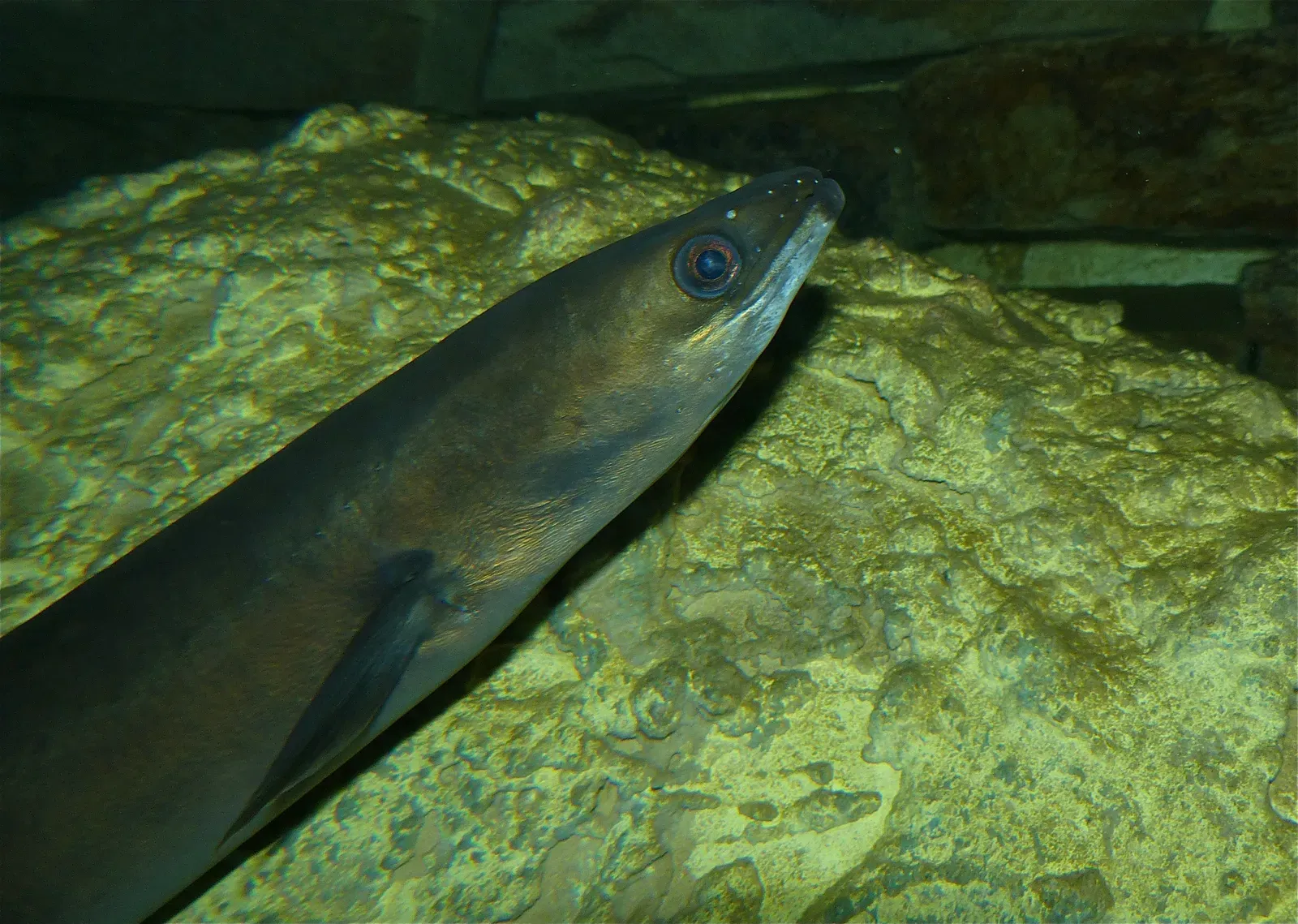
European eels drift, wriggle, hunt, and migrate across an astonishing watery world. Their journey is one of nature’s grandest adventures, and it needs our help.
European eels drift, wriggle, hunt, and migrate across an astonishing watery world. Their journey is one of nature’s grandest adventures, and it needs our help.
A ribbon flickers beneath the river’s dark surface
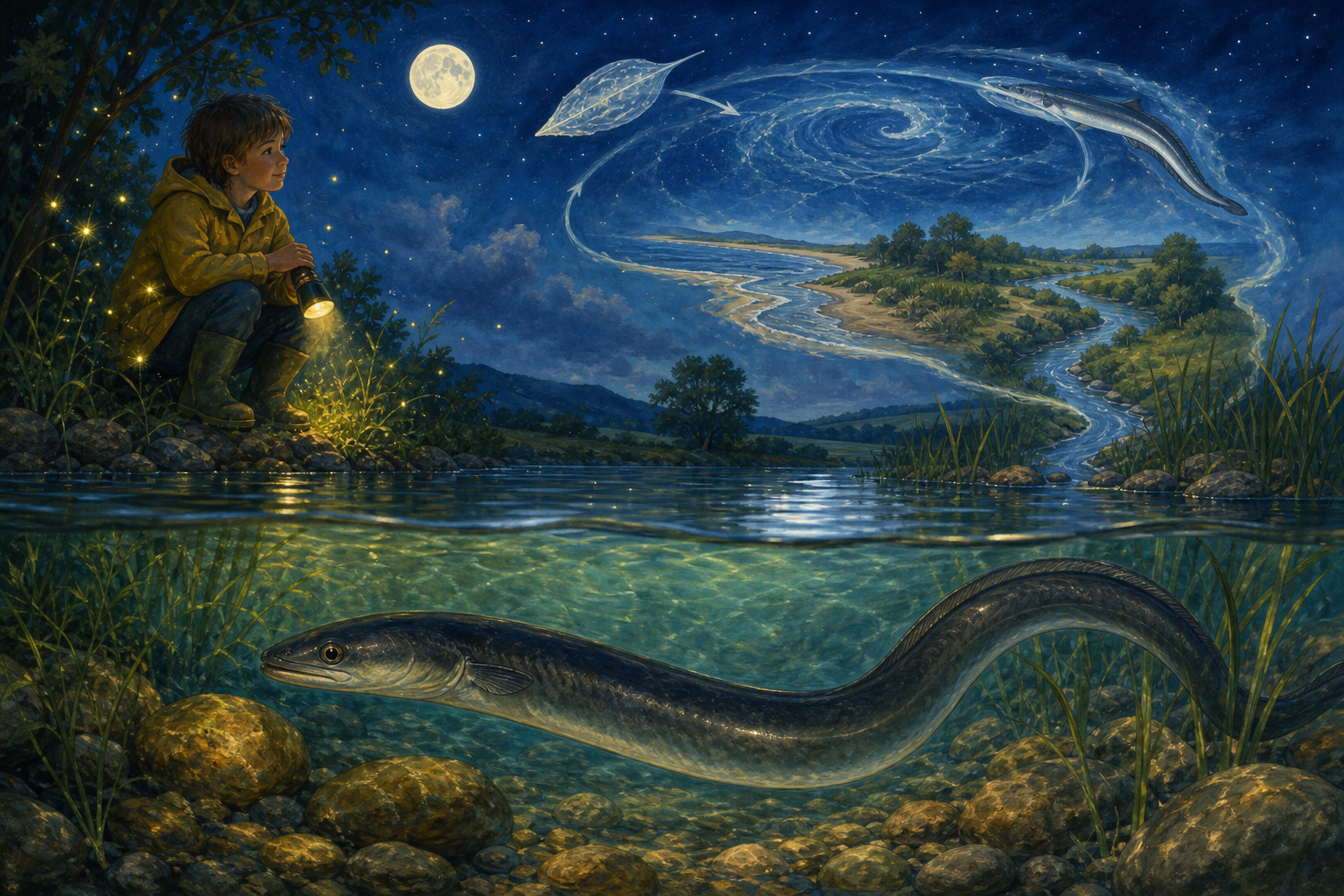
Imagine standing beside a quiet river at dusk. The water makes soft shushing sounds against the bank. A leaf spins past. Then—whoosh!—a long, smooth shape ripples through the shadows like a wet ribbon that has decided to go exploring.
That mysterious swimmer may be a European eel, Anguilla anguilla. It is a ray-finned fish, even though its long body can make it look rather like a snake in a swimming costume. Its fins form a gentle frill along much of its body, helping it bend into flowing S-curves.
European eels are mostly active at night. That makes them excellent secret-keepers. While many of us are brushing our teeth or hunting for a missing sock, an eel may be sliding along a riverbed, feeling its way through its underwater neighbourhood.
An adult is often around 45 to 65 centimetres long—roughly the length of a skateboard. Some become much larger, with a recorded maximum length of 133 centimetres. That is an impressively long fish, especially when it is quietly squeezing past reeds and stones.
Evidence: IUCN Red List of Threatened Species: Anguilla anguilla (European Eel) — Red List Assessment; Animal Diversity Web, University of Michigan Museum of Zoology: Anguilla anguilla (Common eel); Wikipedia: European eel
Where does an eel’s adventure begin? Far, far out at sea
Here is the astonishing part: a European eel’s story begins in the Sargasso Sea, a warm region of the Atlantic Ocean. Its tiny young hatch there as see-through, leaf-shaped larvae called leptocephali. “Leaf-shaped fish baby” sounds like something invented during a very silly game, but it is real.
The larvae drift on ocean currents toward Europe for about 300 days. They are not carrying tiny suitcases or asking, “Are we there yet?” Still, this is a giant journey across the ocean. By the time they reach Europe’s coasts, they have changed into clear, slim youngsters called glass eels.
Next come the elvers: small eels beginning to enter estuaries and freshwater. As they grow, they become yellow eels, living in rivers, lakes, coastal waters, and brackish places where fresh and salty water mingle. Later, on the return trip to sea, they are known as silver eels.
So a single eel can belong to the ocean, an estuary, and a river at different times in its life. It is a traveller with a map written not on paper, but in water currents, changing bodies, and an ancient urge to keep moving.
Evidence: IUCN Red List of Threatened Species: Anguilla anguilla (European Eel) — Red List Assessment; Animal Diversity Web, University of Michigan Museum of Zoology: Anguilla anguilla (Common eel); Wikipedia: European eel
What’s for supper in a muddy river?
After dark, a growing eel searches along the bottom for food. European eels are carnivores and scavengers. Their menu can include aquatic invertebrates, insect larvae, crustaceans, molluscs, worms, small fish, and carrion. In other words: they are not picky restaurant critics.
That broad diet links an eel to many other creatures in its watery home. A river is not just a blue line on a map. It is a busy shared table of plants, tiny animals, fish, birds, and visitors such as eels. When an eel hunts or scavenges, it is part of that living web.
Researchers do not yet know much about what the leaf-like larvae eat in the open ocean. That is a wonderful reminder that nature still has mysteries tucked into its pockets. Knowing some things does not mean we know everything.
Eels may spend many years growing in continental waters. Typical wild lifespans are often described as around 15 to 20 years, while an exceptional wild maximum of 85 years has been reported. An 85-year-old eel would have had a very long time to practise its graceful wiggle.
Evidence: Animal Diversity Web, University of Michigan Museum of Zoology: Anguilla anguilla (Common eel); Wikipedia: European eel
The call of the Atlantic: one more enormous swim
When adult eels become silver eels, their lives take another dramatic turn. They leave the rivers and coastlines where they grew and begin a migration back across the Atlantic toward the Sargasso Sea, where the next generation begins.
This return journey stretches for thousands of kilometres. Think of all the places an eel must pass: river mouths, coastal waters, wide ocean, and currents that no human can see from a window. The eel does not use a compass held in a fin. Yet it makes this mighty migration as part of its life cycle.
During the spawning migration, mature silver eels stop feeding. Their journey is not a casual weekend splash. It is one of the great travel stories in the animal world: a fish that begins far offshore, grows up in Europe and nearby waters, then heads back into the Atlantic.
That is why a clear path matters so much. For an eel, a river is not merely a place to live. It is part of a long, connected road between freshwater and sea.
Evidence: Animal Diversity Web, University of Michigan Museum of Zoology: Anguilla anguilla (Common eel); Wikipedia: European eel; IUCN Red List of Threatened Species: Anguilla anguilla (European Eel) — Red List Assessment
Why this watery road has become so hard
The European eel is listed as Critically Endangered on the IUCN Red List, and its population trend is decreasing. That means this remarkable traveller needs serious protection. Far fewer young eels are reaching Europe than in the past; one conservation summary reports a decline of around 90 percent, and possibly as much as 98 percent, since the 1970s.
Their journey can be blocked by dams and other barriers, including hydroelectric structures. Picture trying to walk home when a wall suddenly stands across every street. Eels also face pressure from fishing, pollution such as PCBs, changes in ocean currents, and a swim-bladder parasite called Anguillicola crassus.
None of this makes eels less amazing. It makes their survival more important. An animal that connects sea, estuary, and river needs all those places to be cared for together—not in separate little boxes.
There are reasons for hope. International trade controls are in place through CITES Appendix II, and reducing fishing pressure, tackling illegal trade, and restoring free migration routes can ease some of the dangers. Helping fish move past barriers and keeping water cleaner are practical ways people can make the route friendlier.
Evidence: IUCN Red List of Threatened Species: Anguilla anguilla (European Eel) — Red List Assessment; Wikipedia: European eel; Animal Diversity Web, University of Michigan Museum of Zoology: Anguilla anguilla (Common eel)
Be an eel-route detective
You do not need to swim across the Atlantic to care about eels. Start nearby. When you visit a stream, canal, lake, or river, pause and notice where the water goes. Is there a bridge? A weir? A drain? Reeds along the bank? Every waterway is connected to somewhere else, even if we cannot see the whole route.
You can help by treating rivers and their edges with respect: keep litter out of water, learn about local river-clean-up or habitat-restoration projects with an adult, and share the eel’s story. A friend who hears about a fish that changes from a transparent leaf-like larva into a river explorer may never look at a dark stream in quite the same way again.
It is also fine to keep asking questions. How does an eel find its way? What happens at a barrier? Which other animals use this river? Curiosity is not just a school subject. It is how people learn what is precious, and how to protect it.
The next time water whispers past a riverbank at night, imagine a smooth silver traveller below. It may be following a route older than any road, carrying a whole ocean-to-river adventure in its wriggling body.
Evidence: IUCN Red List of Threatened Species: Anguilla anguilla (European Eel) — Red List Assessment; Animal Diversity Web, University of Michigan Museum of Zoology: Anguilla anguilla (Common eel); Wikipedia: European eel
A kind choice can start at the dinner table
Eels are not ingredients first; they are wild travellers with a remarkable life story. Choosing not to eat eel is one gentle way to leave more room for these Critically Endangered animals and their journeys. You can be kind without making a fuss: try a favourite plant-based meal, or help make one with a trusted adult.
Plant-forward eating can be colourful and adventurous too—think beans, lentils, whole grains, vegetables, fruit, nuts, and seeds. The World Health Organization includes these foods in guidance about healthy dietary patterns, while reminding us that individual needs differ. Families can talk with a qualified health professional for personal advice.
There is a wider ripple as well. The IPCC reports that shifts toward sustainable, healthy, more plant-based diets can reduce food-system emissions and pressure on land and biodiversity. A bean burrito or veggie pasta will not solve everything alone, of course. But it can be a small, cheerful vote for a world where rivers stay alive and animal journeys have room to continue.
Evidence: IUCN Red List of Threatened Species: Anguilla anguilla (European Eel) — Red List Assessment; World Health Organization: Healthy diet; Intergovernmental Panel on Climate Change: Climate Change 2022: Mitigation of Climate Change — Chapter 7
Questions people ask
Is a European eel a snake?
No. A European eel is a ray-finned fish. Its long, slender body and flowing fins can make it look snake-like, but it is a fish built for wriggling through water.
Evidence: Animal Diversity Web, University of Michigan Museum of Zoology: Anguilla anguilla (Common eel); Wikipedia: European eel
Why are young eels called glass eels?
At that stage, they are clear or almost transparent, which makes “glass eel” a very fitting nickname. Before that, they are leaf-shaped larvae; after that, they become elvers and then growing yellow eels.
Evidence: Wikipedia: European eel; Animal Diversity Web, University of Michigan Museum of Zoology: Anguilla anguilla (Common eel)
Do European eels live only in rivers?
No. Their lives connect ocean, coast, estuary, and freshwater. They hatch in the Sargasso Sea, drift through the Atlantic, grow mainly in continental waters, and return to the sea to spawn.
Evidence: Animal Diversity Web, University of Michigan Museum of Zoology: Anguilla anguilla (Common eel); Wikipedia: European eel
What makes dams difficult for eels?
Dams and other migration barriers can interrupt the route eels need to travel between rivers and the sea. Restoring paths for migration is one practical way to reduce pressure on the species.
Evidence: IUCN Red List of Threatened Species: Anguilla anguilla (European Eel) — Red List Assessment; Wikipedia: European eel
Read the evidence
Sources behind this story
- Anguilla anguilla (European Eel) — Red List Assessment — IUCN Red List of Threatened Species
- Anguilla anguilla (Common eel) — Animal Diversity Web, University of Michigan Museum of Zoology
- European eel — Wikipedia
- Healthy diet — World Health Organization
- Climate Change 2022: Mitigation of Climate Change — Chapter 7 — Intergovernmental Panel on Climate Change
Health information is general education, not personal medical advice. Young readers should make food choices with a trusted adult and qualified health professional.