Today's animal friend · 20 September 2026
Emu on the Move: Australia’s Feathered Road-Runner
An emu cannot fly—but when it is racing over grassland, you might wonder whether the ground is having trouble keeping up.

An emu cannot fly—but when it is racing over grassland, you might wonder whether the ground is having trouble keeping up.
A doorway-sized bird goes strolling
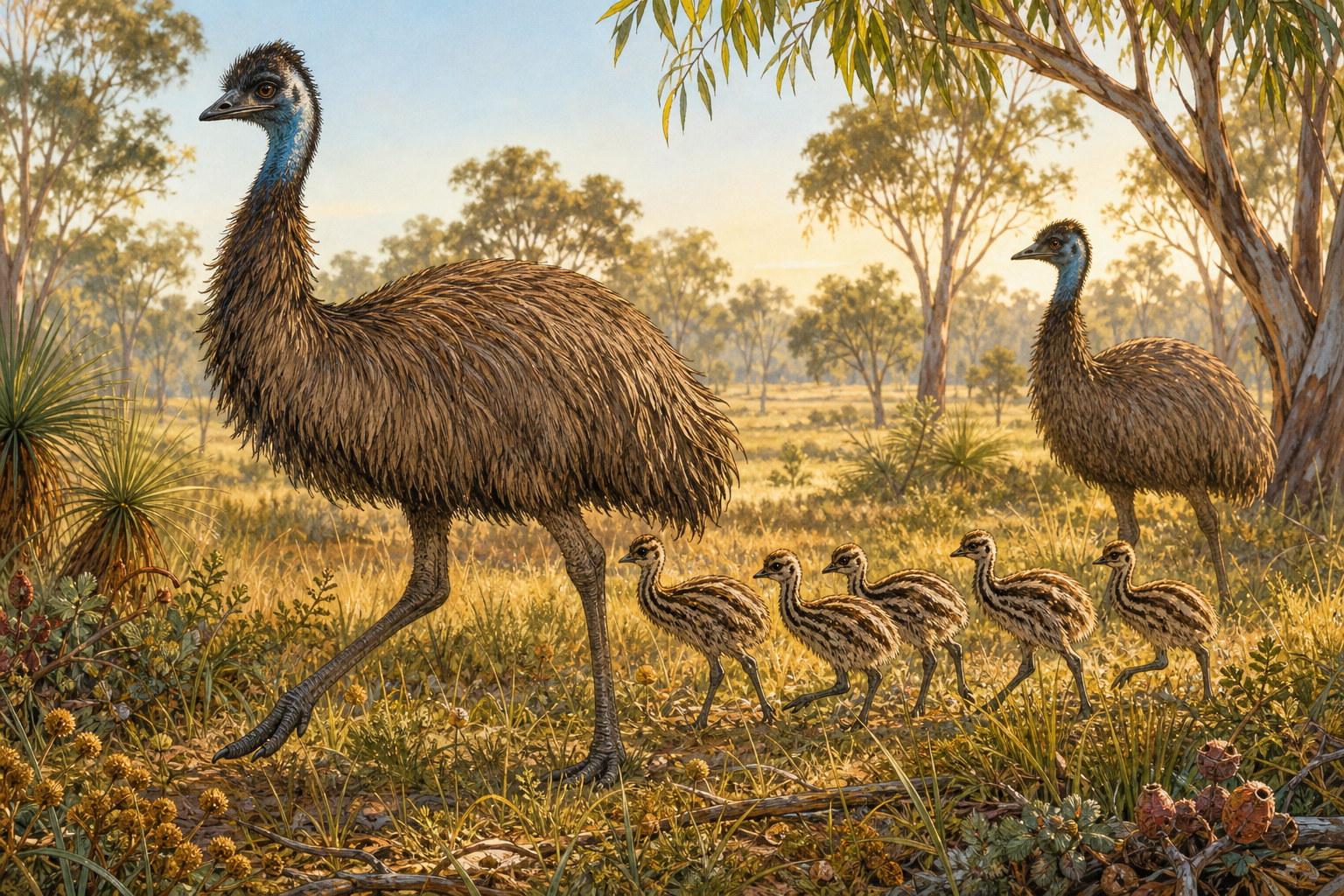
Imagine you are walking through open Australian grassland. Dry stems whisper at your ankles. Then a tall, shaggy shape rises above the plants: long neck, long legs, soft brown feathers ruffling like a slightly windswept coat. It is an emu—and it may stand almost as tall as a doorway.
The emu, or Dromaius novaehollandiae, is Australia’s tallest living bird. It belongs to the bird family Dromaiidae, yet it cannot fly. Its tiny wings are not made for lifting its large body into the sky. No matter. An emu has chosen a different superpower: getting places on foot.
Adult emus can reach about 1.9 metres tall. That is a lot of bird to meet eye-to-eye—or, more likely, knee-to-beak. But tall does not mean clumsy. With each careful step, an emu can seem calm and curious, as if it has somewhere important to be and is politely not explaining where.
Evidence: Wikipedia: Emu (Dromaius novaehollandiae); Animal Diversity Web, University of Michigan Museum of Zoology: Dromaius novaehollandiae (emu); IUCN Red List of Threatened Species / BirdLife International: Dromaius novaehollandiae (Emu) — Red List Assessment
If it cannot fly, why is it in such a hurry?
Here is the answer: emus are remarkable runners. They can sprint at around 48 kilometres per hour—faster than most people can pedal a bicycle. Picture a bird with legs doing the work of a speedy pair of trainers, carrying a feathered body across open ground.
Emus are active in the daytime. They travel long distances in search of food and water, and their movements can follow the changing seasons. In Western Australia, seasonal north-to-south journeys have been recorded. Instead of staying in one little patch, an emu may wander through a big changing landscape.
Their preferred places include savanna woodland and grassland, and they also use scrubland and forests. They tend to avoid very heavily wooded places and the driest districts. Standing water matters, too. An emu’s home is not one single kind of scenery; it is a broad outdoor map of places that can offer food, water, and room to stride.
Sometimes emus travel in pairs. Bigger gatherings can happen when many birds arrive at the same food-rich spot. That sounds a bit like everyone appearing in the kitchen at once when something delicious is being made—except the guests are tall birds, and nobody has brought plates.
Evidence: Animal Diversity Web, University of Michigan Museum of Zoology: Dromaius novaehollandiae (emu); Wikipedia: Emu (Dromaius novaehollandiae); IUCN Red List of Threatened Species / BirdLife International: Dromaius novaehollandiae (Emu) — Red List Assessment
What is on an emu’s menu? A little bit of almost everything
Emus are omnivores. As they forage, they eat fruits, seeds, insects, and other small animals. They may also eat flowers and young shoots. Their menu changes with what the land is offering, rather than following a fussy restaurant order.
This wandering snack-search has an important side effect. When emus eat fruit and move on, they can spread the seeds of low-growing plants over wide areas. A seed carried away from its parent plant gets a chance to grow somewhere new. So an emu is not only looking for lunch; it can also be an accidental gardener with very long legs.
They opportunistically eat insects, too. And emus are part of a web of life, not the whole story by themselves: dingoes and birds of prey can hunt them. Every animal has connections—to food, to plants, to water, and to other creatures sharing the same land.
An emu may look as though it is simply pecking about, but its day is full of choices: Which way has rain fallen? Where might fruit be ripening? Is there water ahead? A walk can be an adventure when your home is as wide as much of mainland Australia.
Evidence: Animal Diversity Web, University of Michigan Museum of Zoology: Dromaius novaehollandiae (emu); Wikipedia: Emu (Dromaius novaehollandiae); IUCN Red List of Threatened Species / BirdLife International: Dromaius novaehollandiae (Emu) — Red List Assessment
The nest secret: Dad takes the night shift—and the day shift
Emu family life holds one of the best surprises. After the female lays the eggs, the father incubates them. He sits on the nest for about eight weeks, keeping the eggs warm. That is a patient job. Try sitting still through one long film, then imagine doing your careful bird-parent duty day after day.
When the chicks hatch, they wear cream and brown stripes. These stripes help them blend into grassy surroundings. Their father guards and cares for them for months, guiding the little group as they learn where to find food. Sources report that he may protect the chicks for up to seven months.
This does not make every emu family identical, but it does remind us that animal care can take many shapes. Sometimes a parent’s greatest adventure is not racing across the landscape. Sometimes it is slowing down, staying watchful, and keeping tiny stripy companions together.
Next time someone says birds are all about wings, you can tell them about the emu dad: a flightless runner who becomes a devoted nest-sitter and chick-guard. That is quite a job description.
Evidence: Wikipedia: Emu (Dromaius novaehollandiae); Animal Diversity Web, University of Michigan Museum of Zoology: Dromaius novaehollandiae (emu); IUCN Red List of Threatened Species / BirdLife International: Dromaius novaehollandiae (Emu) — Red List Assessment
A big range is good news—but local care still matters
The mainland emu is listed as Least Concern on the IUCN Red List, with a very large range across mainland Australia. The 2018 assessment reports an increasing population trend. That is encouraging news for this extraordinary bird.
Still, “Least Concern” is not another way of saying “nothing to worry about.” It is a global conservation category, and local places can have different problems. In the past, hunting and culling for crop damage reduced or removed some emu populations, including island forms that are now extinct. Habitat pressure and persecution can still matter locally.
A hopeful way to think about conservation is to notice the essentials an emu needs: connected habitat, food, and access to water. Protecting those things helps wildlife keep moving through a changing world. It also leaves room for the surprising moments: a tall bird crossing the distance with its feathers bouncing softly behind it.
Emus do not need us to turn them into cartoon heroes. They are already impressive as themselves—fast, watchful, seed-scattering, and wonderfully odd. Caring about them means making space for their real lives.
Evidence: IUCN Red List of Threatened Species / BirdLife International: Dromaius novaehollandiae (Emu) — Red List Assessment; Animal Diversity Web, University of Michigan Museum of Zoology: Dromaius novaehollandiae (emu); Wikipedia: Emu (Dromaius novaehollandiae)
A kind choice can begin with a curious question
Watching an emu search for seeds, fruit, and shoots can invite a gentle question: what foods can help people enjoy a wide, colourful menu while showing kindness to animals and the places they live? The World Health Organization describes healthy diets in broad terms that include plenty of whole grains, vegetables, fruit, pulses, nuts, and seeds.
With a parent or trusted adult, you might try a plant-based snack or meal: fruit with peanut butter, bean tacos, lentil soup, or a seed-filled sandwich. It is not about being perfect or telling another family what to do. It is about practising care, one delicious choice at a time.
The IPCC reports that shifts toward sustainable, healthy, more plant-based diets can reduce food-system emissions and pressure on land and biodiversity. Choosing more plant foods can be one small way to cheer for living landscapes—places where an emu can keep striding, foraging, and raising its stripey young.
Evidence: World Health Organization: Healthy diet; Intergovernmental Panel on Climate Change: Climate Change 2022: Mitigation of Climate Change — Chapter 7
Questions people ask
Are emus related to ostriches?
They are both large, flightless birds often grouped among ratites, but they are different species. The ostrich is the only living bird taller than the emu.
Evidence: Animal Diversity Web, University of Michigan Museum of Zoology: Dromaius novaehollandiae (emu); Wikipedia: Emu (Dromaius novaehollandiae)
Can an emu really outrun a bicycle?
An emu can sprint at around 48 kilometres per hour. That can be faster than many people ride a bike, especially on an ordinary path rather than in a race.
Evidence: Animal Diversity Web, University of Michigan Museum of Zoology: Dromaius novaehollandiae (emu); Wikipedia: Emu (Dromaius novaehollandiae)
Do emus live only in one kind of habitat?
No. They use a range of Australian habitats, including grasslands, savanna woodland, scrubland, and some forests, especially where food and water are available.
Evidence: Animal Diversity Web, University of Michigan Museum of Zoology: Dromaius novaehollandiae (emu); Wikipedia: Emu (Dromaius novaehollandiae); IUCN Red List of Threatened Species / BirdLife International: Dromaius novaehollandiae (Emu) — Red List Assessment
Who looks after young emus?
The father incubates the eggs for about eight weeks and then guards the striped chicks for months as they grow.
Evidence: Wikipedia: Emu (Dromaius novaehollandiae); Animal Diversity Web, University of Michigan Museum of Zoology: Dromaius novaehollandiae (emu)
Read the evidence
Sources behind this story
- Emu (Dromaius novaehollandiae) — Wikipedia
- Dromaius novaehollandiae (emu) — Animal Diversity Web, University of Michigan Museum of Zoology
- Dromaius novaehollandiae (Emu) — Red List Assessment — IUCN Red List of Threatened Species / BirdLife International
- Healthy diet — World Health Organization
- Climate Change 2022: Mitigation of Climate Change — Chapter 7 — Intergovernmental Panel on Climate Change
Health information is general education, not personal medical advice. Young readers should make food choices with a trusted adult and qualified health professional.