Today's animal friend · 26 October 2026
The Moonlit Blue-Green Secret of the Emperor Scorpion
Meet Pandinus imperator: a big, calm-looking nighttime hunter with powerful pincers, a taste for termites, and a wild home worth keeping wild.
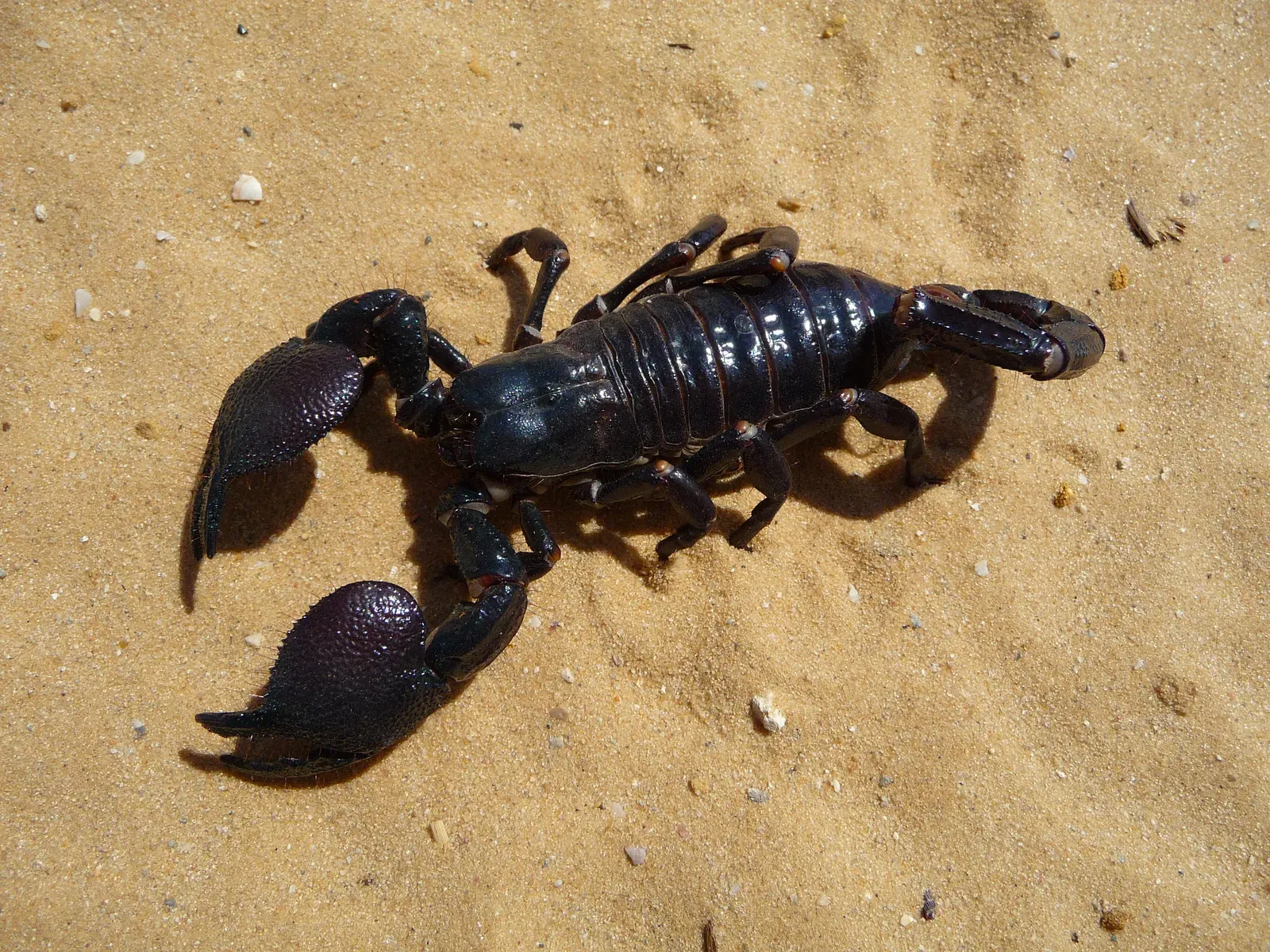
Meet Pandinus imperator: a big, calm-looking nighttime hunter with powerful pincers, a taste for termites, and a wild home worth keeping wild.
A tiny lantern wakes on the forest floor
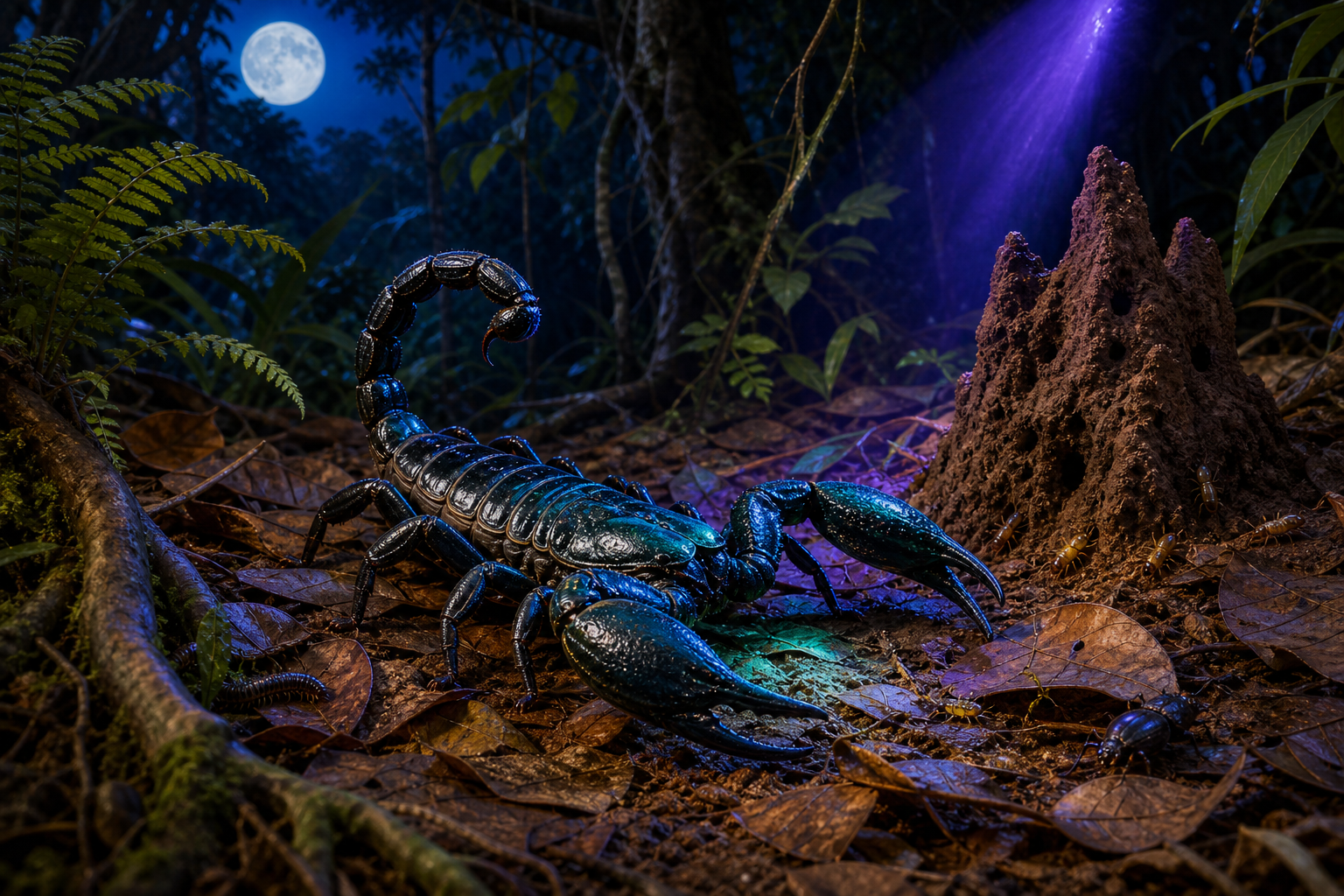
Picture a warm West African night. Leaves lie in crumbly layers like nature’s old cereal, and the air feels damp and busy. Then a large, shiny black scorpion slips from beneath the leaf litter. In ordinary light it looks almost like a polished pebble with legs. But shine ultraviolet light nearby and—whoosh—it glows a soft blue-green.
This is the emperor scorpion, also called the imperial scorpion. Its scientific name is Pandinus imperator. That glow is not a magic trick or a superhero costume; it is a real feature of its body. Scientists are still puzzling over why scorpions fluoresce under ultraviolet light, which makes the mystery even better.
The emperor scorpion belongs to the arachnid group, alongside spiders. It has a curling tail with a stinger at the end, plus two very noticeable pincers at the front. If you saw one glowing in the dark, you might feel as if you had found a small creature from another planet. Really, though, it is at home on Earth—especially on Africa’s forest floors.
Evidence: IUCN Red List of Threatened Species / CITES: Pandinus imperator (Emperor Scorpion) — conservation status; Animal Diversity Web, University of Michigan Museum of Zoology: Pandinus imperator; Wikipedia, the free encyclopedia: Emperor scorpion
Big pincers, small panic
Emperor scorpions are among the world’s biggest scorpions. An adult can grow to about 20 centimetres long—roughly the length of a grown-up’s hand. It may look ready to star in a monster movie, but its usual style is much less dramatic.
These scorpions are generally timid. Adults usually try to flee, or they use their large pincers, rather than sting. Their venom is described as mild for most people, though any wild animal deserves space and respect. The best plan is simple: look with your eyes, not your hands.
Those pincers are useful tools for holding prey. Imagine trying to pick up a wriggly noodle with two very strong grabbers. The emperor scorpion is built for that sort of job. Its dark, sturdy body and giant claws make it seem fierce, but being calm does not make it boring. It makes it a wonderful reminder that an animal’s appearance is not the whole story.
Evidence: Animal Diversity Web, University of Michigan Museum of Zoology: Pandinus imperator; Wikipedia, the free encyclopedia: Emperor scorpion
Where does a nighttime giant hide?
By day, an emperor scorpion can stay tucked away in a burrow, under leaf litter and other debris, beside stream banks, or in and around termite mounds. Its homes include tropical forests and savannas in West and west-central Africa. Think of the forest floor as a whole downstairs world, filled with tunnels, roots, fallen leaves, and tiny neighbours.
When night arrives, the scorpion becomes active. Darkness is not empty to it. The ground carries clues, and a hidden meal may be nearby. Its low-to-the-ground journey is more shuffle-and-feel than stomp-and-see.
Termite mounds can be especially exciting places. Emperor scorpions are strong diggers and may tunnel into them in search of termites. A termite mound might look like a lump of soil to us, but to a hungry scorpion it can be a bustling snack bar—one where the food does not exactly volunteer to be eaten.
The scorpion is part of a bigger nighttime neighbourhood. It hunts small animals, and it can also be prey for birds, bats, mammals, and spiders. Every creature is connected to others in ways that are easy to miss when we only look at the tops of trees.
Evidence: Animal Diversity Web, University of Michigan Museum of Zoology: Pandinus imperator; Wikipedia, the free encyclopedia: Emperor scorpion
What is on the emperor’s dinner menu?
Despite its grand name, an emperor scorpion does not dine on royal cakes. It is a carnivorous hunter. Termites are a major food, and it also eats insects and spiders. Sometimes it may take a small lizard or another small vertebrate.
That menu tells us why the scorpion’s pincers matter so much. Adults usually subdue prey with those powerful claws. Young scorpions rely more on their sting, but a grown emperor scorpion often has all the grabbing power it needs.
It is tempting to call a scorpion “scary” just because it eats other animals. But in its own habitat, it is simply doing the work of being an emperor scorpion. A forest has many eaters, many eaten, and many surprising partnerships. The more closely we look, the more we see that even a termite-hunting tunnel-digger has a place in the pattern.
Evidence: Animal Diversity Web, University of Michigan Museum of Zoology: Pandinus imperator; Wikipedia, the free encyclopedia: Emperor scorpion
A family ride with tiny passengers?
Here is a softer side of this shiny hunter: emperor scorpion mothers carry their young on their backs. Picture a careful parent wearing a living, wriggly backpack. For a while, the babies travel above the ground instead of across it.
Emperor scorpions are also more social than many people expect from scorpions. Groups of up to about 15 have been observed living together. That does not mean every moment is a cozy sleepover—wild animals still need food and space—but it does challenge the idea that every scorpion must be a lonely grump in a corner.
An emperor scorpion may live for around six to eight years. That is plenty of nights for burrowing, hunting, hiding, glowing under ultraviolet light, and perhaps carrying the next generation across the forest floor. When we pause to notice this hidden life, a creature that once seemed spooky can become a neighbour worth cheering for.
Evidence: Animal Diversity Web, University of Michigan Museum of Zoology: Pandinus imperator; Wikipedia, the free encyclopedia: Emperor scorpion
How can a scorpion stay wild and wonderful?
Because emperor scorpions are large, calm, and striking, people have collected them for the pet trade. Over-collection from the wild is the main pressure named in the available sources. The species has not been formally evaluated on the IUCN Red List, so its overall population trend is unknown. Unknown is a reason to pay attention, not a reason to give up.
International trade is regulated through CITES Appendix II to help prevent over-exploitation. Rules like these can help, especially when people follow them. Protecting forests and savannas also protects the leaf litter, burrows, termite mounds, and all the other small worlds emperor scorpions need.
A good animal-friend question is: “Can this creature stay part of its own wild story?” Choosing not to treat wild animals as souvenirs is one caring answer. A scorpion under leaves, free to follow its nighttime route, is not a decoration. It is an explorer with important work to do.
Evidence: IUCN Red List of Threatened Species / CITES: Pandinus imperator (Emperor Scorpion) — conservation status; Animal Diversity Web, University of Michigan Museum of Zoology: Pandinus imperator; Wikipedia, the free encyclopedia: Emperor scorpion
A kind choice can begin at the dinner table
Caring about an emperor scorpion can make us curious about every living thing sharing our planet—from a termite mound to a rainforest tree. One gentle way families can show that care is by enjoying more plant foods such as vegetables, fruit, beans, whole grains, nuts, and seeds, in ways that work for them and with guidance from trusted adults when needed.
The World Health Organization includes these foods in healthy, varied eating patterns. The IPCC also reports that shifts toward sustainable, healthy, more plant-based diets can reduce pressure on land and biodiversity, as well as food-system emissions. Nobody has to be perfect to be kind. A bean-filled meal, a crunchy fruit snack, or trying a new vegetable can be a small, hopeful vote for a world with room for wild scorpions and their leafy nighttime homes.
Evidence: World Health Organization: Healthy diet; Intergovernmental Panel on Climate Change: Climate Change 2022: Mitigation of Climate Change — Chapter 7
Questions people ask
Does an emperor scorpion really glow?
Yes. Its body fluoresces a blue-green colour under ultraviolet light. In normal light, it appears shiny black.
Evidence: Animal Diversity Web, University of Michigan Museum of Zoology: Pandinus imperator; Wikipedia, the free encyclopedia: Emperor scorpion
Is it the biggest scorpion ever?
It is one of the biggest scorpions in the world, with adults reaching about 20 centimetres long. That is big for a scorpion, even if it is not the record-holder for every measurement.
Evidence: Animal Diversity Web, University of Michigan Museum of Zoology: Pandinus imperator; Wikipedia, the free encyclopedia: Emperor scorpion
What should I do if I see a scorpion in the wild?
Give it room and observe from a safe distance. Wild animals should not be picked up or disturbed, and an emperor scorpion usually prefers to get away.
Evidence: Animal Diversity Web, University of Michigan Museum of Zoology: Pandinus imperator; Wikipedia, the free encyclopedia: Emperor scorpion
Why should people care about a termite-eating scorpion?
It is part of the food web in its African habitats: it hunts small animals and is eaten by other animals. Its wild home is full of connected lives, from termites to birds and bats.
Evidence: Animal Diversity Web, University of Michigan Museum of Zoology: Pandinus imperator
Read the evidence
Sources behind this story
- Pandinus imperator (Emperor Scorpion) — conservation status — IUCN Red List of Threatened Species / CITES
- Pandinus imperator — Animal Diversity Web, University of Michigan Museum of Zoology
- Emperor scorpion — Wikipedia, the free encyclopedia
- Healthy diet — World Health Organization
- Climate Change 2022: Mitigation of Climate Change — Chapter 7 — Intergovernmental Panel on Climate Change
Health information is general education, not personal medical advice. Young readers should make food choices with a trusted adult and qualified health professional.