Today's animal friend · 25 October 2026
The Pond Has a Blue Emperor
On a warm day beside still water, look up. Something long, bright, and wonderfully speedy may be patrolling overhead: Anax imperator, the emperor dragonfly.
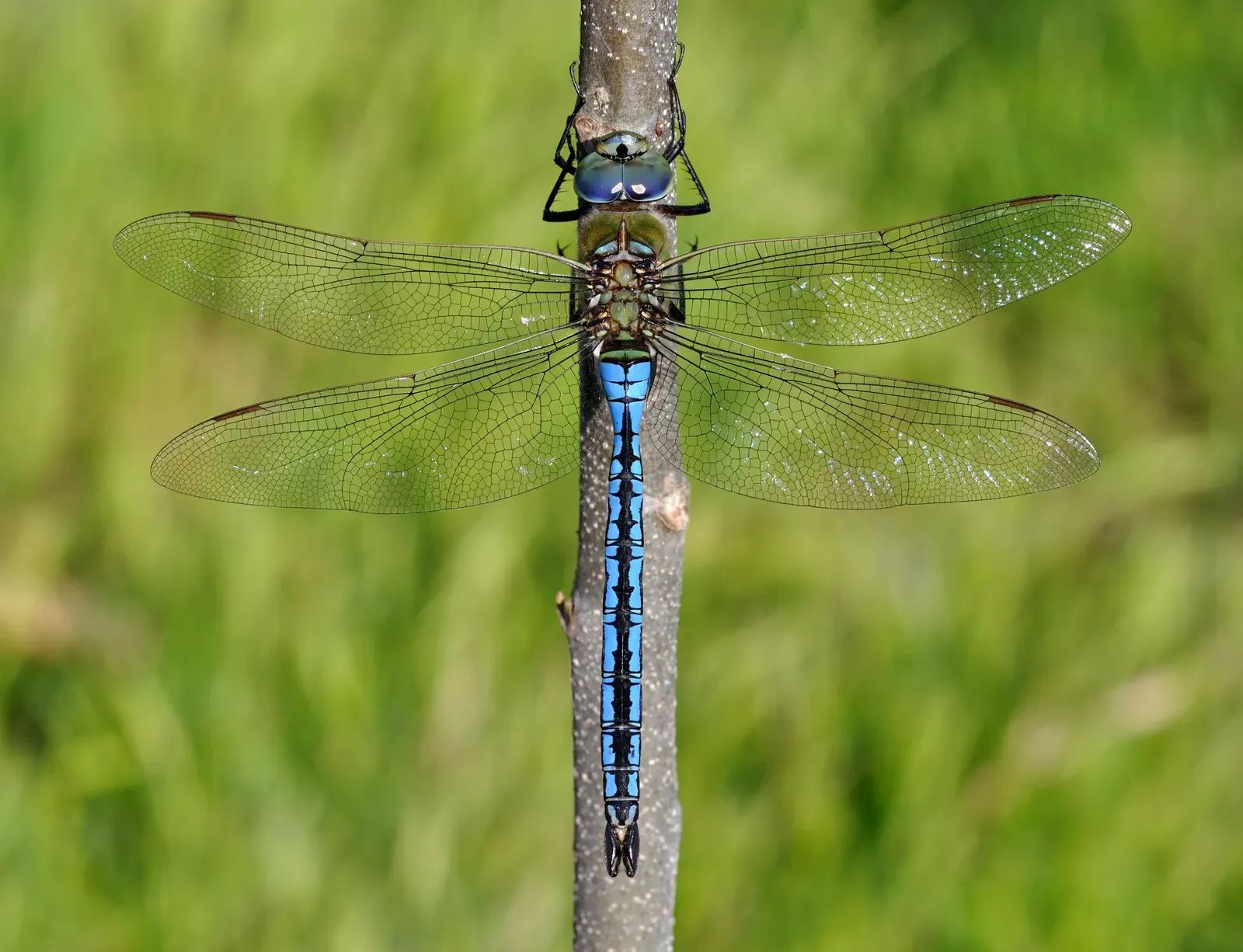
On a warm day beside still water, look up. Something long, bright, and wonderfully speedy may be patrolling overhead: Anax imperator, the emperor dragonfly.
A blue flash over the water
The pond looks sleepy at first. A reed wiggles. A tiny ripple wrinkles the water. Then—zip!—a blue flash shoots past your nose and races along the bank. It is an emperor dragonfly, also called a blue emperor, and it has turned this quiet pond into its own sky-high racetrack.
An emperor dragonfly is one of Europe’s biggest dragonflies. Its long body can be about as long as a finger, while its wings stretch to roughly the width of a small ruler. Adults are about 73 to 82 millimetres long, but their size is not the only impressive thing. They are daytime fliers built for movement: hovering, darting, and patrolling over sunny water.
If you are lucky enough to see one, do not expect it to sit still for a portrait. This is not a “pose beside the flower” sort of insect. It is more of a “whoosh past the reeds and make everyone blink” sort of insect. The scientific name for this flying friend is Anax imperator. It belongs to the dragonfly order, Odonata.
Evidence: IUCN Red List of Threatened Species: Anax imperator (Emperor Dragonfly) — Red List Assessment; Animal Diversity Web, University of Michigan Museum of Zoology: Anax imperator; Wikipedia: Emperor dragonfly
Why is it called an emperor?
Imagine a tiny ruler of the pond, cruising back and forth above the water instead of sitting on a throne. Adult male emperor dragonflies defend territories around breeding water, so a pond edge can become their royal patrol route. There is no dragonfly castle and no crown—sadly—but there is plenty of determined flying.
The males are known for their sky-blue bodies, while females are softer green. Both have long bodies and shining wings that make them look almost too grand for an ordinary puddle-sized world. Yet an emperor dragonfly does not need a fancy palace. It needs the right kind of watery neighbourhood.
Across Africa, much of Europe, the Arabian Peninsula, and parts of Asia, emperor dragonflies live around freshwater places. They breed in ponds, lakes, canals, dikes, and slow-moving rivers where aquatic plants are plentiful. Those plants are not just underwater decorations: females lay eggs into vegetation. A pond with plants is a pond with hiding places, landing spots, and dragonfly possibilities.
Evidence: IUCN Red List of Threatened Species: Anax imperator (Emperor Dragonfly) — Red List Assessment; Wikipedia: Emperor dragonfly
The flying snack basket
Here is a surprising emperor trick: it can catch prey and eat it while still flying. Flies, butterflies, and other insects may become part of its meal. It may also take tadpoles. Hunting while airborne sounds like trying to eat a sandwich while riding a skateboard downhill—except the emperor dragonfly is much better at it.
Its bristly legs can work like a basket. As it zooms through the air, it scoops up smaller flying animals. Then it can keep moving as it eats. This makes the emperor a powerful hunter of the daytime sky.
That does not make the dragonfly mean. It is simply an animal finding food in the way its body and life require. Ponds are busy places, full of creatures eating, hiding, growing, and being careful. Emperor dragonflies are part of both the air-and-water sides of that busy community: adults hunt above the surface, while young dragonflies hunt below it.
Next time you watch a dragonfly, try this gentle challenge: do not chase it. Stand quietly a little way from the bank and follow its route with your eyes. Does it loop around one patch of reeds? Does it pause in mid-air? A patient watcher may notice that the pond is not silent or still at all.
Evidence: Animal Diversity Web, University of Michigan Museum of Zoology: Anax imperator; Wikipedia: Emperor dragonfly
Before the wings: the underwater chapter
Every emperor dragonfly begins with a secret water-world chapter. After hatching, it lives as a nymph, a young dragonfly without wings. Instead of zipping above the pond, the nymph is an aquatic hunter. It spends a year or two underwater before becoming the familiar winged adult.
Picture the change: a young dragonfly climbs out of the water on a plant stem, leaves its old skin behind, and unfolds new wings. It is one of nature’s great costume changes, except nobody has to sew the costume. The wings arrive as part of the transformation.
This is why a dragonfly’s story cannot be told by looking only at the sky. It belongs to the water, the plants, and the sunny air above them. Young nymphs are large aquatic predators and can affect which freshwater creatures live together. Adults, meanwhile, patrol and hunt in the air. One animal, two very different worlds.
A shed dragonfly skin, called an empty skin rather than a living dragonfly, may sometimes be found clinging to a stem near water. If you find one, look with care and leave it where it is. It is a clue that a remarkable transformation happened there.
Evidence: IUCN Red List of Threatened Species: Anax imperator (Emperor Dragonfly) — Red List Assessment; Wikipedia: Emperor dragonfly
Good news, with a pond-sized promise
The emperor dragonfly is listed as Least Concern on the IUCN Red List. It is widespread, and its population is described as stable to increasing. In Europe, its range has expanded northwards in recent decades. That is encouraging news for this bright pond patroler.
Still, “doing well” does not mean “does not need us.” Emperor dragonflies need breeding waters with aquatic plants. Keeping ponds, lakes, canals, and slow waters welcoming gives eggs a place to be laid and young nymphs a watery home. Protecting or creating well-vegetated ponds is a hopeful way to make room for dragonfly lives.
You do not need to become the Official Royal Pond Keeper of Everything. You can begin by noticing water kindly: admire pond plants rather than pulling them out, avoid disturbing animals at the edge, and share what you spot with a grown-up, school group, or local nature project. Care often starts with looking closely enough to say, “Oh! Someone lives here.”
An emperor dragonfly may be only finger-length, but it connects a great many things: sunlight, clean-looking open water, stems rising from the shallows, flying insects, tadpoles, and patient observers on the bank. That is a lot of world for one blue flash to carry.
Evidence: IUCN Red List of Threatened Species: Anax imperator (Emperor Dragonfly) — Red List Assessment; Wikipedia: Emperor dragonfly
A kind choice that reaches beyond the pond
Caring about an emperor dragonfly can make us curious about all the lives connected to water, plants, and food. One gentle way families can care for animals and wild places is to enjoy more plant-based meals together: think beans, lentils, whole grains, vegetables, fruit, nuts, and seeds. The World Health Organization describes these foods as useful parts of varied healthy diets.
Plant-forward eating can be a planet-kind choice, too. The IPCC reports that shifts toward sustainable, healthy, more plant-based diets can reduce food-system emissions and pressure on land and biodiversity. No one needs to be perfect. Perhaps try a favourite bean chilli, lentil soup, or a sandwich with hummus and crunchy vegetables—with a trusted adult helping choose what works for your family.
It is a small, everyday way to practise the same thought we bring to the pond bank: other animals have homes, needs, and lives of their own. The blue emperor does not ask us to be gloomy. It invites us to notice, care, and make room for more living things.
Evidence: World Health Organization: Healthy diet; Intergovernmental Panel on Climate Change: Climate Change 2022: Mitigation of Climate Change — Chapter 7; Wikipedia: Emperor dragonfly
Questions people ask
Can an emperor dragonfly really eat while flying?
Yes. Adults can catch smaller prey in the air with their bristly legs and may eat it while still on the wing. It is a remarkable skill for an animal with a body about as long as a finger.
Evidence: Wikipedia: Emperor dragonfly
Where might I see one?
Look near ponds, lakes, canals, marshy waters, or slow-moving rivers with plenty of water plants, especially on warm sunny days. Watch from a respectful distance so wildlife can carry on with its day.
Evidence: IUCN Red List of Threatened Species: Anax imperator (Emperor Dragonfly) — Red List Assessment; Wikipedia: Emperor dragonfly
Is a dragonfly born with wings?
No. The young stage is an underwater nymph. After a year or two in the water, it climbs out, leaves its old skin, and develops wings for its adult life.
Evidence: Wikipedia: Emperor dragonfly
Are emperor dragonflies in danger of disappearing?
They are currently listed as Least Concern and are widespread, with a stable to increasing population described in the supplied assessments. But they still rely on suitable freshwater habitats with aquatic plants.
Evidence: IUCN Red List of Threatened Species: Anax imperator (Emperor Dragonfly) — Red List Assessment; Wikipedia: Emperor dragonfly

Read the evidence
Sources behind this story
- Anax imperator (Emperor Dragonfly) — Red List Assessment — IUCN Red List of Threatened Species
- Anax imperator — Animal Diversity Web, University of Michigan Museum of Zoology
- Emperor dragonfly — Wikipedia
- Healthy diet — World Health Organization
- Climate Change 2022: Mitigation of Climate Change — Chapter 7 — Intergovernmental Panel on Climate Change
Health information is general education, not personal medical advice. Young readers should make food choices with a trusted adult and qualified health professional.