Today's animal friend · 24 August 2026
Dingo Moon Song: Following Australia’s Wild Dog
From soft-footed evening journeys to moonlit messages between family members, discover the dingo—Australia’s wild dog with a voice worth listening for.
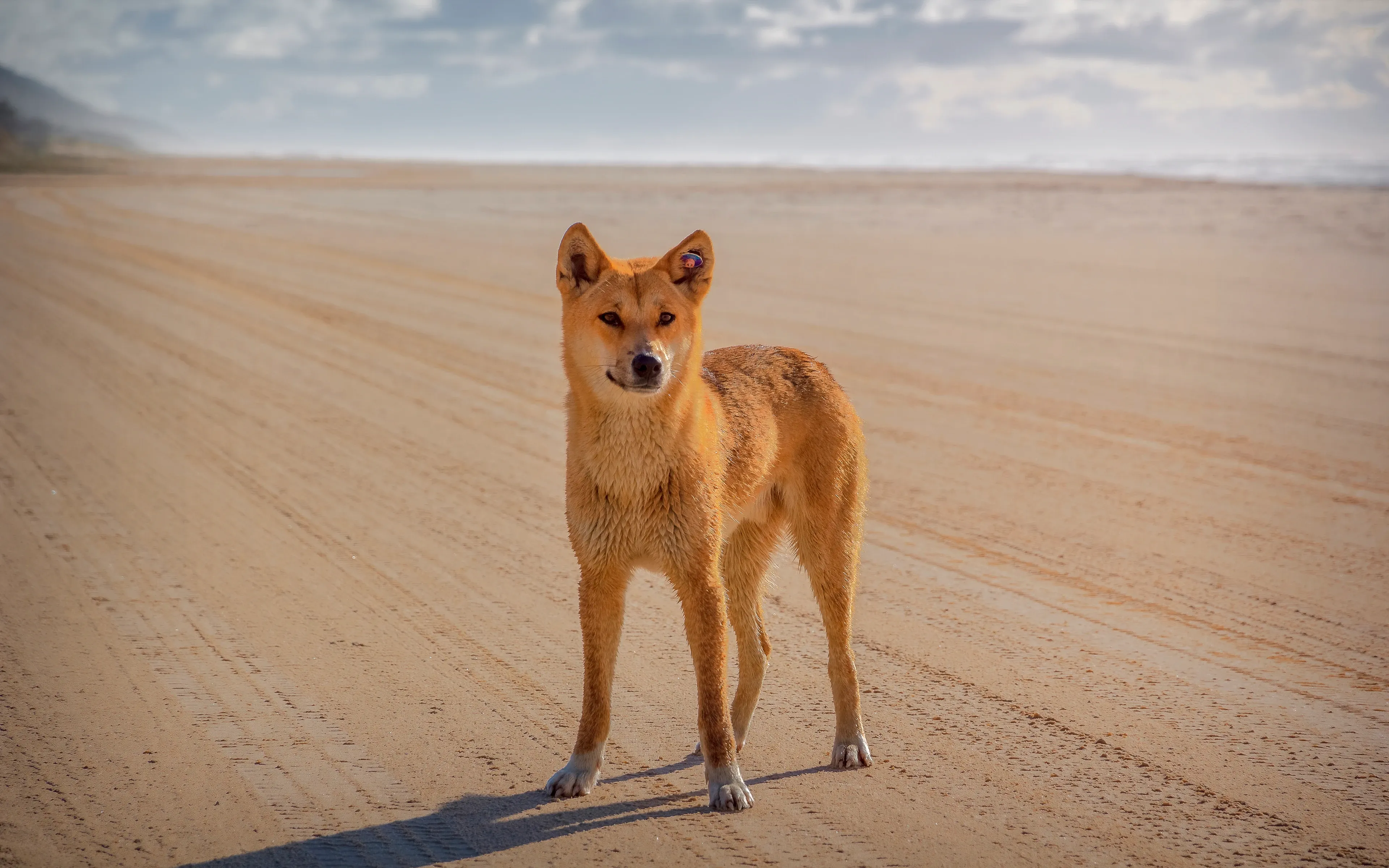
From soft-footed evening journeys to moonlit messages between family members, discover the dingo—Australia’s wild dog with a voice worth listening for.
A howl slips into the evening
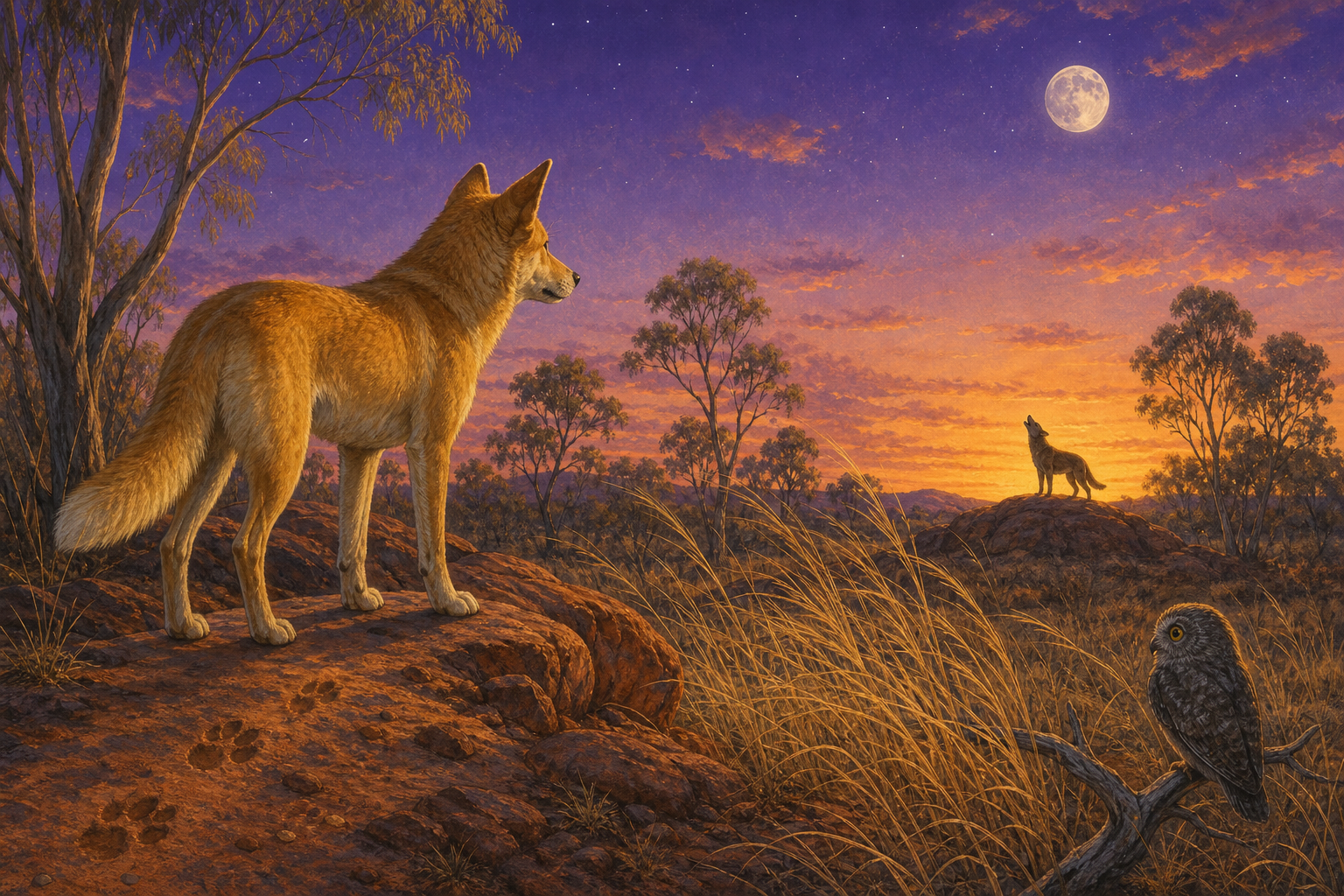
The hot Australian day is loosening its grip. Sand cools beneath padded feet. Dry grass whispers against a sandy-golden coat. Then a long howl rises from beyond a rocky slope—more song than the familiar sharp bark of many pet dogs. Somewhere farther away, another dingo may answer. Across the open country, the dusk has become a conversation.
A dingo is Australia’s wild dog, also called a warrigal or Australian native dog. It belongs to the dog family, Canidae, and the genus Canis, alongside wolves and domestic dogs. Its exact scientific label is still debated: you may see Canis dingo, Canis lupus dingo, or a grouping within Canis familiaris. That is quite a name puzzle for an animal with such excellent pointy ears.
An adult Australian dingo’s body is usually a little under a metre long, roughly the height of a large guitar stood upright. It stands about 47–67 centimetres at the shoulder and weighs about 9.6–19.4 kilograms. Its flexible body and paws help it thread through rocky ground and wooded places like a quiet, four-legged explorer.
Evidence: IUCN Red List of Threatened Species: Dingo (Canis dingo / Canis lupus dingo) — conservation status; Animal Diversity Web, University of Michigan Museum of Zoology: Canis lupus dingo (dingo); Wikipedia: Dingo (Canis familiaris / Canis lupus dingo)
Where does a dingo put its paws? Almost anywhere
Dingoes use a surprising variety of mainland Australian landscapes: deserts, grasslands, woodland, and open forest. A route might lead over sun-warmed stone, between trees, or through crisp dry grass. What matters is having prey, cover, and room to travel. The enormous Dingo Fence also shapes where some southern populations occur.
Many dingoes are most active around twilight and at night. While people might be pulling on pyjamas, a dingo may be sniffing the breeze as if it were a very exciting newspaper. A daytime sighting can happen, but the cooler, quieter hours often suit this watchful traveller.
A dingo is not a pet dog taking itself for a walk. It is a wild animal making careful choices in its own home. In dingo country, the kindest rule is simple: give wildlife space. Follow local guidance, keep food safely packed away, and enjoy the mystery from a respectful distance.
Evidence: Animal Diversity Web, University of Michigan Museum of Zoology: Canis lupus dingo (dingo); Wikipedia: Dingo (Canis familiaris / Canis lupus dingo); IUCN Red List of Threatened Species: Dingo (Canis dingo / Canis lupus dingo) — conservation status
What is on a dingo’s dinner menu?
Dingoes are carnivores, so they eat other animals. In Australia, mammals make up much of the menu, including rabbits and rats. They also take birds and reptiles, and may hunt wallabies or kangaroos. The meal changes with what is available. A dingo is an opportunistic hunter: alert to tracks, scents, rustles, and chances.
A dingo can hunt small prey alone. For bigger prey, a pair or family group may work together. Picture a team that communicates without a whistle or a scoreboard, reading one another’s movement while following scent through the landscape. Their hunts are part of a much larger living pattern.
In many Australian ecosystems, dingoes are top land predators and can influence the prey animals around them, including rabbits. That does not mean we should cheer for one animal’s danger. Every creature is trying to stay alive. It does remind us that a landscape is not a row of separate boxes. It is more like a giant, wiggly web: change one strand, and others may quiver.
Evidence: Animal Diversity Web, University of Michigan Museum of Zoology: Canis lupus dingo (dingo); Wikipedia: Dingo (Canis familiaris / Canis lupus dingo)
Is a dingo family like a wolf pack? Sometimes, but not always
A common dingo social group is a mated mother and father with their pups growing up beside them. Yet not every dingo lives in the same arrangement. Some travel alone or in pairs, and larger groups can form when bigger prey is being hunted. Wild families are practical, not copies of a single rulebook.
Pups need care and time with adults. Family members use howls and other sounds to keep in touch across large areas. Dingoes may bark, but howling is especially important compared with the barking we expect from many domestic dogs.
Imagine your friends scattered at opposite ends of a football field. A whisper would be useless. A long, carrying call would work far better. A dingo howl is not monster music from a spooky film. It is communication: “I’m here!” “Where are you?” Or perhaps, “Keep up—dinner will not find itself.”
Evidence: Animal Diversity Web, University of Michigan Museum of Zoology: Canis lupus dingo (dingo); Wikipedia: Dingo (Canis familiaris / Canis lupus dingo)
A name puzzle—and a real conservation worry
Because scientists are still sorting out the dingo’s classification, conservation labels can be confusing too. The IUCN Red List does not currently maintain a separate assessment for the dingo as its own species. Some older sources say “Vulnerable,” but that older listing was superseded when the dingo was folded into a different naming group. Not being separately assessed does not mean there is nothing to care about.
A major concern is hybridisation: dingoes sometimes have pups with domestic dogs. Over generations, this can reduce the number of genetically distinct dingo family lines, often called “pure” dingoes in conservation discussions. Dingo-like animals may still be present while those distinctive lineages become harder to protect. Persecution and population barriers, including parts of the Dingo Fence, can create further pressure.
There is hopeful work to do. Protected areas, careful management of wild populations, and research that seeks to reduce dog–dingo hybridisation can help conserve distinctive dingo lineages. Good solutions must take people’s needs seriously while remembering that a wild dingo is not a problem-shaped object. It is an animal with a family, a voice, and a place in the landscape.
Evidence: IUCN Red List of Threatened Species: Dingo (Canis dingo / Canis lupus dingo) — conservation status; Animal Diversity Web, University of Michigan Museum of Zoology: Canis lupus dingo (dingo); Wikipedia: Dingo (Canis familiaris / Canis lupus dingo)
How can a faraway kid care about a twilight traveller?
Start with attention. When an animal feels unfamiliar, it is easy to turn it into a cartoon hero, a villain, or a mascot. Dingoes are more interesting than all three. They are wild neighbours with their own needs, routes, and relationships. Learning about them can lead to care for habitats, respectful wildlife rules, and responsible care of domestic dogs.
Kindness can also appear at mealtimes. A varied eating pattern can include vegetables, fruit, whole grains, pulses such as beans and lentils, nuts, and seeds. With a trusted adult, trying more plant-based meals can be one gentle way to care about animals and the places they share with us.
A bean burrito, veggie pasta, or lentil soup will not make a dingo howl with applause—dingoes need their own very different foods. But the IPCC says shifts toward sustainable, healthy, more plant-based diets can reduce food-system emissions and pressure on land and biodiversity. Small, cheerful choices can help leave more room for wild neighbours.
Evidence: World Health Organization: Healthy diet; Intergovernmental Panel on Climate Change: Climate Change 2022: Mitigation of Climate Change — Chapter 7; Animal Diversity Web, University of Michigan Museum of Zoology: Canis lupus dingo (dingo); Wikipedia: Dingo (Canis familiaris / Canis lupus dingo)
A kind choice can begin on your plate
Dingoes remind us that every animal has a life that matters to it: a pup to find, a safe nighttime route, and a place to belong. We can practise that respect by treating wildlife as neighbours rather than things for us to use, and by enjoying more plant-based foods when that works for our families.
The World Health Organization includes vegetables, fruit, whole grains, pulses, nuts, and seeds in healthy varied eating patterns. The IPCC reports that sustainable, healthy diets with more plant-based foods can lower food-system emissions and reduce pressure on land and biodiversity. If you are curious, ask a trusted adult to help make one bright, tasty plant-based meal together.
Evidence: World Health Organization: Healthy diet; Intergovernmental Panel on Climate Change: Climate Change 2022: Mitigation of Climate Change — Chapter 7
Questions people ask
Are dingoes dogs or wolves?
Dingoes are wild canids closely related to domestic dogs and wolves. Scientists still debate their exact classification, so more than one scientific name may be used.
Evidence: Animal Diversity Web, University of Michigan Museum of Zoology: Canis lupus dingo (dingo); Wikipedia: Dingo (Canis familiaris / Canis lupus dingo); IUCN Red List of Threatened Species: Dingo (Canis dingo / Canis lupus dingo) — conservation status
Do dingoes only live in deserts?
No. They use deserts, grasslands, woodland, and open forest across mainland Australia, choosing places with prey, cover, and room to move.
Evidence: Animal Diversity Web, University of Michigan Museum of Zoology: Canis lupus dingo (dingo); Wikipedia: Dingo (Canis familiaris / Canis lupus dingo)
Why do dingoes howl?
Howls and other sounds help dingoes communicate when family members are spread across open country. They generally howl more than typical domestic dogs bark.
Evidence: Animal Diversity Web, University of Michigan Museum of Zoology: Canis lupus dingo (dingo); Wikipedia: Dingo (Canis familiaris / Canis lupus dingo)
What is the biggest challenge for genetically distinct dingoes?
Breeding with domestic dogs is a major concern. Over time, hybridisation can reduce the number of distinct dingo family lines, even where dingo-like animals remain common.
Evidence: IUCN Red List of Threatened Species: Dingo (Canis dingo / Canis lupus dingo) — conservation status; Animal Diversity Web, University of Michigan Museum of Zoology: Canis lupus dingo (dingo); Wikipedia: Dingo (Canis familiaris / Canis lupus dingo)
Read the evidence
Sources behind this story
- Dingo (Canis dingo / Canis lupus dingo) — conservation status — IUCN Red List of Threatened Species
- Canis lupus dingo (dingo) — Animal Diversity Web, University of Michigan Museum of Zoology
- Dingo (Canis familiaris / Canis lupus dingo) — Wikipedia
- Healthy diet — World Health Organization
- Climate Change 2022: Mitigation of Climate Change — Chapter 7 — Intergovernmental Panel on Climate Change
Health information is general education, not personal medical advice. Young readers should make food choices with a trusted adult and qualified health professional.