Today's animal friend · 22 October 2026
The Tiny Skater Who Turns a Pond into a Playground
On a quiet pond in Europe, a common pond skater can read a splash, row across the surface and steer without sinking. Its secret is not magic—though it looks wonderfully like it is.

On a quiet pond in Europe, a common pond skater can read a splash, row across the surface and steer without sinking. Its secret is not magic—though it looks wonderfully like it is.
A ripple says, “Come and look!”
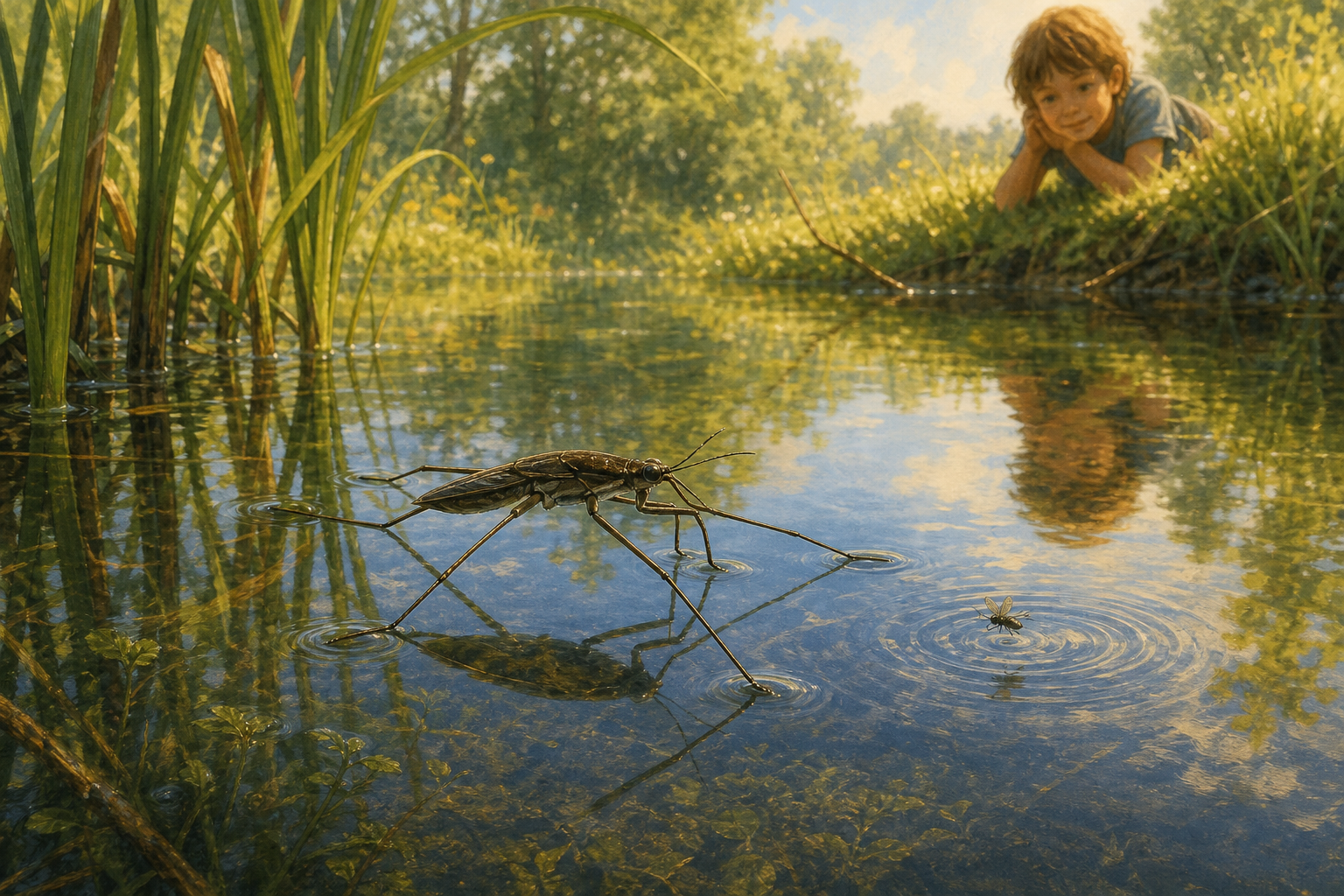
Imagine crouching beside a still pond. The water looks like a sheet of glass, until a small insect lands with a plip. Out zips a common pond skater, skimming over the surface as if it has forgotten the usual water rule: down you go!
This little animal is also called a common water strider. Its scientific name is Gerris lacustris, and it is an insect—a true bug in the order Hemiptera. It is slender, dark brown and only about 8–10 millimetres long. That is around the length of a small fingernail, yet it makes a whole pond seem like its giant skating rink.
The pond skater is active by day. On calm water, its long legs create little dimples, shadows and ripples. If you spot one, pause quietly. You may be watching a very small hunter on a very big adventure.
Evidence: IUCN Red List of Threatened Species: Gerris lacustris — IUCN Red List status check; Animal Diversity Web, University of Michigan Museum of Zoology: Gerris lacustris — Classification; Wikipedia: Gerris lacustris
How can it walk on water without wearing boots?
Here is the surprising answer: water has surface tension. At the top, water molecules tug together to make a stretchy surface layer. It is not a solid floor—please do not test it with your own feet—but it can hold up an animal that spreads its weight very lightly.
A pond skater’s legs and body are covered with thousands of tiny hairs. These hairs have a waxy, water-repelling coating, so water does not easily wet them. Instead of breaking through the surface, the skater rests on it. Think of a careful dancer balancing on a trampoline, rather than a pebble crashing through a puddle.
It is a brilliant partnership: the pond supplies the stretchy surface, and the skater brings its special non-wetting hairs. What looks like a magic trick is a real piece of insect engineering.
Evidence: IUCN Red List of Threatened Species: Gerris lacustris — IUCN Red List status check; Animal Diversity Web, University of Michigan Museum of Zoology: Gerris lacustris — Classification; Wikipedia: Gerris lacustris
Six legs, three jobs
A common pond skater has three pairs of legs, but they are not all doing the same job. Its short front legs grab prey. The middle pair rows it forward, rather like oars on a tiny boat. The back pair helps it steer, like rudders at the back of a ship.
That means this insect can travel, turn and catch food while staying on the water’s skin. No backpack full of gadgets required. Its body is the gadget.
Look closely only from the bank. You may notice it pause, then suddenly dart away. The movement can seem jerky or zigzaggy because the pond skater is responding to a world of tiny water signals that our eyes and ears mostly miss.
Evidence: IUCN Red List of Threatened Species: Gerris lacustris — IUCN Red List status check; Animal Diversity Web, University of Michigan Museum of Zoology: Gerris lacustris — Classification; Wikipedia: Gerris lacustris
The pond’s ripple-reader
What is the skater racing toward? Often, it is food. The common pond skater is an insect-eater. It hunts small insects and other small water invertebrates, including insects that fall onto the water.
A struggling insect makes ripples spread across the surface. The pond skater can feel those ripples through its legs and quickly skate toward them. In a way, the pond becomes a message board: splash, wiggle, ripple—someone is there.
Then the short front legs help hold the prey. The pond skater feeds using piercing-sucking mouthparts. That may sound a bit like a superhero tool, but it is simply how this small predator eats. By hunting at the water surface, it plays its own part in the busy life of a pond.
Every pond contains more stories than we first notice: swimmers below, fliers above, and this nimble creature right on the watery border between the two.
Evidence: IUCN Red List of Threatened Species: Gerris lacustris — IUCN Red List status check; Animal Diversity Web, University of Michigan Museum of Zoology: Gerris lacustris — Classification; Wikipedia: Gerris lacustris
Where does a water-walker go?
Common pond skaters live on still or slow-moving freshwater. Ponds, ditches and slow streams can all offer the calm surface they need. The supplied species records place Gerris lacustris in Europe.
A smooth patch of water is important for their unusual way of moving. On a blustery day, wind-made waves can turn a pond’s surface from skating rink to wobbly obstacle course. Even so, a pond is never simply “empty water.” It is a place of reflections, floating leaves, visiting insects and tiny lives making use of every layer.
If you are exploring near water, be a gentle guest: stay on paths where possible, leave animals where they are, and let the pond keep its quiet. The best wildlife detective often uses their eyes first.
Evidence: IUCN Red List of Threatened Species: Gerris lacustris — IUCN Red List status check; Animal Diversity Web, University of Michigan Museum of Zoology: Gerris lacustris — Classification; Wikipedia: Gerris lacustris
A small animal worth noticing
The common pond skater is recorded as Not Evaluated on the IUCN Red List in the supplied sources. That is not the same as a full global assessment or a promise that every local pond is safe. Its overall population trend is unknown in these records.
But we do not need a dramatic label to care about a creature. A pond skater depends on freshwater surfaces where it can move and hunt. Looking after ponds and streams helps protect the fascinating neighbours that use them, from surface skaters to the creatures hidden below.
Next time you see one, try a pond-skater question: how does it know where to go? The answer may be arriving under its feet, written in rings of ripples. Suddenly, a puddle or pond is not just water. It is a living map.
Evidence: IUCN Red List of Threatened Species: Gerris lacustris — IUCN Red List status check; Animal Diversity Web, University of Michigan Museum of Zoology: Gerris lacustris — Classification; Wikipedia: Gerris lacustris
Kind choices can send ripples outward too
Watching a pond skater hunt can remind us that every animal is busy living its own life, even when it is smaller than a crumb. We can meet wildlife with curiosity rather than treating it as something to collect, poke or frighten.
At home, plant-forward meals can be one gentle way to care about animals and the places they live. The World Health Organization describes healthy diets as including a variety of foods such as vegetables, fruit, whole grains, pulses, nuts and seeds. Food choices are family choices, so chat with a trusted adult if you are curious about trying something new.
More plant-based, sustainable dietary patterns can also help reduce food-system emissions and pressure on land and biodiversity. A bean-and-veg meal will not personally save one pond skater by teatime—nature is not a button to press—but caring choices can join together, like ripples across water. Kindness can be delicious, too.
Evidence: World Health Organization: Healthy diet; Intergovernmental Panel on Climate Change: Climate Change 2022: Mitigation of Climate Change — Chapter 7
Questions people ask
Is a common pond skater really walking on water?
Yes. It is supported by water’s surface tension and by tiny wax-coated hairs that help keep its legs and body from getting wet. It stays on the surface rather than swimming underneath it.
Evidence: IUCN Red List of Threatened Species: Gerris lacustris — IUCN Red List status check; Animal Diversity Web, University of Michigan Museum of Zoology: Gerris lacustris — Classification; Wikipedia: Gerris lacustris
Does it eat plants?
The common pond skater is a predator. It eats small insects and other small water invertebrates, especially creatures that are on or fall onto the water.
Evidence: IUCN Red List of Threatened Species: Gerris lacustris — IUCN Red List status check; Animal Diversity Web, University of Michigan Museum of Zoology: Gerris lacustris — Classification; Wikipedia: Gerris lacustris
How big is it?
Adults are typically about 8–10 millimetres long: tiny enough to fit comfortably along a small fingernail, though their long legs make them look larger on the water.
Evidence: Wikipedia: Gerris lacustris
Where might I find one?
Look carefully at the surface of a calm pond, ditch or slow stream in Europe. Watch from the edge and avoid disturbing the water or the animal.
Evidence: IUCN Red List of Threatened Species: Gerris lacustris — IUCN Red List status check; Animal Diversity Web, University of Michigan Museum of Zoology: Gerris lacustris — Classification; Wikipedia: Gerris lacustris
Read the evidence
Sources behind this story
- Gerris lacustris — IUCN Red List status check — IUCN Red List of Threatened Species
- Gerris lacustris — Classification — Animal Diversity Web, University of Michigan Museum of Zoology
- Gerris lacustris — Wikipedia
- Healthy diet — World Health Organization
- Climate Change 2022: Mitigation of Climate Change — Chapter 7 — Intergovernmental Panel on Climate Change
Health information is general education, not personal medical advice. Young readers should make food choices with a trusted adult and qualified health professional.