Today's animal friend · 18 September 2026
The Blue Flash by the River: Meet the Common Kingfisher
A sparrow-sized bird with a jewel-blue back, tiny swimming goggles, and the patience of a superhero statue is waiting beside the water.

A sparrow-sized bird with a jewel-blue back, tiny swimming goggles, and the patience of a superhero statue is waiting beside the water.
Wait—was that a flying blue jewel?
Picture a quiet riverbank. The water makes a shushy sound over stones. A reed trembles. Then—zip!—a bright blue streak shoots low above the surface and vanishes around the bend before you can say “Where did that come from?”
That flash may have been a common kingfisher, also called the Eurasian kingfisher or river kingfisher. Its scientific name is Alcedo atthis. It has a shining blue back, a warm orange underside, and a long pointed beak. The funny part? This dazzling bird is only about sparrow-sized, roughly 16–17 centimetres long. A tiny jewel with places to be.
Common kingfishers live near rivers, streams, lakes, ponds, and wetlands across parts of Europe, Asia, and Africa. They are daytime adventurers, so a morning or afternoon walk beside water is a good time to keep your eyes open. Do not worry if you miss one at first. Kingfishers are experts at turning “I was right here!” into “Did anybody else see that?”
Evidence: IUCN Red List of Threatened Species: Alcedo atthis (Common Kingfisher) — Red List Assessment; Animal Diversity Web, University of Michigan Museum of Zoology: Alcedo atthis (Eurasian kingfisher); Wikipedia (Wikimedia Foundation): Common kingfisher
The world’s stillest fishing contest
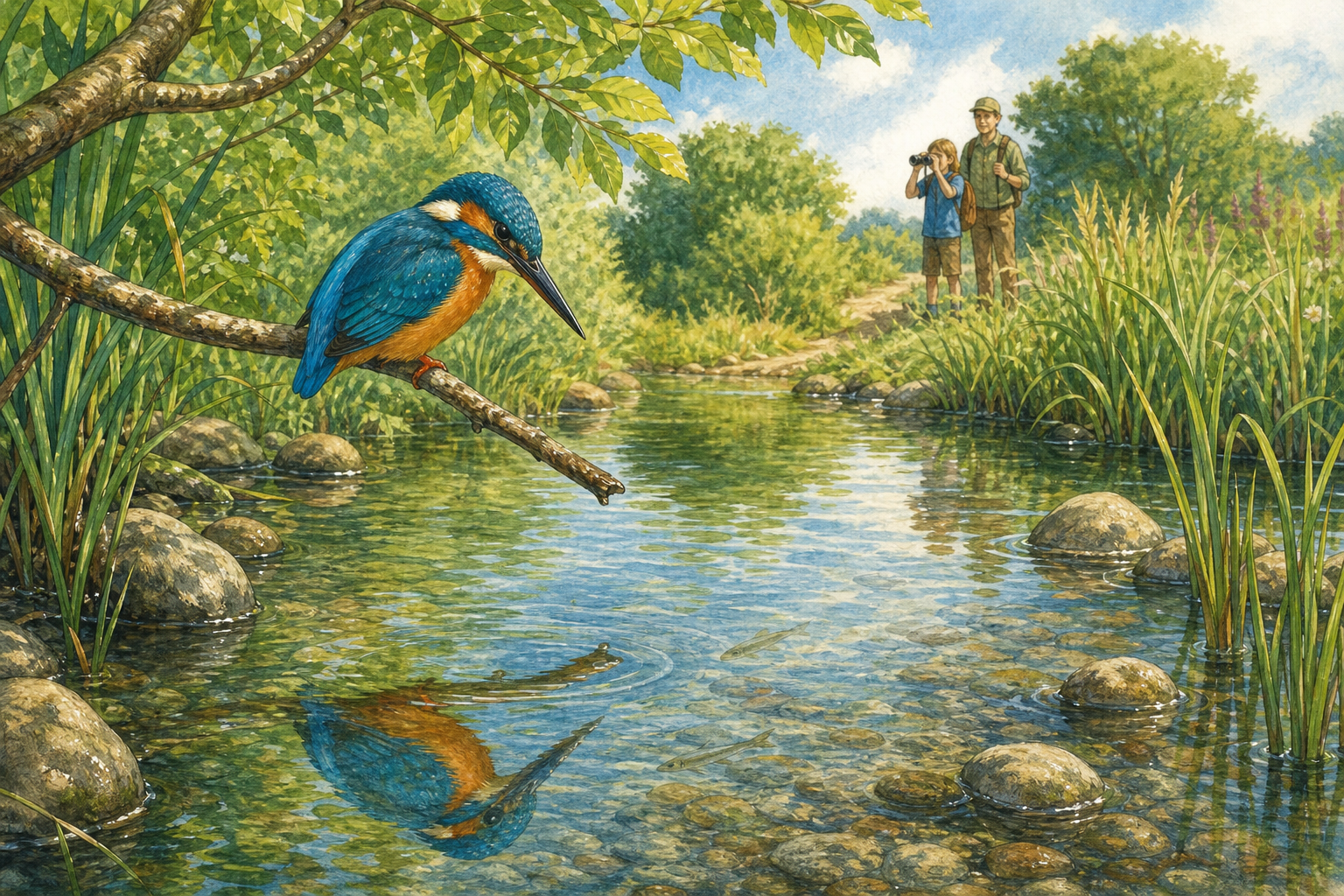
A kingfisher does not usually splash about looking for lunch. Instead, it perches low above the water on a branch, post, or another handy lookout. It waits so quietly that it can seem like a colourful ornament someone accidentally left outdoors.
But that little head is working hard. The bird bobs it as it watches, helping it judge where a fish is in the water. Fish can look as though they are in a slightly different place when seen through the water’s surface, so careful aiming matters. This is not random swooping; it is a patient, super-focused hunt.
Then comes the dramatic bit. When the moment is right, the kingfisher dives head-first into the water for a small fish. It may also eat aquatic insects and other small water animals. Imagine needing to leap from a diving board, with no goggles in your hands, and catch your lunch before it wriggles away. That is a very ambitious snack plan.
Evidence: Animal Diversity Web, University of Michigan Museum of Zoology: Alcedo atthis (Eurasian kingfisher); Wikipedia (Wikimedia Foundation): Common kingfisher
Tiny goggles, no strap required
How can a bird plunge into water without getting its eyes in a muddle? The common kingfisher has a clear third eyelid, called a nictitating membrane. As it goes underwater, this membrane slides across the eye. It works a bit like a built-in pair of swimming goggles.
After a successful dive, the bird returns to a perch with its catch. Its sharp beak is a useful fishing tool, and its compact body helps it move quickly. Every part of the moment feels quick: watch, bob, dive, rise, flash away.
Kingfishers need plenty of fuel for this busy life. Sources describe them as eating around 60 percent of their own body weight each day. Since they weigh only a few dozen grams, that does not mean a mountain of food by human standards—but for one small bird, it is a serious daily mission. No wonder a good fishing patch is worth defending.
Evidence: Animal Diversity Web, University of Michigan Museum of Zoology: Alcedo atthis (Eurasian kingfisher); Wikipedia (Wikimedia Foundation): Common kingfisher
A home with water, banks, and room for secrets
A common kingfisher is usually alone for much of the year. It guards its stretch of water because it needs enough food there to keep going. For a small bird, it has a remarkably firm opinion about personal space. “This branch? Mine. Those fish? Also mine.”
When the breeding season arrives, a pair works together to make a nest in a burrow in a riverbank. Natural banks are not just muddy edges: they can be shelter, nesting space, and part of a family’s future. That is one reason a wild-looking, leafy riverbank can be so important.
In cold places, winter can be especially hard. If freshwater freezes, fishing becomes difficult. Some northern birds move when rivers freeze, and kingfishers may fish in brackish water in winter. Their lives are closely tied to water that stays open, clear, and full of small creatures.
This closeness to freshwater gives us a clue. A kingfisher can be an indicator of healthy, fish-rich water. Seeing one is not a scorecard for a whole river, but it can make us wonder: Is this water clean? Are there fish? Are there banks and perches where wildlife can thrive?
Evidence: Animal Diversity Web, University of Michigan Museum of Zoology: Alcedo atthis (Eurasian kingfisher); Wikipedia (Wikimedia Foundation): Common kingfisher
Why the blue flash needs our help
The common kingfisher is listed as Least Concern on the IUCN Red List assessment cited for 2016, and it has a very wide range. That is welcome news. In Europe alone, estimates cited by the assessment place the population at about 160,000–320,000 individuals. Yet “Least Concern” does not mean “nothing to care about.”
In particular places, water pollution can make a river unsuitable, while altered or lost natural banks can remove nesting places. Severe winter cold can also cause sharp local losses. A kingfisher cannot simply order a replacement riverbank online, sadly.
The hopeful answer is wonderfully practical. Cleaner waterways, less pollution flowing from industry and farms, and natural leafy banks can all support kingfishers locally. Children can help notice and value rivers, ponds, and wetlands; follow local rules that protect wildlife; and share what they see with a trusted adult or community nature group. Caring often starts with looking closely—perhaps at one small ring spreading across the water after a dive.
Evidence: IUCN Red List of Threatened Species: Alcedo atthis (Common Kingfisher) — Red List Assessment; Animal Diversity Web, University of Michigan Museum of Zoology: Alcedo atthis (Eurasian kingfisher); Wikipedia (Wikimedia Foundation): Common kingfisher
One small bird, a big watery neighbourhood
It is easy to think of a kingfisher as only a beautiful blur. But it is also a neighbour in a busy freshwater world: a predator of small fish, an inhabitant of banks and streams, and a sign that the water may be supporting life.
Next time you visit a river or lake, try a kingfisher pause. Stand quietly with an adult, give wildlife plenty of space, and look at likely perches over the water. Listen for a sharp call or watch for a low, fast blue flight. You might not see one—and that is okay. The waiting changes how a place feels.
And if you do see that blue flash, let it remind you that a river is not just water moving from here to there. It is a travelling home full of stories: insects skating, fish darting, plants waving, and one little bird wearing invisible goggles.
Evidence: Animal Diversity Web, University of Michigan Museum of Zoology: Alcedo atthis (Eurasian kingfisher); Wikipedia (Wikimedia Foundation): Common kingfisher
A kind picnic thought for river friends
A kingfisher’s life reminds us that every animal is somebody, busy finding food and a safe place to live. We can make room for wild neighbours by caring for clean water, wasting less, and choosing meals with kindness in mind.
Plant-forward foods such as vegetables, fruit, beans, lentils, whole grains, nuts, and seeds can be part of a varied healthy diet. The World Health Organization includes these foods in its general healthy-diet guidance. The IPCC also reports that shifts toward sustainable, healthy, more plant-based diets can lower food-system emissions and reduce pressure on land and biodiversity.
That does not mean you need to lecture anybody at lunch. You might simply try a bean wrap, lentil soup, or fruit-and-oat snack with your family, and celebrate the plants on your plate. If you are thinking about bigger food changes, talk with a trusted adult and a qualified health professional. Small caring choices can be a quiet cheer for animals, rivers, and the wider living world.
Evidence: World Health Organization: Healthy diet; Intergovernmental Panel on Climate Change: Climate Change 2022: Mitigation of Climate Change — Chapter 7
Questions people ask
Is a common kingfisher really common?
It has a wide range across parts of Europe, Asia, and Africa and is listed as Least Concern in the cited 2016 IUCN assessment. But it can still be hard to spot because it is small, fast, and often stays near water.
Evidence: IUCN Red List of Threatened Species: Alcedo atthis (Common Kingfisher) — Red List Assessment; Animal Diversity Web, University of Michigan Museum of Zoology: Alcedo atthis (Eurasian kingfisher); Wikipedia (Wikimedia Foundation): Common kingfisher
What does it eat?
It mainly catches small fish. It can also eat aquatic insects and other small water animals, including tadpoles and small crustaceans.
Evidence: Animal Diversity Web, University of Michigan Museum of Zoology: Alcedo atthis (Eurasian kingfisher); Wikipedia (Wikimedia Foundation): Common kingfisher
Why does a kingfisher bob its head?
Head-bobbing helps it work out where prey is before it dives. It is part of its careful perch-and-dive hunting style.
Evidence: Animal Diversity Web, University of Michigan Museum of Zoology: Alcedo atthis (Eurasian kingfisher); Wikipedia (Wikimedia Foundation): Common kingfisher
Can I get closer for a better look?
The kindest choice is to watch from a distance and stay quiet. A hunting kingfisher needs to concentrate, and a bird near a nest needs space. Binoculars, if an adult has them, are brilliant “close-up eyes.”
Evidence: Animal Diversity Web, University of Michigan Museum of Zoology: Alcedo atthis (Eurasian kingfisher); Wikipedia (Wikimedia Foundation): Common kingfisher
Read the evidence
Sources behind this story
- Alcedo atthis (Common Kingfisher) — Red List Assessment — IUCN Red List of Threatened Species
- Alcedo atthis (Eurasian kingfisher) — Animal Diversity Web, University of Michigan Museum of Zoology
- Common kingfisher — Wikipedia (Wikimedia Foundation)
- Healthy diet — World Health Organization
- Climate Change 2022: Mitigation of Climate Change — Chapter 7 — Intergovernmental Panel on Climate Change
Health information is general education, not personal medical advice. Young readers should make food choices with a trusted adult and qualified health professional.