Today's animal friend · 14 November 2026
The Tiny Crab With a Borrowed House
On Europe’s Atlantic shores, Pagurus bernhardus shuffles over sand and stones with its soft tail tucked safely inside a borrowed shell. Its days can include house-hunting, scavenging, and the occasional surprising shell-top passenger.
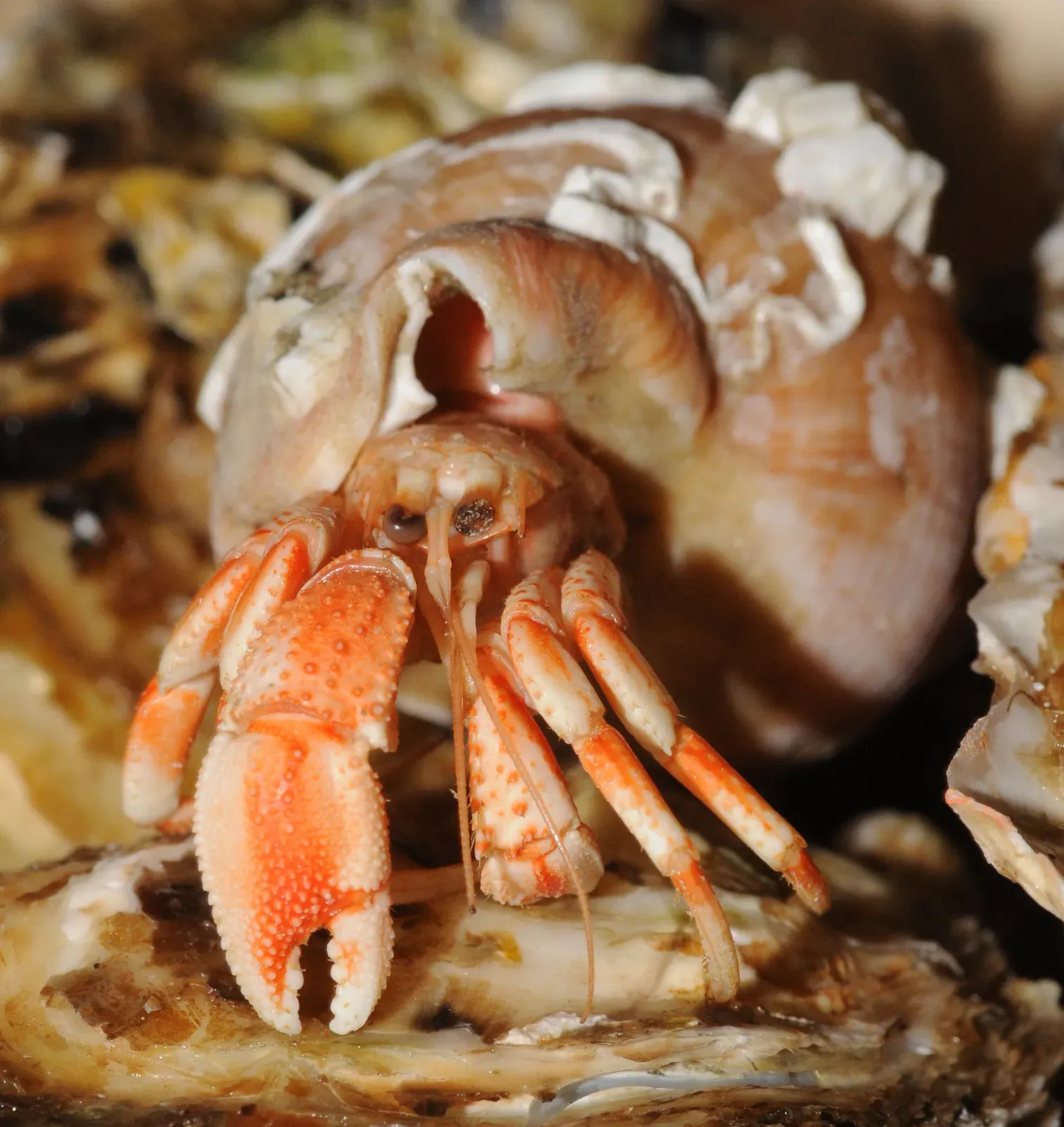
On Europe’s Atlantic shores, Pagurus bernhardus shuffles over sand and stones with its soft tail tucked safely inside a borrowed shell. Its days can include house-hunting, scavenging, and the occasional surprising shell-top passenger.
Is that shell walking?
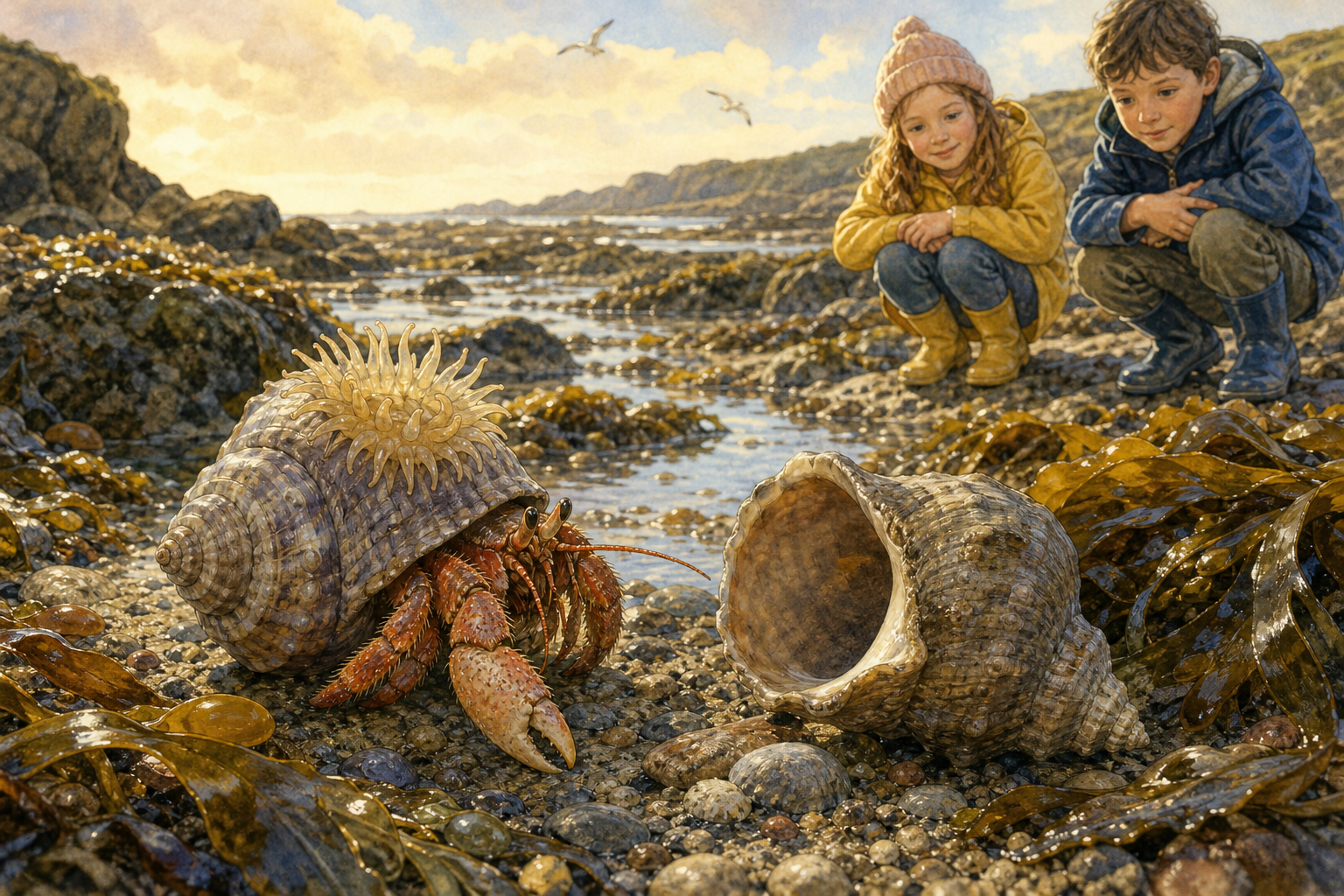
Picture a tide pool after the sea has slipped away. Brown seaweed shines like wet ribbons, pebbles glimmer, and a little snail shell seems to creep across the sand. Look closer: it is not a snail at all. A common hermit crab is carrying that shell as it walks.
This marine crab is also called Bernhard’s hermit crab or soldier crab. Its scientific name is Pagurus bernhardus. It is a small reddish rover of rocky shores, tide pools, sandy seabeds, and coastal waters along Europe’s Atlantic coasts.
A hermit crab turns an ordinary-looking empty shell into a marvellous moving hideaway. That is a good reminder for beach detectives: even a shell that seems unoccupied to us may be important in the busy small world of the shore.
Evidence: IUCN Red List of Threatened Species: Pagurus bernhardus — IUCN Red List status check; MarLIN — The Marine Life Information Network (Marine Biological Association): Bernhard’s hermit crab (Pagurus bernhardus); Wikipedia: Pagurus bernhardus
Why does this crab need a borrowed house?
Many crabs have a tough outer covering around their bodies. The common hermit crab’s tail is different: it is soft and curly. An empty snail shell gives that vulnerable part a sheltered place to curl up.
The shell is not just a costume. It is a home carried over rocks, through pools, and across the seabed. When something worrying comes near, the crab can draw itself inside. Its right pincer is much larger than its left and can help guard the shell opening, like a tiny claw-shaped door.
The crab uses shells that are already empty, including shells once made by periwinkles and whelks. It does not grow the shell itself. In a shore full of waves, hungry animals, and rough stones, finding the right second-hand home is serious business.
Evidence: MarLIN — The Marine Life Information Network (Marine Biological Association): Bernhard’s hermit crab (Pagurus bernhardus); Wikipedia: Pagurus bernhardus; IUCN Red List of Threatened Species: Pagurus bernhardus — IUCN Red List status check
When your house starts to pinch
A borrowed home is brilliant—until it becomes too small. As a common hermit crab grows, it needs to find a roomier empty shell. Imagine discovering that your bedroom had shrunk overnight and then having to search the neighbourhood for one that fits.
Suitable shells are valuable, and hermit crabs can compete for the types they prefer. A shell can be a shield, a hiding place, and a place to rest, all at once. The crab must leave its old shelter and tuck its soft tail into the new one, so a good fit matters.
That is one reason to be a gentle visitor at a rock pool. Watch shells closely, but leave them where they are. A shell may be a future home for a growing hermit crab, even if no one is living in it right now.
Evidence: MarLIN — The Marine Life Information Network (Marine Biological Association): Bernhard’s hermit crab (Pagurus bernhardus); Wikipedia: Pagurus bernhardus
A shell with a waving hat
Sometimes a common hermit crab’s shell carries an unexpected passenger: a sea anemone. Its waving tentacles can make the shell look as though the crab is wearing a soft, wobbly hat.
In warmer parts of this crab’s range, Calliactis parasitica often grows on an occupied shell. In colder waters, Hormathia digitata has also been recorded. The anemone has a moving surface to live on and may catch scraps drifting near the crab’s meals.
It is tempting to call these animals best friends, but nature is often more complicated than a storybook team-up. Still, their association is a wonderful clue that one small shell can become a travelling neighbourhood. What else might be living on a rock, a seaweed frond, or a shell?
Evidence: Wikipedia: Pagurus bernhardus; MarLIN — The Marine Life Information Network (Marine Biological Association): Bernhard’s hermit crab (Pagurus bernhardus)
What is on the menu for a seabed scavenger?
The common hermit crab is an omnivore and a detritivore. Those big words mean it can eat a variety of things and often feeds on leftovers and organic bits on the seabed. Its menu can include worms, small shellfish, algae, detritus, and carrion.
That may not sound like a fancy feast, but scavenging is an important part of a shore community. While the crab searches and picks through what it finds, it helps recycle material in its underwater neighbourhood.
Common hermit crabs may be active by day or by night. Their firm front body, called the carapace, can reach about 3.5 centimetres long—shorter than many children’s thumbs. Small does not mean unimportant: this little traveller is part of the constant, hidden bustle of the sea floor.
Evidence: MarLIN — The Marine Life Information Network (Marine Biological Association): Bernhard’s hermit crab (Pagurus bernhardus); Wikipedia: Pagurus bernhardus; IUCN Red List of Threatened Species: Pagurus bernhardus — IUCN Red List status check
From rock-pool sparkle to dimmer water
This species lives along Europe’s Atlantic coasts, from Arctic waters near Iceland, Svalbard, and Russia south to southern Portugal. It occurs around British and Irish coasts. The supplied records do not place it in the Mediterranean.
You might spot one in a rock pool near the shore, or it may live farther out on rocky or sandy seabeds. Records place the species from upper-shore pools down to about 140 metres, where the water is far deeper and dimmer than a sunlit pool between the rocks.
The registered sources record the common hermit crab as Not Evaluated on the IUCN Red List, with no population trend supplied. That does not tell us everything about its future, so it is better not to guess at a conservation label. We can simply treat shore animals and their homes with care.
Evidence: IUCN Red List of Threatened Species: Pagurus bernhardus — IUCN Red List status check; MarLIN — The Marine Life Information Network (Marine Biological Association): Bernhard’s hermit crab (Pagurus bernhardus); Wikipedia: Pagurus bernhardus
Be the sort of guest a tide pool would welcome
A tide pool is someone’s kitchen, hiding place, and home—not a toy box. Pause quietly and watch. Notice the crab’s legs, its oversized claw, and the moment it vanishes into its shell. A sketch, a remembered detail, or a photograph with an adult’s okay can be a better souvenir than a living creature or a shell.
Try to leave shore animals, rocks, seaweed, and shells as you found them. Looking carefully without grabbing lets the crab get on with its shell-searching life—and gives you the chance to see what it chooses to do next.
Caring for wild neighbours can also inspire kind choices away from the beach. There are many ways to practise curiosity and respect, from wasting less to noticing whose homes we share.
Evidence: MarLIN — The Marine Life Information Network (Marine Biological Association): Bernhard’s hermit crab (Pagurus bernhardus); Wikipedia: Pagurus bernhardus
A small kindness with wide ripples
The hermit crab’s borrowed shell shows that a beach object can be precious to somebody else. Leaving shells and shore animals undisturbed is a simple, practical way to respect wild neighbours.
Kindness can be delicious at the table, too. The World Health Organization includes vegetables, fruit, whole grains, pulses, nuts, and seeds in varied healthy dietary patterns. With a trusted adult, you might enjoy trying plant-forward favourites such as bean wraps, lentil soup, or a colourful vegetable meal.
The IPCC reports that shifts toward sustainable, healthy, more plant-based diets can reduce food-system emissions and pressure on land and biodiversity. Nobody needs to be perfect. Choosing and wasting food thoughtfully can be one cheerful way to make more room for other living things.
Evidence: World Health Organization: Healthy diet; Intergovernmental Panel on Climate Change: Climate Change 2022: Mitigation of Climate Change — Chapter 7
Questions people ask
Is a common hermit crab born with its shell?
No. It uses an empty snail, or gastropod, shell to shelter its soft tail. As it grows, it needs to find a larger suitable shell.
Evidence: MarLIN — The Marine Life Information Network (Marine Biological Association): Bernhard’s hermit crab (Pagurus bernhardus); Wikipedia: Pagurus bernhardus
Can this hermit crab live on land?
No. Pagurus bernhardus is a marine hermit crab found in coastal waters, tide pools, and on rocky or sandy seabeds. It is not one of the tropical land hermit crabs sometimes kept as pets.
Evidence: MarLIN — The Marine Life Information Network (Marine Biological Association): Bernhard’s hermit crab (Pagurus bernhardus); Wikipedia: Pagurus bernhardus
Why is one claw bigger?
Its right pincer is much larger than the left. When the crab pulls into its shell, that large claw can help protect the opening.
Evidence: MarLIN — The Marine Life Information Network (Marine Biological Association): Bernhard’s hermit crab (Pagurus bernhardus); Wikipedia: Pagurus bernhardus
What should I do if I see one in a tide pool?
Watch quietly and leave the crab, its shell, and nearby rocks where they are. Empty shells may be important future shelters.
Evidence: MarLIN — The Marine Life Information Network (Marine Biological Association): Bernhard’s hermit crab (Pagurus bernhardus); Wikipedia: Pagurus bernhardus
Read the evidence
Sources behind this story
- Pagurus bernhardus — IUCN Red List status check — IUCN Red List of Threatened Species
- Bernhard's hermit crab (Pagurus bernhardus) — MarLIN — The Marine Life Information Network (Marine Biological Association)
- Pagurus bernhardus — Wikipedia
- Healthy diet — World Health Organization
- Climate Change 2022: Mitigation of Climate Change — Chapter 7 — Intergovernmental Panel on Climate Change
Health information is general education, not personal medical advice. Young readers should make food choices with a trusted adult and qualified health professional.