Today's animal friend · 21 October 2026
The Moonlit March of the Common Harvestman
On a fence, a leaf, or the side of a shed, a common harvestman can look like a tiny round bead balancing on eight threads. Follow its nighttime adventure and discover why this harmless neighbour deserves a cheer, not a squeal.
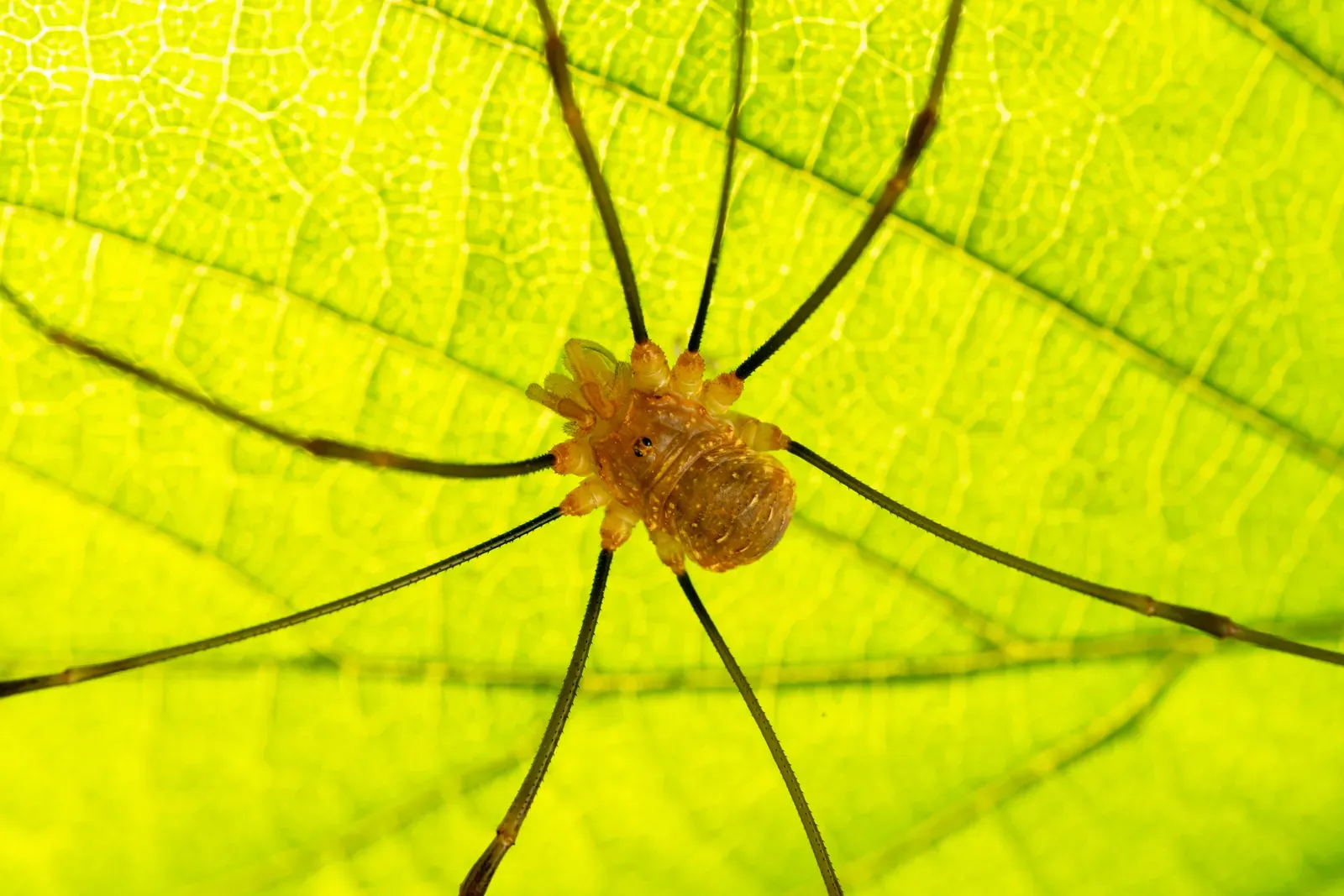
On a fence, a leaf, or the side of a shed, a common harvestman can look like a tiny round bead balancing on eight threads. Follow its nighttime adventure and discover why this harmless neighbour deserves a cheer, not a squeal.
A tiny walker on stilts
Imagine stepping outside as evening cools the garden. A leaf rustles. A fence feels rough under your fingertips. Then, on the wall, something moves: eight impossibly slender legs carrying a little round body, as if a peppercorn had borrowed a set of very bendy stilts.
That traveller is a common harvestman, Phalangium opilio. You may know it as a harvestman or a daddy longlegs. Its body is only about 3.5 to 9 millimetres long—smaller than many fingernails—but its long legs make it look grand and gangly, like it is dressed for a very fancy tiny parade.
Common harvestmen live in places people know well: gardens, farmland, hedgerows, grassland, and woodland. They occur across Europe, Asia, and North America. So a nighttime stroll near a patch of grass, a tree trunk, or an old fence can become a treasure hunt. Look closely, but let the little walker choose its own route.
Evidence: IUCN Red List of Threatened Species: Phalangium opilio — IUCN Red List (no assessment found); Animal Diversity Web (University of Michigan Museum of Zoology): Phalangium opilio — Animal Diversity Web (classification); Wikipedia: Phalangium opilio
Wait—why isn’t it a spider?
It is easy to mistake a harvestman for a spider. Both belong to the arachnid group and both have eight legs. But the common harvestman belongs to its own order, Opiliones. Its body is one compact, rounded piece, rather than the two main body sections joined by a narrow waist that a true spider has.
Here comes the surprising part: harvestmen do not make silk, so they do not spin webs. They also have no venom and are harmless to people. A harvestman on your wall is not plotting a spooky surprise. It is simply a small neighbour passing through, probably hoping you will not make a giant thunderclap with your footsteps.
That does not make it boring. Far from it! Being different from spiders is part of its charm. Nature is full of creatures that seem familiar at first glance, then turn out to have their own secret design.
Evidence: IUCN Red List of Threatened Species: Phalangium opilio — IUCN Red List (no assessment found); Animal Diversity Web (University of Michigan Museum of Zoology): Phalangium opilio — Animal Diversity Web (classification); Wikipedia: Phalangium opilio
When the garden turns into a nighttime map
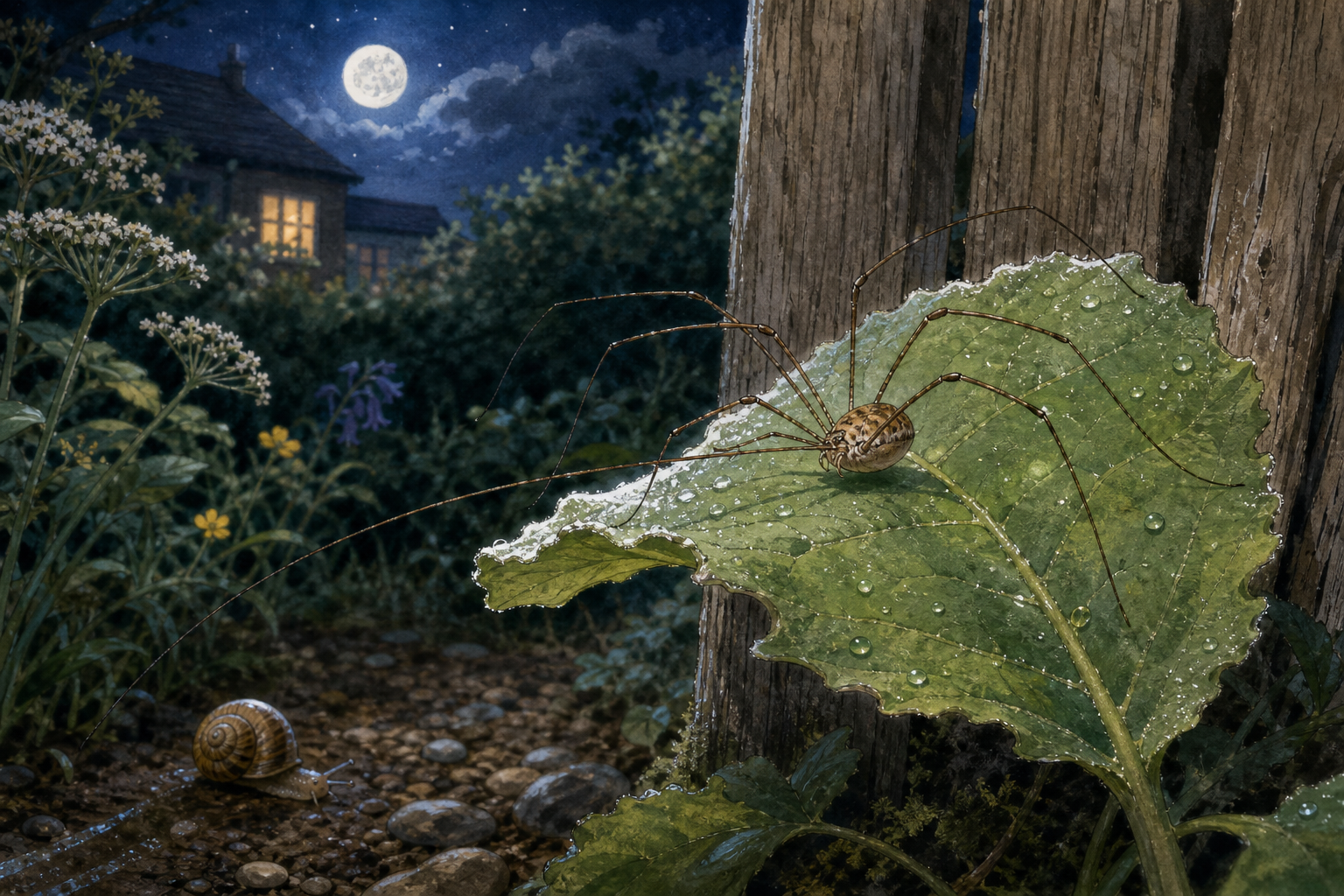
The common harvestman is mainly active at night. While we are pulling up blankets or brushing our teeth, it may be exploring leaves, stones, walls, and low plants. Darkness turns an ordinary garden into a giant landscape: a crack in paving becomes a canyon, and a damp leaf becomes a shiny bridge.
Its second pair of legs are especially long and act like feelers, touching ahead as it travels. Picture someone walking through a dark room with their arms stretched out—not because they are clumsy, but because they are gathering clues. Those long legs help the harvestman sense its way around while other legs do the walking or climbing.
This quiet explorer may spend a lot of time still, too. Being still can be a clever choice for a tiny animal. If you spot one, try pausing instead of poking. Watching without interrupting is a kind of outdoor superpower.
Evidence: Wikipedia: Phalangium opilio
The garden’s small, snacky cleaner
What is on the menu for a creature with no web? The common harvestman is an omnivore: a generalist predator and scavenger. It can eat soft-bodied tiny animals such as aphids, caterpillars, leafhoppers, mites, and beetle larvae. It also scavenges bits of decaying plant and animal matter.
That means it has a useful, untidy-looking job. It may nibble some small garden pests, then help clear leftovers that would otherwise remain on the ground. Think of it as a nighttime clean-up crew of one—without a uniform, a broom, or even pockets for snacks.
Its work matters because gardens and fields are communities, not just collections of plants. Leaves, soil, insects, fungi, birds, and small crawlers all affect one another. A harvestman is not the boss of this community. It is one of the many busy neighbours helping the place tick along.
Evidence: IUCN Red List of Threatened Species: Phalangium opilio — IUCN Red List (no assessment found); Animal Diversity Web (University of Michigan Museum of Zoology): Phalangium opilio — Animal Diversity Web (classification); Wikipedia: Phalangium opilio
A friend worth making room for
The common harvestman is widely distributed and is listed in the supplied sources as Not Evaluated on the IUCN Red List, rather than given a global threatened category. That is reassuring, but it is still worth treating each small animal with care. Common does not mean unimportant. A common creature can be part of the everyday web of life that makes a garden feel alive.
One gentle way to welcome small wildlife is to leave some cover in a garden: a hedge, low plants, leaf litter where it is wanted, or quiet corners that are not scrubbed bare. Avoiding unnecessary broad-spectrum insecticides can also help protect the many little animals that share these spaces, including harvestmen and the prey they eat.
You do not need to pick up a harvestman to admire it. Give it space. If it is indoors and you want it outside, ask an adult to help guide it carefully to a sheltered spot. Kindness can be as simple as choosing curiosity over fear.
Evidence: IUCN Red List of Threatened Species: Phalangium opilio — IUCN Red List (no assessment found); Wikipedia: Phalangium opilio; Animal Diversity Web (University of Michigan Museum of Zoology): Phalangium opilio — Animal Diversity Web (classification)
The next time eight long legs appear
Maybe you will see one climbing a shed wall after rain, paused on a tree trunk, or threading carefully across the garden path. Instead of shouting, “Spider!” you can try a new question: “Is that a harvestman?” Look for the single round body, the threadlike legs, and the absence of a web.
Then imagine the journey already behind it: feeler-legs testing the way, tiny feet crossing a world of twigs and stones, and a night’s search for a small meal. It is a mighty adventure scaled down to peppercorn size.
The common harvestman reminds us that the outdoors is not only made of spectacular creatures. It is also made of quiet helpers—the ones who clean, wander, sense, and survive beneath our notice. Once you have noticed one, the garden may never feel quite so ordinary again.
Evidence: IUCN Red List of Threatened Species: Phalangium opilio — IUCN Red List (no assessment found); Animal Diversity Web (University of Michigan Museum of Zoology): Phalangium opilio — Animal Diversity Web (classification); Wikipedia: Phalangium opilio
A kind dinner-table connection
Caring about a harvestman can begin with one simple thought: even the tiniest garden neighbour has a life of its own. We can make room for creatures outdoors, and we can practise kindness in the choices we make indoors, too.
Meals built around vegetables, fruit, whole grains, pulses, nuts, and seeds can be colourful, filling, and full of possibilities. With a trusted adult, trying a plant-based meal—perhaps bean tacos, lentil soup, or a bright veggie stir-fry—can be a cheerful way to explore food that is kinder to animals and gentler on the living places animals need.
The World Health Organization includes plant foods such as vegetables, fruit, pulses, nuts, seeds, and whole grains in healthy dietary patterns. The IPCC reports that shifts toward sustainable, healthy, more plant-based diets can help reduce pressure from food systems on climate, land, and biodiversity. No one meal has to carry the whole world on its plate; thoughtful choices can simply be one more way to be a good neighbour.
Evidence: World Health Organization: Healthy diet; Intergovernmental Panel on Climate Change: Climate Change 2022: Mitigation of Climate Change — Chapter 7
Questions people ask
Can a common harvestman bite or hurt me?
No. The supplied sources describe common harvestmen as having no venom and being harmless to people. It is best to watch gently rather than handle any small wild animal, because being picked up can be stressful for it.
Evidence: IUCN Red List of Threatened Species: Phalangium opilio — IUCN Red List (no assessment found); Animal Diversity Web (University of Michigan Museum of Zoology): Phalangium opilio — Animal Diversity Web (classification); Wikipedia: Phalangium opilio
Why do people call it a daddy longlegs?
“Daddy longlegs” is one of several everyday names for the common harvestman. The name fits its spectacularly long, thin legs, but it can be confusing because people use the same nickname for different animals in different places.
Evidence: IUCN Red List of Threatened Species: Phalangium opilio — IUCN Red List (no assessment found); Animal Diversity Web (University of Michigan Museum of Zoology): Phalangium opilio — Animal Diversity Web (classification); Wikipedia: Phalangium opilio
Does it really help in a garden?
It can. Common harvestmen eat some soft-bodied creatures such as aphids and caterpillars, and they also scavenge dead matter. They are one of many small animals that play useful roles in garden and farm ecosystems.
Evidence: Wikipedia: Phalangium opilio
What should I do if I find one inside?
Stay calm and give it room. If it needs moving, ask an adult to help gently guide it to a sheltered outdoor place rather than hurting it. It is a harmless nighttime wanderer, not a household villain.
Evidence: IUCN Red List of Threatened Species: Phalangium opilio — IUCN Red List (no assessment found); Wikipedia: Phalangium opilio
Read the evidence
Sources behind this story
- Phalangium opilio — IUCN Red List (no assessment found) — IUCN Red List of Threatened Species
- Phalangium opilio — Animal Diversity Web (classification) — Animal Diversity Web (University of Michigan Museum of Zoology)
- Phalangium opilio — Wikipedia
- Healthy diet — World Health Organization
- Climate Change 2022: Mitigation of Climate Change — Chapter 7 — Intergovernmental Panel on Climate Change
Health information is general education, not personal medical advice. Young readers should make food choices with a trusted adult and qualified health professional.