Today's animal friend · 12 October 2026
The Meadow’s Tiny Morse Code: Meet the Common Eastern Firefly
Follow a common eastern firefly from damp ground to a floating summer flash—and discover why a little patch of wildness can feel like a whole galaxy.
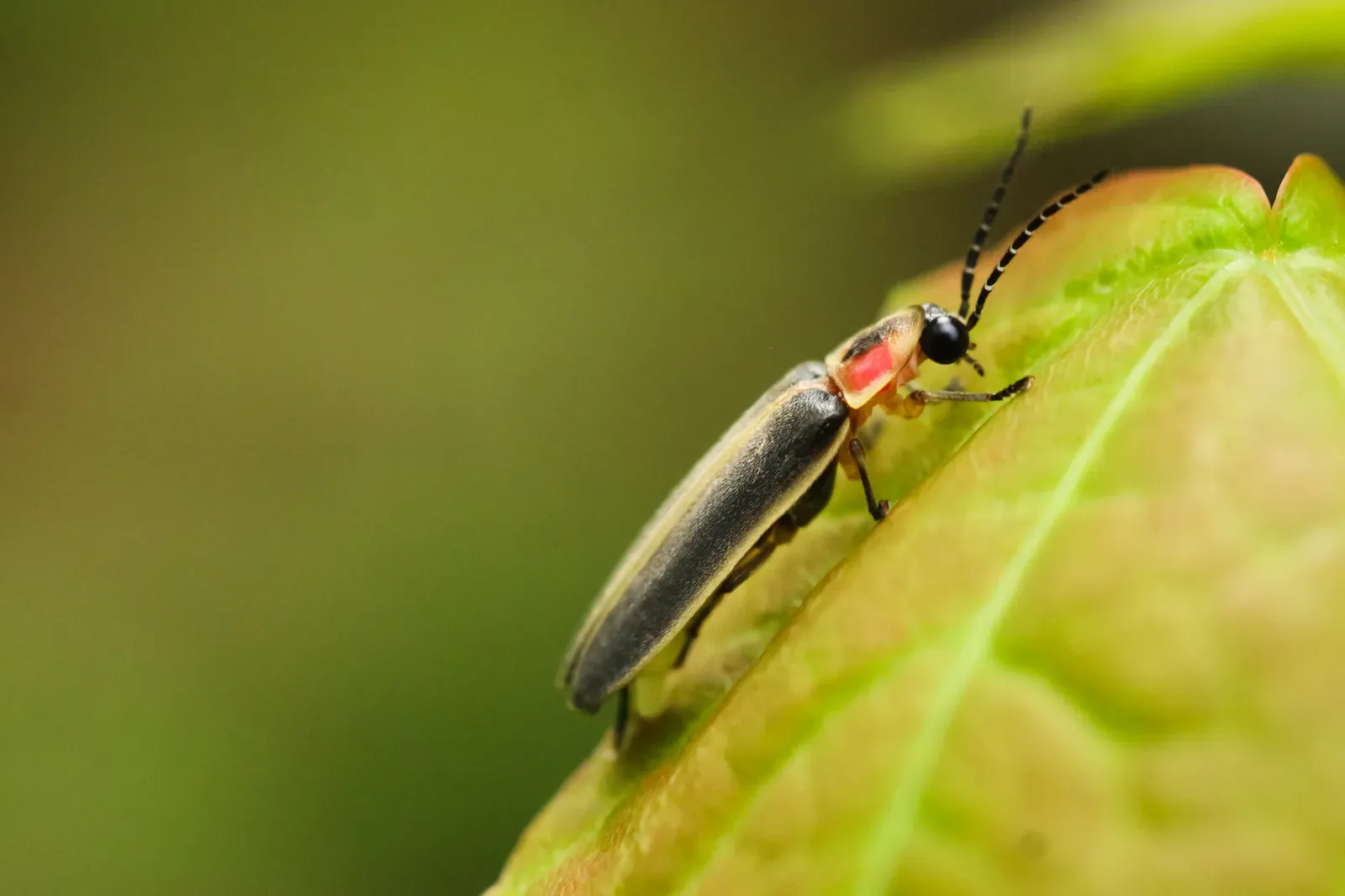
Follow a common eastern firefly from damp ground to a floating summer flash—and discover why a little patch of wildness can feel like a whole galaxy.
A lantern lifts from the grass
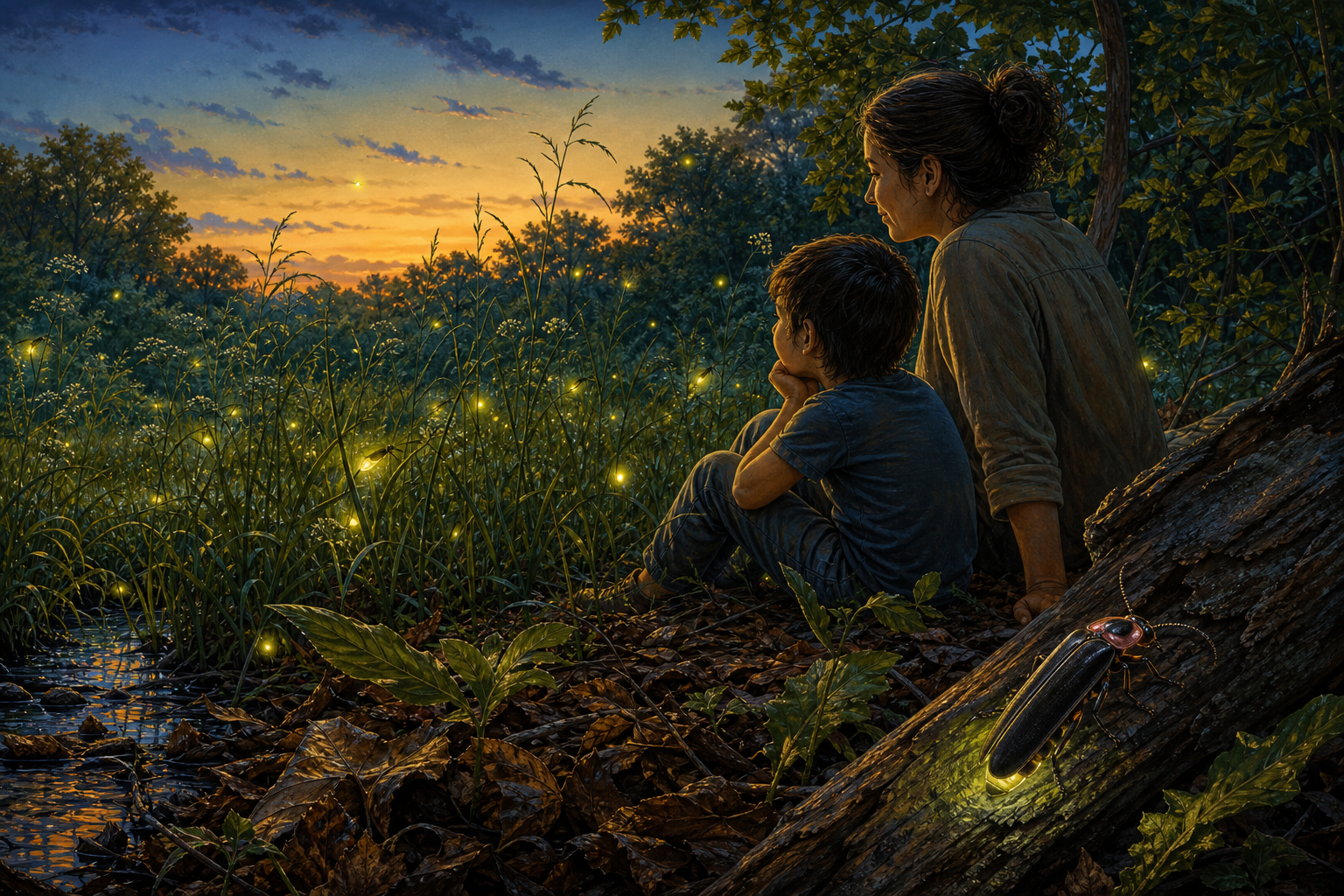
The evening is warm enough for bare arms. Grass brushes your ankles. Then—blink!—a small greenish-yellow light floats over the meadow and vanishes again. Blink! There it is, a tiny lantern with wings, drifting through the dusk as if the sky has dropped one of its stars.
This is the common eastern firefly, Photinus pyralis. You may also know it as a lightning bug or big dipper firefly. Here is the first surprise: it is not a fly at all. It is a soft-bodied beetle, wearing its own little light near the tip of its body.
A firefly’s glow is cool, not a miniature campfire. Inside its light-making organ, a chemical reaction involving air helps create the shine. Imagine carrying a flashlight that never gets hot in your pocket—except the flashlight is part of you. Very handy for a beetle with evening plans.
Evidence: Wikipedia: Photinus pyralis; Animal Diversity Web (University of Michigan Museum of Zoology): Photinus pyralis — Common Eastern Firefly; IUCN Red List of Threatened Species: Photinus pyralis (Common Eastern Firefly) — Red List Assessment
Who is blinking, and what are they saying?
On summer nights, flying male common eastern fireflies blink as they travel through the air. Their flashes can come about every five to seven seconds. A female resting on a leaf or blade of grass watches. If she recognizes the pattern, she flashes an answer after a short delay.
That is not random sparkle. It is a conversation made of timing and light. Different kinds of fireflies use different flash patterns, helping them find others of their own kind among a busy crowd of twinkles. A meadow may look quiet to us, but for fireflies it can be full of glowing messages.
Try listening with your eyes: blink… pause… blink. You do not need to catch a firefly to enjoy its signal. In fact, the most magical view is often simply watching it go about its important beetle business—like a floating punctuation mark in the night.
Evidence: Wikipedia: Photinus pyralis; Animal Diversity Web (University of Michigan Museum of Zoology): Photinus pyralis — Common Eastern Firefly
Before the wings: the glow-worm chapter
A flying adult is only one chapter of a firefly’s life. Young fireflies are called glow-worms, though they are not actually worms. They live on damp ground, under bark, and near streams. They glow there, too—small lights tucked into the earth’s messy, crumbly backstage.
Glow-worms are hunters. They feed on small creatures such as worms, slugs, and snails. This is a useful reminder that even an animal as gentle-looking as a firefly has a job in the web of life. A leaf-litter world is not empty dirt; it is a tiny neighbourhood packed with hidden lives.
The young stage can last a long time, up to about two years. Then, after growing and changing, the adult beetle appears for its brief season of flying, flashing, and finding a mate. The summer light show has a long, damp-soil beginning.
Evidence: Wikipedia: Photinus pyralis; Animal Diversity Web (University of Michigan Museum of Zoology): Photinus pyralis — Common Eastern Firefly; IUCN Red List of Threatened Species: Photinus pyralis (Common Eastern Firefly) — Red List Assessment
Where a lightning bug likes to live
Common eastern fireflies are native across the United States east of the Rocky Mountains. Look for their kind of places: meadows, fields, woodland edges, wetlands, and vegetation near streams. Adults appear from late spring into early autumn, when evenings can hold both soft warmth and the smell of growing things.
They are small—roughly the length of a fingernail clipping, depending on the individual—so their world is built from close-up landmarks. A grass stem can be a lookout tower. A damp patch under bark can be a shelter. A meadow edge can be an entire glowing boulevard.
If you are lucky enough to see one, be a quiet guest. Watch from a path or lawn edge, leave bark and leaf litter where they are, and let the firefly choose its own route through the dark. Wonder works better when the animal gets to stay in charge of its evening.
Evidence: Wikipedia: Photinus pyralis; Animal Diversity Web (University of Michigan Museum of Zoology): Photinus pyralis — Common Eastern Firefly; IUCN Red List of Threatened Species: Photinus pyralis (Common Eastern Firefly) — Red List Assessment
Why the little lights matter
It is easy to admire a firefly because it is beautiful. But beauty is not its only reason for mattering. During their long young stage, these beetles are predators of small animals in soil and leaf litter. They are part of the busy relationships that connect damp ground, plants, tiny creatures, and larger animals.
The common eastern firefly is listed as Least Concern in a 2021 IUCN assessment. That is encouraging, but it is not a reason to stop paying attention. The available information does not confirm a range-wide population trend, and scientists still have questions about what pressures may affect this species in different places.
Caring can be wonderfully ordinary. Notice a meadow instead of calling it “just weeds.” Notice moist leaves instead of seeing a mess to erase. Outdoor places need many kinds of homes, including the small, shadowy, squishy ones that young fireflies use.
Evidence: IUCN Red List of Threatened Species: Photinus pyralis (Common Eastern Firefly) — Red List Assessment; Animal Diversity Web (University of Michigan Museum of Zoology): Photinus pyralis — Common Eastern Firefly; Wikipedia: Photinus pyralis
A backyard detective mission
Want to become a firefly detective? On a warm evening, sit with a trusted grown-up near a grassy edge and wait. Let your eyes adjust. Can you spot one flash, then another? Does one beetle seem to drift while another stays low among the plants? You are watching a real animal communication system, no screen required.
Keep your investigation kind. Do not collect the beetles, pull apart their hiding places, or shine bright lights at them. A notebook sketch can be a brilliant souvenir: draw the shape of the meadow, mark where you saw flashes, and write one question you still have.
Perhaps your question will be the best kind: “What else is living down there?” Under the grass, under the bark, and beside the stream, the world is always more crowded—and more surprising—than it first appears.
Evidence: Animal Diversity Web (University of Michigan Museum of Zoology): Photinus pyralis — Common Eastern Firefly; Wikipedia: Photinus pyralis
Kind choices can glow outward
A firefly is not a decoration or a toy; it is a small neighbour with a whole life to live. We can enjoy its light without taking it away from its meadow, damp soil, or family of blinking beetles. Leaving room for wild places is a caring choice for animals we notice—and animals we never see.
Care can reach beyond the backyard, too. Meals built around vegetables, fruits, whole grains, pulses, nuts, and seeds can be part of a varied healthy diet, according to the World Health Organization. The IPCC reports that shifts toward sustainable, healthy, more plant-based diets can help reduce food-system emissions and pressure on land and biodiversity. With a trusted adult, trying a cheerful bean dish or a colourful vegetable meal can be one gentle way to care for animals and the living places they depend on.
Evidence: World Health Organization: Healthy diet; Intergovernmental Panel on Climate Change: Climate Change 2022: Mitigation of Climate Change — Chapter 7
Questions people ask
Are fireflies really beetles?
Yes. Despite the name “firefly,” the common eastern firefly is a soft-bodied beetle in the family Lampyridae. Its scientific name is Photinus pyralis.
Evidence: Wikipedia: Photinus pyralis; Animal Diversity Web (University of Michigan Museum of Zoology): Photinus pyralis — Common Eastern Firefly; IUCN Red List of Threatened Species: Photinus pyralis (Common Eastern Firefly) — Red List Assessment
Why do common eastern fireflies flash?
Their cool light is used for signalling. Flying males flash, and females resting nearby can answer with their own flash. The timing helps fireflies recognize members of their own kind.
Evidence: Wikipedia: Photinus pyralis; Animal Diversity Web (University of Michigan Museum of Zoology): Photinus pyralis — Common Eastern Firefly
What do baby fireflies eat?
Young fireflies, often called glow-worms, hunt small animals on damp ground. Documented prey includes worms, slugs, and snails.
Evidence: Wikipedia: Photinus pyralis; Animal Diversity Web (University of Michigan Museum of Zoology): Photinus pyralis — Common Eastern Firefly; IUCN Red List of Threatened Species: Photinus pyralis (Common Eastern Firefly) — Red List Assessment
Read the evidence
Sources behind this story
- Photinus pyralis — Wikipedia
- Photinus pyralis — Common Eastern Firefly — Animal Diversity Web (University of Michigan Museum of Zoology)
- Photinus pyralis (Common Eastern Firefly) — Red List Assessment — IUCN Red List of Threatened Species
- Healthy diet — World Health Organization
- Climate Change 2022: Mitigation of Climate Change — Chapter 7 — Intergovernmental Panel on Climate Change
Health information is general education, not personal medical advice. Young readers should make food choices with a trusted adult and qualified health professional.