Today's animal friend · 20 August 2026
The River-Ripple Detective
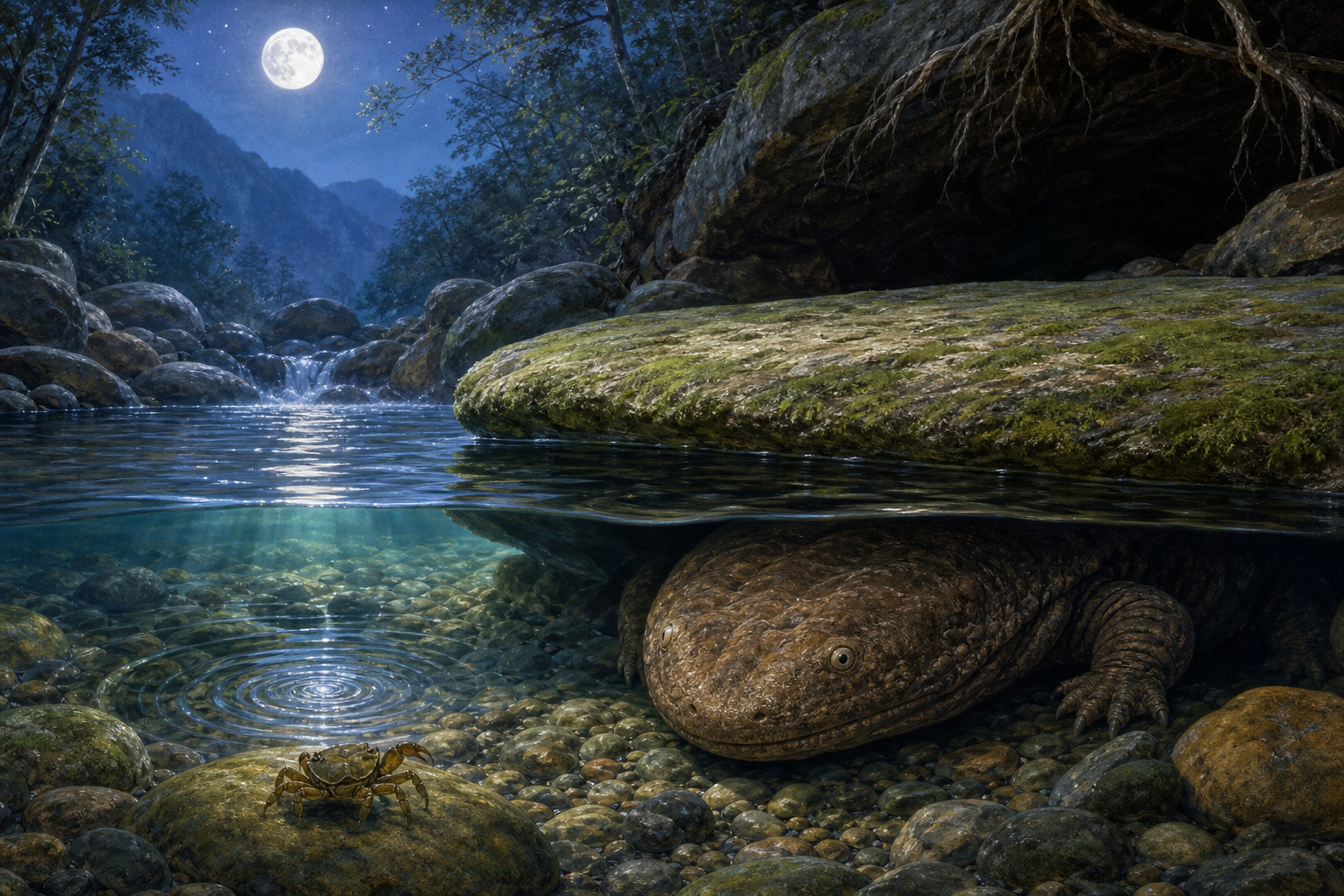
In a cool mountain stream in central China, one of Earth’s largest amphibians waits beneath a rock. It cannot see very well—but it may notice a swimming crab before the crab knows it has company.
In a cool mountain stream in central China, one of Earth’s largest amphibians waits beneath a rock. It cannot see very well—but it may notice a swimming crab before the crab knows it has company.
Shhh… the stream is sending a message
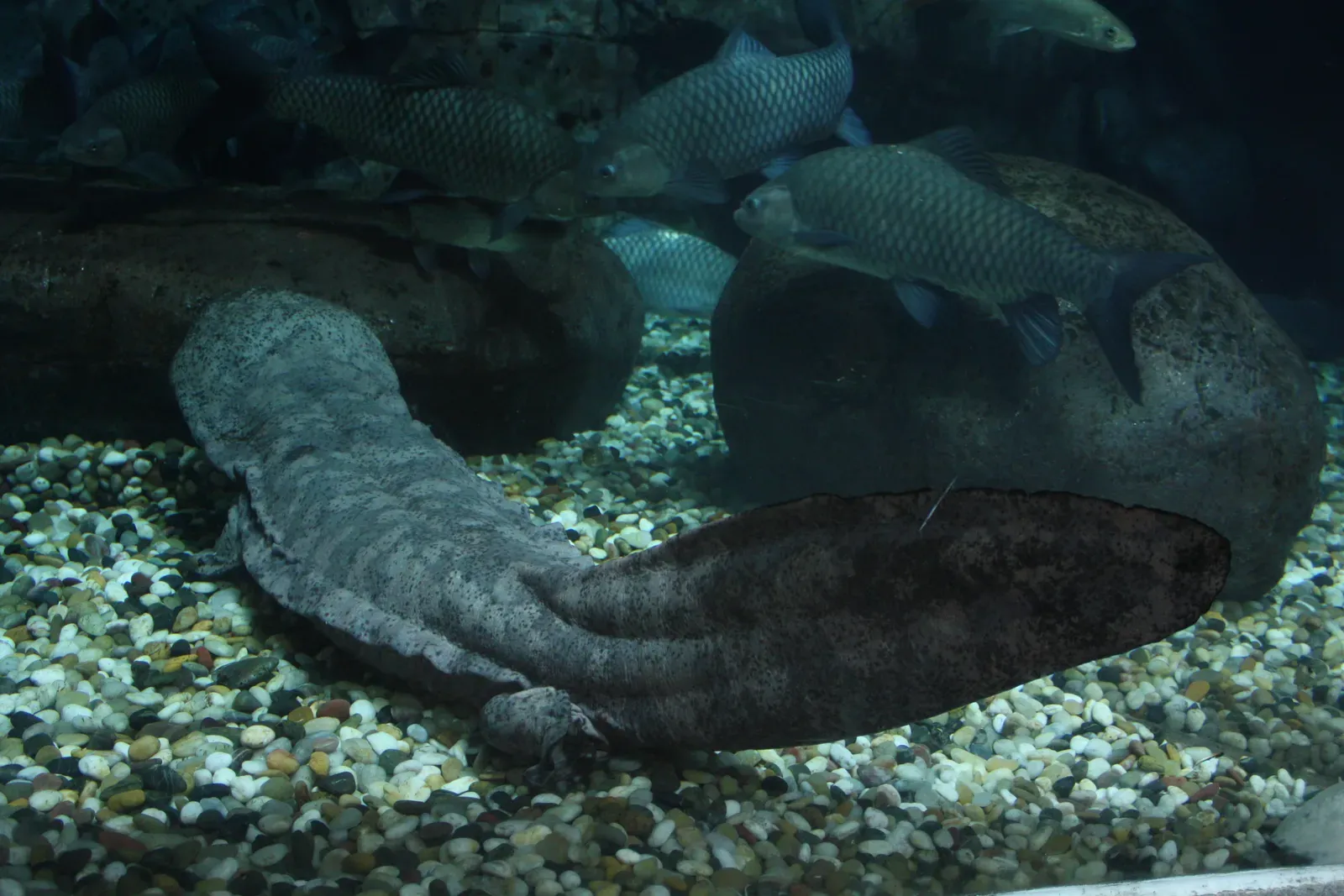
Picture a mountain stream at twilight. Water chatters over stones, slips under roots, and splashes into little pools. Beneath a flat rock, something big and brown lies almost perfectly still. It has a broad head, tiny eyes, and skin that looks a little crinkly, as if it has been in the bath for a very, very long time.
This is a Chinese giant salamander, or Andrias davidianus. It lives in central China’s rocky mountain drainages, especially around the Yangtze basin. It is one of the largest amphibians on Earth: exceptional individuals have reached about 1.8 metres long—longer than most grown-ups are tall. That is a lot of salamander to hide behind a rock.
Yet this giant does not charge about making a fuss. It spends much of its time underwater in cool, clear, fast-flowing streams and rivers, using crevices, cavities, and caves as sheltered dens. In a rushing stream, being quiet can be a superpower.
Evidence: IUCN Red List of Threatened Species: Andrias davidianus (Chinese Giant Salamander) — Red List Assessment; Animal Diversity Web, University of Michigan Museum of Zoology: Andrias davidianus (Chinese giant salamander); Wikipedia: Chinese giant salamander
Tiny eyes, enormous listening skills
How does an animal find dinner in shadowy, rippling water when its eyesight is poor? The Chinese giant salamander has a clever answer: feel the water. Rows of special sensory bumps along its body can detect small vibrations and movements nearby.
Imagine closing your eyes in a bathtub and noticing someone gently swish a hand at the other end. Now imagine being able to tell which direction that swish came from, while a stream is bubbling around you. The salamander’s watery world is full of clues.
A fish flicks its tail. A freshwater crab scuttles over a pebble. A frog paddles past. Those ripples can help the salamander locate prey. Its tiny eyes are not the star of this show; its body is more like a built-in ripple detector. Nature has made a detective with no magnifying glass—just a wonderfully sensitive skin-and-water system.
Evidence: Animal Diversity Web, University of Michigan Museum of Zoology: Andrias davidianus (Chinese giant salamander); Wikipedia: Chinese giant salamander
Why wait for nightfall?
Chinese giant salamanders are mostly active at night and around twilight. When daylight fades, they become ambush hunters. Rather than zooming after every snack, they can wait in a good hiding place and let the stream bring opportunities close.
Their menu includes freshwater crabs, fish, frogs, shrimp, insects, and worms. It is a carnivorous menu, but that does not make this animal a villain. In a stream community, animals have different jobs, and this salamander is a top predator. By feeding on other stream creatures, it helps shape the busy life of the waterway.
It is also territorial, meaning it does not simply welcome every other salamander into its chosen spot. A safe den in a rocky stream is valuable real estate—rather like finding the coziest reading nook in a library, except the library is underwater and your chair is a cave.
Evidence: Animal Diversity Web, University of Michigan Museum of Zoology: Andrias davidianus (Chinese giant salamander); Wikipedia: Chinese giant salamander
A visitor from a very old family
The Chinese giant salamander belongs to the amphibian family Cryptobranchidae. This family has changed relatively little over millions of years, so giant salamanders are sometimes called “living fossils.” The nickname does not mean they are old rocks in disguise. It means their family carries an ancient-looking branch of the animal family tree into the present day.
That makes a salamander in a stream feel a bit like a message from deep time. Long ago, its distant relatives were already part of Earth’s story. Today, this animal still needs the same sort of thing many stream creatures need: clean freshwater, rocky cover, and a river that can flow.
There is an important science twist, too. What people once treated as one Chinese giant salamander species has been divided into several closely related species. This feature follows Andrias davidianus, the Chinese giant salamander named here. Science sometimes redraws the map of who is who—and that can help people protect the right animals in the right places.
Evidence: Animal Diversity Web, University of Michigan Museum of Zoology: Andrias davidianus (Chinese giant salamander); Wikipedia: Chinese giant salamander
When a stream home gets harder to live in
The Chinese giant salamander is listed as Critically Endangered, and its wild population is decreasing. Those are serious words. They mean this remarkable animal faces an extremely high risk of disappearing from the wild if people do not protect it and its habitat.
Several troubles can pile up at once. Salamanders have been over-collected for food and for farming stock. Streams can be damaged or divided by dams. Pollution can spoil the clean water that stream life depends on, while habitat loss can remove the rocky, flowing places where salamanders shelter and hunt.
A river is not just water moving downhill. It is a neighbourhood of stones, insects, fish, frogs, plants, and hidden creatures. When the water is healthy, many neighbours can thrive. When it is harmed, the quiet giant under the rock has fewer safe choices. Its survival is connected to the care of an entire stream.
Evidence: IUCN Red List of Threatened Species: Andrias davidianus (Chinese Giant Salamander) — Red List Assessment; Animal Diversity Web, University of Michigan Museum of Zoology: Andrias davidianus (Chinese giant salamander); Wikipedia: Chinese giant salamander
Hope needs careful hands and clean water
There is room for hope, especially when hope means careful action rather than a magic wand. Chinese giant salamanders are protected under Chinese wildlife law, and international trade controls also apply. Protecting and restoring clean mountain streams matters enormously.
People can also work with captive breeding and release programmes. But this is not as simple as opening a gate and shouting, “Off you go!” Because closely related giant salamander lineages can be different species, conservation teams need to be genetically informed and cautious. Releasing the right animals in the right place can help avoid mixing lineages in harmful ways.
The biggest hopeful idea is beautifully ordinary: protect living rivers. A stream with clear water, natural flow, rocky hiding places, and healthy banks is not merely scenery for a photograph. It is a home. Guarding that home gives this patient, ripple-reading amphibian a better chance to remain part of the night-time chorus of mountain water.
Evidence: IUCN Red List of Threatened Species: Andrias davidianus (Chinese Giant Salamander) — Red List Assessment; Animal Diversity Web, University of Michigan Museum of Zoology: Andrias davidianus (Chinese giant salamander); Wikipedia: Chinese giant salamander
A kind choice can begin at the table
It is sad that Chinese giant salamanders have been over-collected for food. Caring about them can lead to a gentle question: how can our meals leave more room for wild animals and healthy habitats? One positive answer is to enjoy more plant-based foods—such as beans, lentils, vegetables, fruit, whole grains, nuts, and seeds—with a trusted adult helping choose what works for your family.
The World Health Organization describes healthy diets as varied and rich in foods such as vegetables, fruit, whole grains, pulses, nuts, and seeds. The IPCC reports that shifts toward sustainable, healthy, more plant-based diets can reduce pressure from food systems on climate, land, and biodiversity. Nobody has to be perfect to be kind. A plant-based lunch, a new bean recipe, or choosing not to treat a wild animal as food can be a small, thoughtful vote for a world with more wild neighbours.
The giant salamander does not need us to be gloomy. It needs people to notice that a wrinkly creature beneath a river rock has a life of its own—and deserves a safe stream in which to send and receive its watery secret messages.
Evidence: IUCN Red List of Threatened Species: Andrias davidianus (Chinese Giant Salamander) — Red List Assessment; World Health Organization: Healthy diet; Intergovernmental Panel on Climate Change: Climate Change 2022: Mitigation of Climate Change — Chapter 7
Questions people ask
Is the Chinese giant salamander really a fish?
No. It is an amphibian, in the same broad animal class as frogs and other salamanders. Although it lives almost entirely in water, it is not a fish.
Evidence: Animal Diversity Web, University of Michigan Museum of Zoology: Andrias davidianus (Chinese giant salamander); Wikipedia: Chinese giant salamander
Why is it called “giant”?
Because it is enormous for an amphibian. Exceptional animals have been recorded at up to about 1.8 metres long. Still, “giant” does not mean invincible: this species is Critically Endangered in the wild.
Evidence: IUCN Red List of Threatened Species: Andrias davidianus (Chinese Giant Salamander) — Red List Assessment; Animal Diversity Web, University of Michigan Museum of Zoology: Andrias davidianus (Chinese giant salamander); Wikipedia: Chinese giant salamander
Can it see a crab coming?
Its eyes are very small and its vision is poor. Instead, it can sense tiny water movements with special sensory nodes along its body, helping it locate nearby prey.
Evidence: Animal Diversity Web, University of Michigan Museum of Zoology: Andrias davidianus (Chinese giant salamander); Wikipedia: Chinese giant salamander
What can young river-friends do?
Learn which freshwater animals share our planet, value clean waterways, and speak kindly about animals as living beings rather than things to use. Sharing what you learn with a trusted adult is a splendid first step.
Evidence: IUCN Red List of Threatened Species: Andrias davidianus (Chinese Giant Salamander) — Red List Assessment; Animal Diversity Web, University of Michigan Museum of Zoology: Andrias davidianus (Chinese giant salamander); Wikipedia: Chinese giant salamander
Read the evidence
Sources behind this story
- Andrias davidianus (Chinese Giant Salamander) — Red List Assessment — IUCN Red List of Threatened Species
- Andrias davidianus (Chinese giant salamander) — Animal Diversity Web, University of Michigan Museum of Zoology
- Chinese giant salamander — Wikipedia
- Healthy diet — World Health Organization
- Climate Change 2022: Mitigation of Climate Change — Chapter 7 — Intergovernmental Panel on Climate Change
Health information is general education, not personal medical advice. Young readers should make food choices with a trusted adult and qualified health professional.