Today's animal friend · 17 September 2026
Chimpanzee: The Forest’s Stick-Spoon Inventor
A chimpanzee’s long arms can carry it through the treetops, but its sharp mind may be its most astonishing travelling companion.

A chimpanzee’s long arms can carry it through the treetops, but its sharp mind may be its most astonishing travelling companion.
A twig wiggles at the termite mound
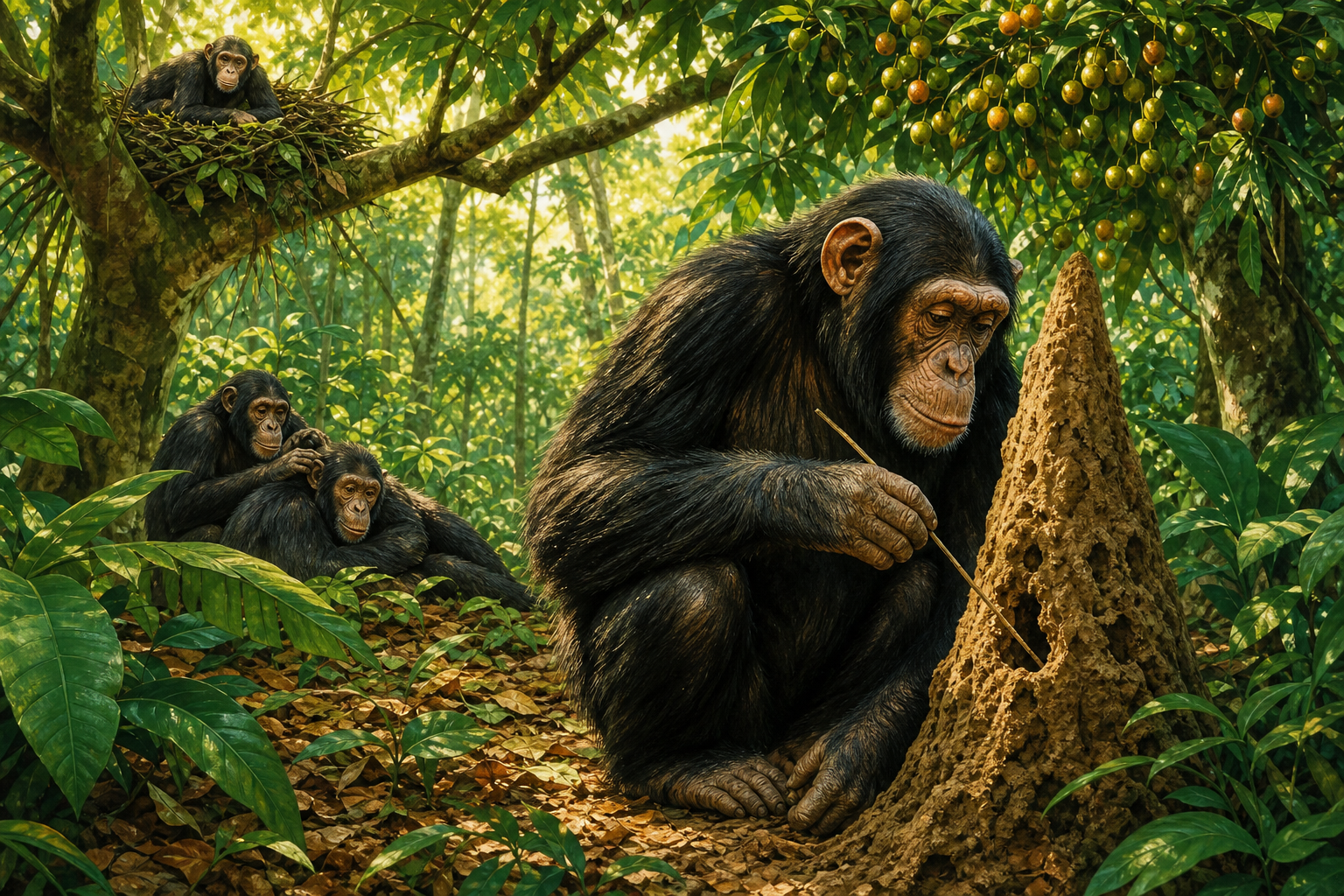
Imagine the warm hush of an African forest. Leaves rustle overhead. Then a chimpanzee chooses a thin stick, slides it into a termite nest, waits, and pulls it out with insects clinging to it. Snack time! It is a little like using a tiny spoon—except this spoon came from the forest floor.
Chimpanzees are African great apes, and they are among our closest animal cousins. One reason that feels especially amazing is that they can learn by watching one another. A young chimp has plenty to notice: which fruit is ready, where to travel, and how a useful stick can turn an insect nest into lunch.
This is not a one-trick animal. Different chimpanzee communities can have their own tool-use traditions, so not every chimp uses tools in exactly the same way. That makes a forest feel less like a silent green place and more like a neighbourhood full of learning, practice, and bright ideas.
Evidence: IUCN Red List of Threatened Species: Pan troglodytes (Chimpanzee) — Red List Assessment; Animal Diversity Web, University of Michigan Museum of Zoology: Pan troglodytes (chimpanzee); Wikipedia: Chimpanzee
Long arms, leafy bedrooms
A chimpanzee is covered mostly in coarse dark hair, with a bare face, ears, hands, and feet. Its arms are wonderfully long: when stretched wide, they reach farther than the chimp is tall. That is excellent equipment for clambering and swinging among branches, though it might make finding a jumper with sleeves quite tricky.
Chimpanzees use rainforest, forest, woodland, and some savanna habitats across equatorial Africa. They spend substantial time feeding and nesting in trees, yet they also travel on the ground. There, they often move on all fours, leaning on their knuckles. Think of a powerful tree-climber who can also take a brisk knuckle-walk when the path is clear.
At the end of a busy day, a chimpanzee can build a leafy nest for sleeping. It is not a human bed with a pillow and a duvet, but it is a clever, cosy-looking resting place made from the materials nearby. Chimpanzees are active in daylight, when there is fruit to find, friends to meet, and branches to inspect.
Evidence: Animal Diversity Web, University of Michigan Museum of Zoology: Pan troglodytes (chimpanzee); Wikipedia: Chimpanzee; IUCN Red List of Threatened Species: Pan troglodytes (Chimpanzee) — Red List Assessment
What is on the chimpanzee menu?
Fruit is a major part of a chimpanzee’s food, so a fruiting tree can be an exciting discovery. But a chimpanzee is an omnivore, meaning it eats more than one kind of food. Leaves, seeds, blossoms, stems, and bark can be part of the menu too, along with insects such as ants and termites. What is available changes with place and season.
A chimpanzee’s food-searching links it closely to its forest home. It moves through fruiting trees and looks for small foods tucked into bark, soil, or nests. Every meal is a puzzle: What is ripe? What can be reached? Is that slim twig the right shape for the job?
It is tempting to imagine every chimpanzee eating the same breakfast, lunch, and dinner. Real wild lives are messier and more interesting than that. A woodland chimp and a rainforest chimp may have different foods nearby, and one day’s feast may not appear again tomorrow.
Evidence: Animal Diversity Web, University of Michigan Museum of Zoology: Pan troglodytes (chimpanzee); Wikipedia: Chimpanzee; IUCN Red List of Threatened Species: Pan troglodytes (Chimpanzee) — Red List Assessment
A hello can be a hug
Chimpanzees live in communities, but they do not necessarily march around all day in one fixed crowd. Their community can split into smaller groups during the day and come together in changing combinations. It is a bit like friends at a big playground: one cluster is looking for food, another is resting, and later everyone’s plans may change.
Keeping relationships going matters. Chimpanzees communicate with calls, facial expressions, and touch. They may greet one another with embraces or hand-holding, and they groom—carefully picking through another chimp’s fur. Grooming helps maintain social bonds, while also providing a calm close-up moment in a busy forest.
Young chimpanzees have years to learn from the adults and other youngsters around them. Watching is serious business when you are figuring out a forest full of routes, foods, calls, and tools. The next time you learn a game by seeing someone else play, remember: copying a good idea is an ancient ape skill.
Evidence: Animal Diversity Web, University of Michigan Museum of Zoology: Pan troglodytes (chimpanzee); Wikipedia: Chimpanzee; IUCN Red List of Threatened Species: Pan troglodytes (Chimpanzee) — Red List Assessment
Why this clever neighbour needs room to roam
Chimpanzees are listed by the IUCN as Endangered, and their population is decreasing. Estimates suggest roughly 172,700 to 299,700 chimpanzees remain in the wild, but that is an estimate rather than a roll call where every chimp raises a hand.
Their biggest troubles include habitat loss, hunting and illegal trade, and disease. When forests are cut into smaller pieces, chimpanzee communities can lose feeding trees, nesting places, and safe connections between areas. Human expansion into forest landscapes can make these pressures worse.
There is hope in actions that match the problem: protecting and connecting forest habitat, preventing illegal hunting and trade, and managing protected places with disease risks in mind. Sanctuaries and research can help individual chimpanzees, but a safe, connected wild forest is something no enclosure can replace. Protecting a chimpanzee means protecting a whole living home of leaves, insects, fruit, calls, and shade.
Evidence: IUCN Red List of Threatened Species: Pan troglodytes (Chimpanzee) — Red List Assessment; Animal Diversity Web, University of Michigan Museum of Zoology: Pan troglodytes (chimpanzee); Wikipedia: Chimpanzee
A small kindness can begin at your table
Caring about chimpanzees does not mean you have to solve every forest problem before Tuesday. You can start by noticing that wild animals are individuals with families, skills, favourite places, and their own reasons to be left in peace. Share what you learn, support trustworthy conservation efforts with your family when possible, and enjoy wildlife from a respectful distance.
Food choices can be one gentle part of caring for the wider world. The World Health Organization describes healthy eating patterns as varied and rich in foods such as vegetables, fruit, whole grains, pulses, nuts, and seeds. The IPCC reports that sustainable, healthy diets with more plant-based foods can reduce pressure from food systems on climate, land, and biodiversity.
Perhaps try a colourful plant-based meal with a trusted adult: bean tacos, lentil soup, fruit and oat bowls, or a seed-topped salad. There is no need for perfection or lectures at the dinner table. It is simply one kind way to practise the big idea a chimpanzee forest teaches us: lives are connected, and thoughtful choices can make more room for other animals to thrive.
Evidence: World Health Organization: Healthy diet; Intergovernmental Panel on Climate Change: Climate Change 2022: Mitigation of Climate Change — Chapter 7; IUCN Red List of Threatened Species: Pan troglodytes (Chimpanzee) — Red List Assessment
Choose curiosity, kindness, and more plants
A chimpanzee is not a prop in a story or a product for people. It is a clever wild neighbour with friendships, learned skills, and a forest home. Let that thought guide your curiosity: look, learn, and give wildlife space.
With a trusted adult, choosing more meals built around pulses, vegetables, fruit, grains, nuts, and seeds can be a friendly step for animals and ecosystems. Global health guidance supports varied eating patterns rich in these foods, and climate science finds that more plant-based sustainable diets can lower pressure on land, biodiversity, and food-system emissions.
Evidence: World Health Organization: Healthy diet; Intergovernmental Panel on Climate Change: Climate Change 2022: Mitigation of Climate Change — Chapter 7
Questions people ask
Are chimpanzees monkeys?
No. Chimpanzees are apes: African great apes in the family Hominidae. Their scientific name is Pan troglodytes.
Evidence: Animal Diversity Web, University of Michigan Museum of Zoology: Pan troglodytes (chimpanzee); Wikipedia: Chimpanzee
Do all chimpanzees fish for termites with sticks?
Chimpanzees can use sticks for termite fishing, but tool traditions differ among communities. A useful skill may be learned by watching others.
Evidence: Animal Diversity Web, University of Michigan Museum of Zoology: Pan troglodytes (chimpanzee); Wikipedia: Chimpanzee
Where do chimpanzees sleep?
They build leafy nests, often in trees. These nests give them a place to rest after a daylight spent travelling and feeding.
Evidence: Animal Diversity Web, University of Michigan Museum of Zoology: Pan troglodytes (chimpanzee); Wikipedia: Chimpanzee
What can help wild chimpanzees?
Protecting and reconnecting forests, stopping illegal hunting and trade, and managing disease risks address the main threats they face.
Evidence: IUCN Red List of Threatened Species: Pan troglodytes (Chimpanzee) — Red List Assessment; Animal Diversity Web, University of Michigan Museum of Zoology: Pan troglodytes (chimpanzee); Wikipedia: Chimpanzee
Read the evidence
Sources behind this story
- Pan troglodytes (Chimpanzee) — Red List Assessment — IUCN Red List of Threatened Species
- Pan troglodytes (chimpanzee) — Animal Diversity Web, University of Michigan Museum of Zoology
- Chimpanzee — Wikipedia
- Healthy diet — World Health Organization
- Climate Change 2022: Mitigation of Climate Change — Chapter 7 — Intergovernmental Panel on Climate Change
Health information is general education, not personal medical advice. Young readers should make food choices with a trusted adult and qualified health professional.