Today's animal friend · 18 August 2026
The Night-Walking Cane Toad With a Dinner-Plate Surprise
Follow the soft hop of a cane toad, discover its clever behind-the-eyes defence, and untangle why a common animal can be welcome in one home and troublesome in another.
Follow the soft hop of a cane toad, discover its clever behind-the-eyes defence, and untangle why a common animal can be welcome in one home and troublesome in another.
A hop in the torchlight
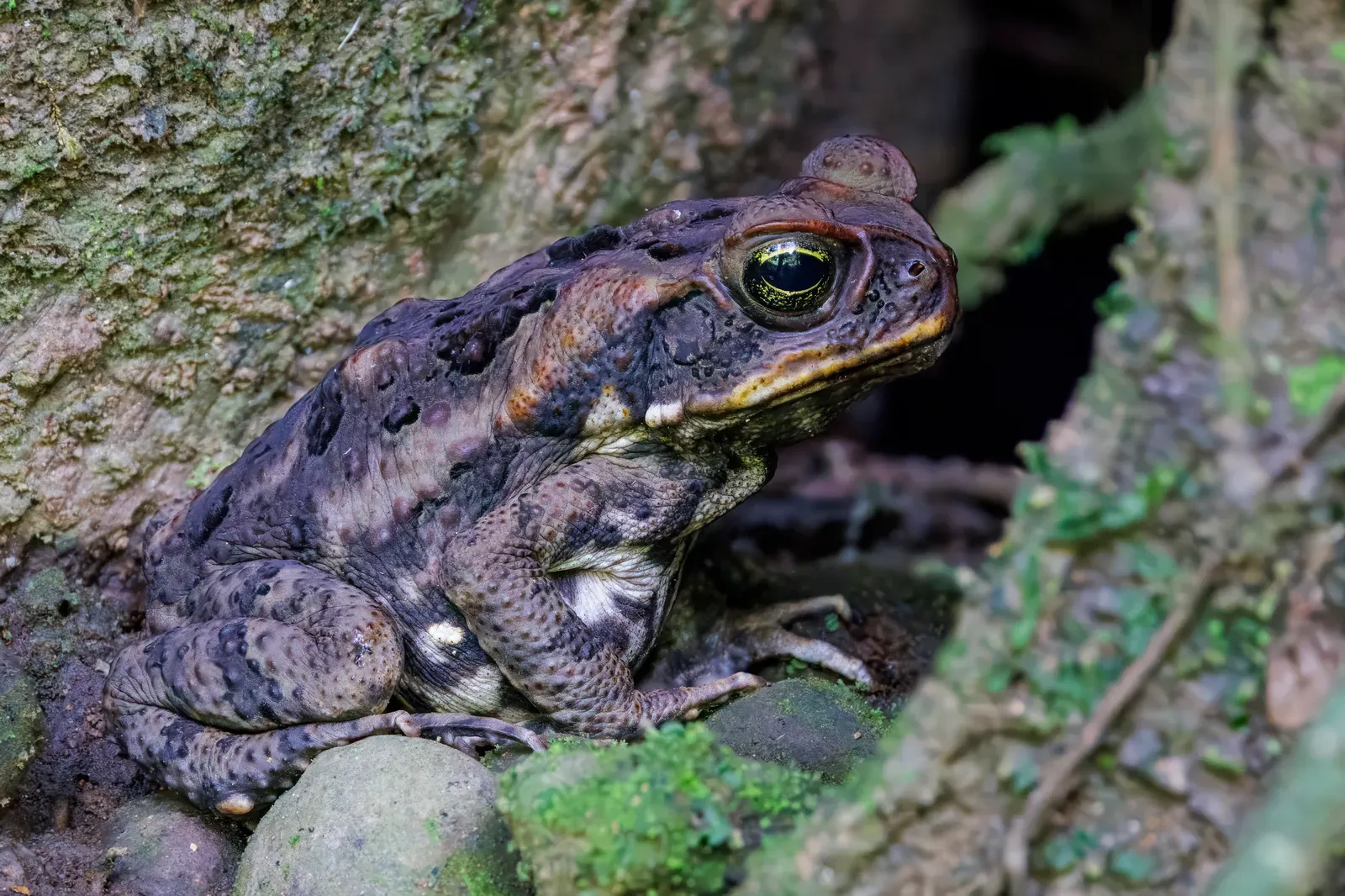
Imagine you are outside after rain. The ground feels springy, the air smells like wet leaves, and somewhere in the dark comes a small rustle: hop… pause… hop. Your torch beam lands on a cane toad, sitting as solidly as a lumpy little loaf of bread.
This is Rhinella marina, also called the giant Neotropical toad or marine toad. It is a true toad in the family Bufonidae, and it can be one of the biggest true toads around. Most adults are much smaller than a dinner plate, but an exceptional female can reach about 24 centimetres long—an astonishing dinner-plate-sized surprise on a nighttime walk.
Its skin is dry and bumpy, often brown or olive, and bony ridges rise above its eyes. Those bumps are not ugly decorations. They are part of a body built for life close to the ground: quietly waiting, noticing, and suddenly getting on with the important business of supper.
Evidence: IUCN Red List of Threatened Species: Rhinella marina (Cane Toad) — Red List Assessment; Animal Diversity Web, University of Michigan Museum of Zoology: Rhinella marina (Cane Toad); Wikipedia: Cane toad
Why does this toad wait for bedtime?
Cane toads are mainly night-time foragers. When daylight fades, they head out in short hops to search for food. That makes a garden, forest edge, grassland, or wetland feel like a giant snack aisle—if your snacks are beetles, ants, snails, and other small invertebrates.
A cane toad is an opportunity-not-a-menu kind of eater. It watches for movement and uses its sense of smell, taking whatever suitable animal food is available. Small vertebrates may sometimes be eaten too, but tiny crawling creatures are far more likely to be on the toad’s evening agenda. It can also take carrion and other available matter, which shows how flexible this hunter can be.
Stillness is one of its superpowers. A toad does not need to race about like a puppy chasing bubbles. It can wait, watch, then snap up a passing meal. In dry or cold times, it may tuck itself away and become inactive until conditions improve. Patient? Very. Boring? Never.
Evidence: Animal Diversity Web, University of Michigan Museum of Zoology: Rhinella marina (Cane Toad); Wikipedia: Cane toad
Two secret shields behind the eyes
Look behind a cane toad’s eyes and you would find two large parotoid glands. When the toad is bothered, these glands can release a milky skin secretion containing bufotoxin. It is a powerful defence: a would-be predator can learn that this chunky snack is not a good choice.
The clever part is that the toad does not need claws, fangs, or a wrestling match. Its body sends a clear message: “Please choose a different dinner.” Tadpoles have defences too. This is one reason cane toads can be hard for predators unfamiliar with them.
That is also why a nighttime encounter is best enjoyed with eyes, not hands. Give the toad room to continue its slow, important journey. It is not asking to be petted; it is trying to find its way through the dark. Watching quietly is a kind of friendship.
Evidence: Animal Diversity Web, University of Michigan Museum of Zoology: Rhinella marina (Cane Toad); Wikipedia: Cane toad
One toad, two very different maps
Here is the twist in the cane toad’s travel tale. Its native home stretches from southern Texas through mainland Central America and much of South America. There, it is one animal among many in warm places with open or forested ground and access to still or slow water for breeding.
People later carried cane toads to other places, including Australia, hoping they would eat insects that damaged sugar-cane crops. The plan did not work as hoped. The toads spread widely in some introduced places, including parts of the Caribbean, Pacific islands, southern Florida, and Australia.
Why does that matter? Animals in a new place may not know to avoid the toad’s toxins. A broad diet and toxic adults and tadpoles can disturb local food webs. So it is fair to hold two thoughts at once: an individual cane toad is a remarkable living creature, and moving animals far from their native homes can cause serious problems for the animals already there. Nature is not a cartoon with heroes and villains; place changes the story.
Evidence: Animal Diversity Web, University of Michigan Museum of Zoology: Rhinella marina (Cane Toad); Wikipedia: Cane toad
A splashy gathering, not a toad club
Cane toads do not live in steady family gangs or permanent toad clubs. But when breeding time arrives near still or slow water, many can gather. Males call, and a quiet pond edge can suddenly become a noisy meeting place.
These gatherings are temporary. They are about breeding, not about sharing a clubhouse afterward. The adults lay large clutches of eggs, and the young begin life in water as tadpoles before changing into land-walking toads.
This transformation is one of the marvels of amphibians. A creature that starts out swimming can later sit under a shrub, cross a path in a series of determined hops, and hunt at night. If you have ever changed out of soggy swimming clothes into dry ones, you know a tiny bit about how different water-life and land-life can feel—though a tadpole’s change is much more dramatic.
Evidence: Animal Diversity Web, University of Michigan Museum of Zoology: Rhinella marina (Cane Toad); Wikipedia: Cane toad
Common does not mean unworthy of care
Globally, the cane toad is listed as Least Concern. It has a large native range, is common there, and its overall population trend is increasing partly because of introduced populations. In other words, this is not an animal thought to be at global risk of disappearing soon.
But “common” is not the same as “doesn’t matter.” In its native range, the cane toad is a regular nighttime predator of invertebrates. Outside that range, local teams and communities may work to reduce its impacts and help native wildlife. The kindest response is thoughtful and place-aware: learn which animals naturally belong where, follow local wildlife guidance, and never move animals from one place to another.
Next time a damp evening makes the pavement shine, listen for the tiny rustles at ground level. A cane toad is not a fairy-tale prince in disguise. It is more interesting than that: an ancient-looking amphibian with a careful hop, a secret shield, and a whole map of complicated connections.
Evidence: IUCN Red List of Threatened Species: Rhinella marina (Cane Toad) — Red List Assessment; Animal Diversity Web, University of Michigan Museum of Zoology: Rhinella marina (Cane Toad); Wikipedia: Cane toad
A gentle choice at our own dinner table
The cane toad’s story begins with a human choice: people moved animals to a new place hoping to solve a crop problem. It is a good reminder that clever-looking shortcuts can have unexpected effects on wildlife. We can practise a gentler kind of care by noticing animals as neighbours with their own needs, not as tools for us to use.
Our food choices can be part of that care, too. The World Health Organization describes healthy eating patterns as varied and rich in foods such as vegetables, fruit, whole grains, pulses, nuts, and seeds. The IPCC reports that shifts toward sustainable, healthy, more plant-based diets can lower food-system emissions and reduce pressure on land and biodiversity. With a trusted adult, trying a bean burrito, lentil pasta sauce, or a colourful vegetable-and-grain bowl can be one cheerful way to care for animals and the shared home beneath all our feet.
Evidence: World Health Organization: Healthy diet; Intergovernmental Panel on Climate Change: Climate Change 2022: Mitigation of Climate Change — Chapter 7
Questions people ask
Is a cane toad a frog?
It is a true toad, which is part of the amphibian order Anura—the same big group that includes frogs and toads. Cane toads are in the family Bufonidae.
Evidence: IUCN Red List of Threatened Species: Rhinella marina (Cane Toad) — Red List Assessment; Animal Diversity Web, University of Michigan Museum of Zoology: Rhinella marina (Cane Toad); Wikipedia: Cane toad
How big is a cane toad usually?
Adults are commonly about 10 to 15 centimetres long. A few exceptional females have been recorded at about 24 centimetres, but that enormous size is not typical.
Evidence: Animal Diversity Web, University of Michigan Museum of Zoology: Rhinella marina (Cane Toad); Wikipedia: Cane toad
Should I touch one if I find it?
No. Cane toads have toxin-containing skin secretions used for defence. Enjoy the sight from a respectful distance and let the animal continue on its way.
Evidence: Animal Diversity Web, University of Michigan Museum of Zoology: Rhinella marina (Cane Toad); Wikipedia: Cane toad
Why are cane toads managed in some places?
Outside their native range, their toxins and wide-ranging diet can harm local food webs, especially where predators have not evolved to avoid them. Local programmes may focus on reducing those impacts.
Evidence: Animal Diversity Web, University of Michigan Museum of Zoology: Rhinella marina (Cane Toad); Wikipedia: Cane toad
Read the evidence
Sources behind this story
- Rhinella marina (Cane Toad) — Red List Assessment — IUCN Red List of Threatened Species
- Rhinella marina (Cane Toad) — Animal Diversity Web, University of Michigan Museum of Zoology
- Cane toad — Wikipedia
- Healthy diet — World Health Organization
- Climate Change 2022: Mitigation of Climate Change — Chapter 7 — Intergovernmental Panel on Climate Change
Health information is general education, not personal medical advice. Young readers should make food choices with a trusted adult and qualified health professional.