Today's animal friend · 16 September 2026
The Night-Shift Cleaner with Sticky Fingers
Under kelp forests and along rocky bottoms, this animal uses a crown of sticky tentacles to gather tiny leftovers. It may look like a cucumber, but it is a very busy ocean neighbour.
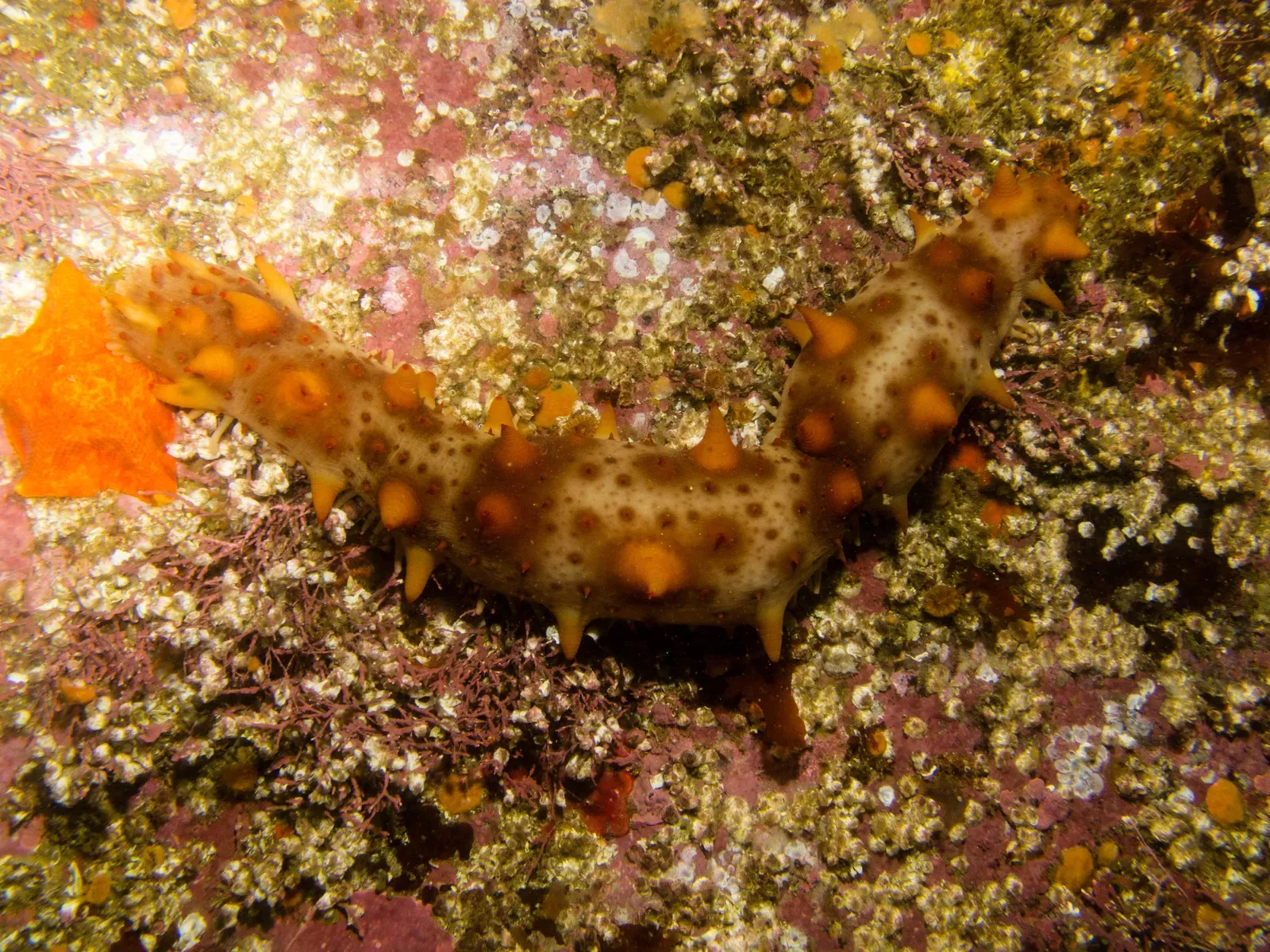
Under kelp forests and along rocky bottoms, this animal uses a crown of sticky tentacles to gather tiny leftovers. It may look like a cucumber, but it is a very busy ocean neighbour.
A squishy shape moves in the dark
Picture a kelp forest after sunset. The long kelp blades sway overhead, the water makes a hush-hush sound, and the rocky sea floor seems almost still. Then a reddish-brown, bumpy tube begins to creep past a pebble. Slowly. Extraordinarily slowly. It is the California sea cucumber, Apostichopus californicus, and it is heading out for its night shift.
Despite its name, this is not a vegetable that tumbled overboard from somebody’s lunch. It is a real animal: a sea cucumber, which belongs to the echinoderm group. Sea stars are in that group too, so this soft, sausage-shaped neighbour has some surprising relatives.
California sea cucumbers live on the Pacific Ocean floor, including rocky places and kelp forests. Their range stretches from Alaska south to Baja California. They can be found near shore and farther below the surface, where daylight fades into a bluish dimness. A quiet-looking patch of seabed can be full of stories when you know whom to look for.
Its skin can be leathery and bumpy, in shades from reddish-brown to yellowish. It does not need to zoom or leap to be interesting. Its superpower is being patient, thorough, and wonderfully good at dealing with leftovers.
Evidence: IUCN Red List of Threatened Species: Parastichopus californicus (Apostichopus californicus) — Red List Assessment; California Sea Grant, University of California San Diego: California Sea Cucumber — Seafood Profile; Wikipedia: California sea cucumber
Twenty tiny tentacles: the world’s slowest snack time
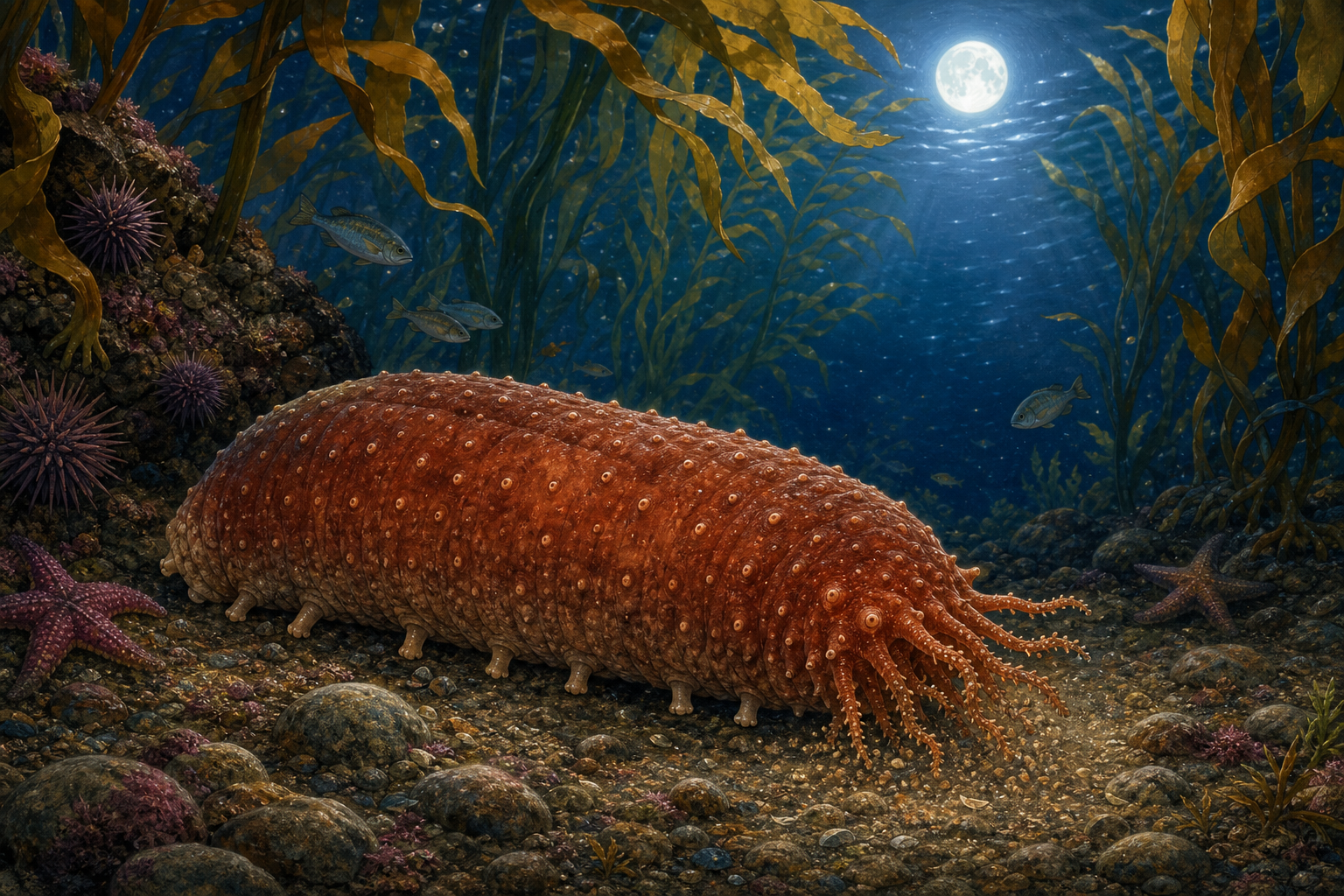
At one end is a mouth surrounded by about twenty retractable tentacles. Think of a flower made of little sticky fingers—except this flower can crawl away and is definitely not for picking. The tentacles gather organic bits and microorganisms from sediment on the sea floor. In places with a current, the animal may also catch drifting food.
One by one, the tentacles bring their gathered snack to the mouth. The menu is made of detritus: tiny bits of organic matter left in the sea-floor world. It may not sound like a fancy café meal to us, but to a California sea cucumber it is exactly the right sort of supper.
This feeding habit makes the animal a detritivore and scavenger. That means it processes scraps that have settled on the bottom. Rather than being “yucky,” this is a useful recycling job. The sea cucumber takes in material from the sediment as it feeds, helping keep the sea floor’s organic leftovers moving through the living ocean.
A California sea cucumber can reach about 50 centimetres long—about the length of many children’s arms. Its life may last around 10 to 12 years. So a creature that seems like a humble squish can spend a long time making its careful way across rocks, sand, and shell-covered ground.
Evidence: California Sea Grant, University of California San Diego: California Sea Cucumber — Seafood Profile; Wikipedia: California sea cucumber; IUCN Red List of Threatened Species: Parastichopus californicus (Apostichopus californicus) — Red List Assessment
How do you walk without legs? Tube feet, of course
Flip the scene in your imagination: underneath this soft body are rows of small tube feet. These feet grip the surface and help the sea cucumber creep along the bottom. “Creep” is exactly the right word. This is not an ocean race-car. It is more like watching a determined blob of jelly travel somewhere important.
Rocky seabeds suit this traveller. Sources describe it on hard bottoms such as cobbles, boulders, bedrock, rocks, and shell. A current may carry food past its tentacles, while the firm ground gives its tube feet something to hold. Kelp forests can add a leafy underwater roof to the neighbourhood.
California sea cucumbers are described as solitary and nocturnal. A lone animal may potter about at night while other sea-floor residents tuck themselves away. Yet being alone does not mean being unimportant. Its work connects it to a larger community: it is prey for animals including sea stars, fishes, sea otters, and crabs.
When threatened, a sea cucumber has some startling defences. It may release sticky filaments, and it can expel internal organs and later regenerate them. That is a remarkable emergency response, not a party trick or something it does on ordinary strolls. The best plan for a wild sea cucumber is to leave it undisturbed to carry on with its life.
Evidence: California Sea Grant, University of California San Diego: California Sea Cucumber — Seafood Profile; Wikipedia: California sea cucumber
Not a lonely story forever: tiny beginnings in the water
Although adults are usually solitary, California sea cucumbers have an ocean-wide way of beginning new lives. Males and females are separate. During spawning, eggs and sperm are released into the water, where fertilisation happens outside the animals’ bodies. The young begin as planktonic larvae, drifting in the water before later becoming sea-floor animals.
Spawning is often concentrated around August, and researchers think it may be linked with phytoplankton blooms. That is a lovely reminder that the ocean is full of timed events we cannot see from a beach: microscopic food blooming, larvae drifting, currents carrying life, and a new generation preparing to settle.
It also gives us a reason to be humble about an animal we might overlook. A sea cucumber is not merely a lumpy shape beside a rock. It has a childhood, a food-finding routine, ways to avoid danger, and a place in a web of neighbours. The more carefully we look, the less “ordinary” it becomes.
Evidence: California Sea Grant, University of California San Diego: California Sea Cucumber — Seafood Profile; Wikipedia: California sea cucumber
Good news, careful news, and why this recycler matters
The IUCN Red List assessment from 2013 lists the California sea cucumber as Least Concern. That means it was not considered at high risk of extinction across its whole range at that time. This is encouraging news, especially for an animal living across a broad stretch of the Pacific coast.
But “Least Concern” is not a sign saying, “No need to care!” Fishing in some areas is a documented pressure. These sea cucumbers grow slowly, and local populations can be vulnerable if too many are taken without careful rules. California Sea Grant reports that harvest restrictions helped stocks recover after declines in the 1980s, while also noting that continued monitoring matters.
That is a hopeful kind of protection: pay attention, make sensible rules, and keep learning. Scientists and managers can follow catches and watch slow-growing populations. People who visit tide pools or dive near rocky shorelines can also be kind observers—looking closely, leaving animals where they are, and treating the sea floor as a home rather than a collection shelf.
The next time you picture ocean wildlife, save a spot in your mind for the nighttime recycler. Sea cucumbers show that caring for a habitat is not always flashy. Sometimes it looks like a soft animal, a patient crawl, and twenty sticky tentacles tidying up one teeny snack at a time.
Evidence: IUCN Red List of Threatened Species: Parastichopus californicus (Apostichopus californicus) — Red List Assessment; California Sea Grant, University of California San Diego: California Sea Cucumber — Seafood Profile; Wikipedia: California sea cucumber
A kind choice can begin at the dinner table
It is easier to care for a sea cucumber once you imagine its night walk: tube feet gripping a rock, tentacles gathering a meal, and a quiet animal doing its part in a busy ocean home. We can let that picture guide us toward choices that give animals more room to live their own lives.
One positive option is to enjoy more plant-based meals and snacks—perhaps beans, lentils, vegetables, fruit, whole grains, nuts, or seeds, with help from a trusted adult. The World Health Organization includes these foods in varied healthy eating patterns, and the IPCC says shifts toward sustainable, healthy, more plant-based diets can lower food-system emissions and pressure on land and biodiversity.
Nobody has to be perfect to be thoughtful. Trying a new plant-based taco, soup, sandwich filling, or family recipe can be a small vote for a world where ocean animals are friends to wonder about, not just things to use. Ask curious questions, celebrate tasty discoveries, and keep making room in your imagination for the gentle recyclers below the waves.
Evidence: World Health Organization: Healthy diet; Intergovernmental Panel on Climate Change: Climate Change 2022: Mitigation of Climate Change — Chapter 7; California Sea Grant, University of California San Diego: California Sea Cucumber — Seafood Profile; IUCN Red List of Threatened Species: Parastichopus californicus (Apostichopus californicus) — Red List Assessment
Questions people ask
Why is it called a sea cucumber?
Its long, soft, cylinder-shaped body resembles a cucumber, but it is an animal called a sea cucumber. It is an echinoderm, in the same broad animal group as sea stars.
Evidence: Wikipedia: California sea cucumber; IUCN Red List of Threatened Species: Parastichopus californicus (Apostichopus californicus) — Red List Assessment
What does a California sea cucumber eat?
It gathers organic matter and tiny organisms from sea-floor sediment with its tentacles. It can also catch food drifting in a current.
Evidence: California Sea Grant, University of California San Diego: California Sea Cucumber — Seafood Profile; Wikipedia: California sea cucumber
Where might one live?
On Pacific Ocean sea floors from Alaska to Baja California, especially on hard surfaces such as rocks, cobbles, boulders, bedrock, and shell. It can also live around kelp forests.
Evidence: California Sea Grant, University of California San Diego: California Sea Cucumber — Seafood Profile; Wikipedia: California sea cucumber
Should people touch a sea cucumber they find?
It is kinder to observe wild sea cucumbers without handling or disturbing them. They are living animals with important sea-floor jobs and defences meant for danger, not for human curiosity.
Evidence: California Sea Grant, University of California San Diego: California Sea Cucumber — Seafood Profile; Wikipedia: California sea cucumber
Read the evidence
Sources behind this story
- Parastichopus californicus (Apostichopus californicus) — Red List Assessment — IUCN Red List of Threatened Species
- California Sea Cucumber — Seafood Profile — California Sea Grant, University of California San Diego
- California sea cucumber — Wikipedia
- Healthy diet — World Health Organization
- Climate Change 2022: Mitigation of Climate Change — Chapter 7 — Intergovernmental Panel on Climate Change
Health information is general education, not personal medical advice. Young readers should make food choices with a trusted adult and qualified health professional.