Today's animal friend · 18 October 2026
The Tree-Top Night Builder: Meet the Bornean Orangutan
Come climbing—at least in your imagination—with the Bornean orangutan, a thoughtful forest neighbour whose home is a whole world of branches.

Come climbing—at least in your imagination—with the Bornean orangutan, a thoughtful forest neighbour whose home is a whole world of branches.
A bedroom in the branches? Absolutely.
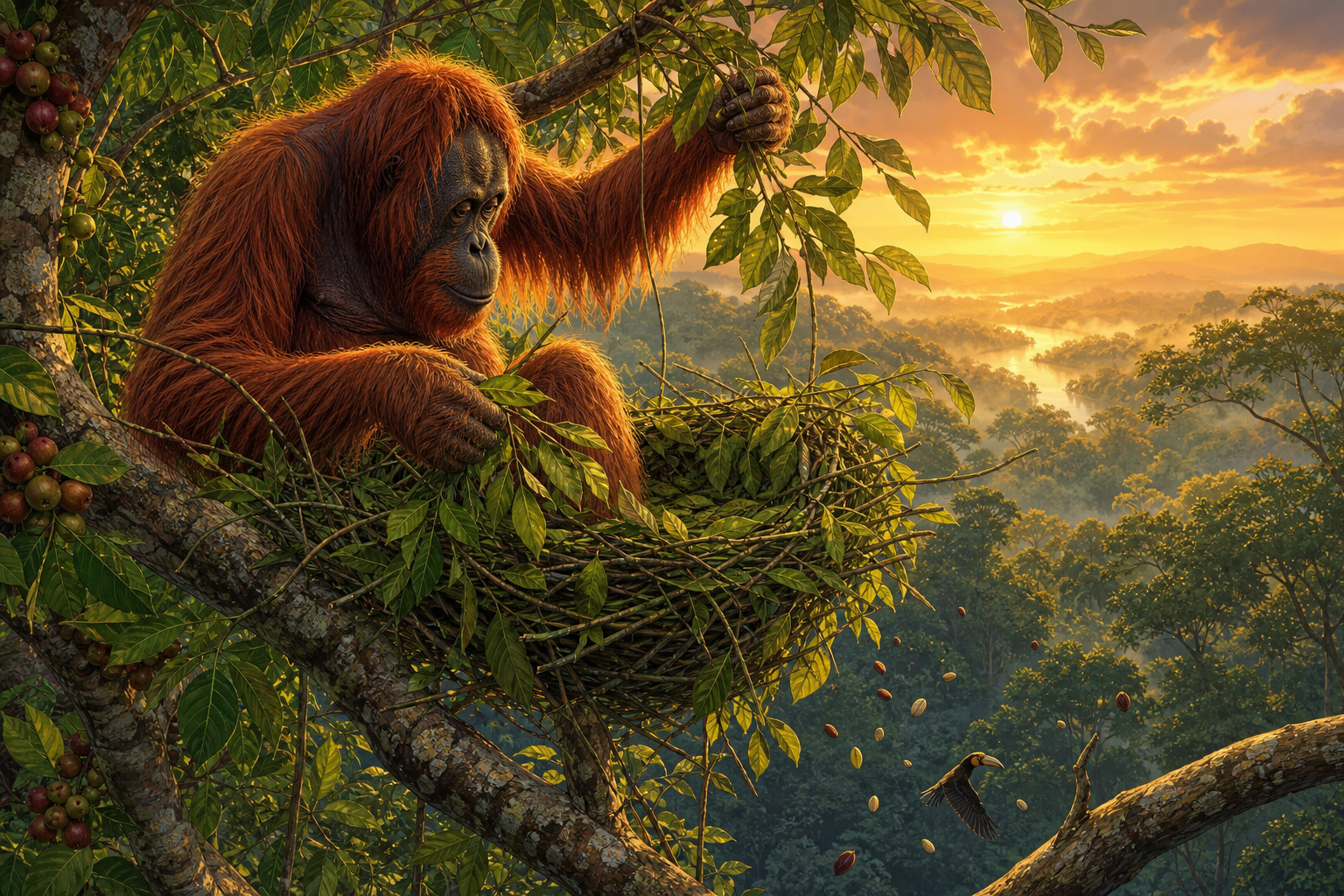
Imagine looking up through warm rainforest air and spotting a huge, shaggy, reddish-brown shape moving through the leaves. A branch trembles. Leaves rustle. Then the Bornean orangutan settles down and starts bending leafy twigs together. It is making a bed—high above the ground.
Each evening, an orangutan builds a sleeping nest from branches and leaves, then makes another new one the next day. Think of it as a fresh, green tree-house mattress, except the builder has long, powerful arms and no need for an instruction booklet. This is one reason an orangutan is such an amazing neighbour of the canopy.
The Bornean orangutan is a great ape called Pongo pygmaeus. Its name means “person of the forest,” a fitting idea when you watch how carefully it travels, chooses food, and fashions a cosy place to sleep. It is not a person, of course—but it is a clever animal with its own busy forest life.
Evidence: IUCN Red List of Threatened Species: Pongo pygmaeus (Bornean Orangutan) — Red List Assessment; World Wildlife Fund (WWF): Bornean Orangutan — Species Profile; Wikipedia: Bornean orangutan; Orangutan Foundation International: Orangutan Behavior; Orangutan Foundation International: Orangutan Ecology
Who is the biggest tree-liver around?
Bornean orangutans are the largest animals that live up in the trees. Adults are roughly 1 to 1.4 metres tall, and their weight varies greatly, from about 30 to 100 kilograms. That is a lot of ape to balance among branches! Their long arms, strong hands, and shaggy fur help them belong in this leafy world.
They live on the island of Borneo, in Indonesian Kalimantan and the Malaysian states of Sabah and Sarawak. Their home is not one giant unbroken jungle. Orangutan populations are spread across separate forest areas, which makes keeping remaining forest connected especially important.
A Bornean rainforest can include lowland forest, peat-swamp forest, tropical-heath forest, and mixed dipterocarp forest. Some places are steamy and low; others climb toward mistier slopes. Wherever an orangutan goes, fruit-rich trees are especially valuable. No fruit buffet, no easy day.
Evidence: World Wildlife Fund (WWF): Bornean Orangutan — Species Profile; Wikipedia: Bornean orangutan; Orangutan Foundation International: Orangutan Ecology; Orangutan Foundation International: Orangutan Behavior
What is on an orangutan’s menu? Mostly forest snacks.
When the sun is up, Bornean orangutans spend much of their day foraging and travelling through the canopy. Ripe fruit is the star of the menu. Figs and durians are among the tempting treats, while young leaves, flowers, bark, vines, shoots, seeds, honey, and insects can fill in the gaps when food availability changes.
So, are they fruit specialists or omnivores? The simplest answer is: fruit is their main food, and they also eat a changing mix of other forest foods, including insects. A rainforest does not serve the same lunch every day. An orangutan has to remember where food trees are and make smart choices as seasons shift.
Sometimes orangutans use simple tools, such as sticks, but tool traditions differ among groups. It is best not to imagine every orangutan doing exactly the same thing. Each forest neighbourhood can have its own ways of getting by—rather like people having different favourite ways to eat corn on the cob.
Evidence: Orangutan Foundation International: Orangutan Ecology; Orangutan Foundation International: Orangutan Behavior; Wikipedia: Bornean orangutan
One ape, many lessons from Mum
You might picture apes living in a noisy troop all day. Bornean orangutans are different: they are semi-solitary, meaning they do not permanently live in big groups. They may gather temporarily where fruit is plentiful, but much of the time they travel on their own.
A mother and her dependent young, though, share a close and important partnership for a long time. The young orangutan learns by watching and following: which foods are good, how to move through trees, and how to build a night nest. Those lessons are not quick. In a complicated forest, knowing what to do can matter enormously.
Their fruit eating also helps the forest. As orangutans carry fruit and move or spit out seeds, they help spread seeds through the landscape. In that way, a hungry ape can help new plants get started. The forest feeds the orangutan, and the orangutan helps the forest keep growing: a wonderfully tangled teamwork.
Evidence: Orangutan Foundation International: Orangutan Behavior; Orangutan Foundation International: Orangutan Ecology; Wikipedia: Bornean orangutan
Why does this quiet forest neighbour need our help?
The IUCN lists the Bornean orangutan as Critically Endangered, with a decreasing population. A 2024 assessment cited an estimate of about 104,700 individuals in the wild. That estimate is not a headcount made in one afternoon—thank goodness, because counting hidden canopy apes would be very tricky—but it tells us this species needs serious care.
Their greatest troubles include forest loss and fragmentation from logging, fire, and land conversion. Hunting, conflict killings, and capture for the pet trade also threaten them. When forests are broken into isolated pieces, it can be harder for orangutans to move between food trees and for populations to stay connected.
There is hope with action. Protecting and reconnecting forest, preventing fires, stopping illegal killing, enforcing wildlife-trade laws, and supporting ways for communities to manage forests can all address these pressures. Helping an orangutan does not only mean helping one fuzzy face in one tree. It means caring for a living forest home full of roots, seeds, insects, birds, and shade.
Evidence: IUCN Red List of Threatened Species: Pongo pygmaeus (Bornean Orangutan) — Red List Assessment; World Wildlife Fund (WWF): Bornean Orangutan — Species Profile; Orangutan Foundation International: Orangutan Ecology
A small promise from far away
Most of us will never need to swing across Borneo on arms longer than a sofa is wide. But we can practise noticing that forests are homes, not empty spaces. Learn about wildlife protection, support trustworthy conservation efforts with your family if you can, and share what you discover with a friend. Curiosity can travel a long way.
Here is another gentle choice to explore at the table. Meals built around foods such as fruit, vegetables, whole grains, pulses, nuts, and seeds can be part of a varied healthy diet. Choosing more plant-based meals can also help reduce pressure from food systems on land, biodiversity, and climate. It is not about judging anyone’s family dinner; it is about trying kind, tasty possibilities together with a trusted adult.
Perhaps start with a question: “Could we make one colourful plant-powered meal this week?” A bean burrito, lentil soup, noodle bowl with vegetables, or fruit-and-oat snack might do nicely. While we eat, we can remember the orangutan’s rainforest menu—and wish this great tree-dweller plenty of safe, fruit-filled branches.
Evidence: World Health Organization: Healthy diet; Intergovernmental Panel on Climate Change: Climate Change 2022: Mitigation of Climate Change — Chapter 7; IUCN Red List of Threatened Species: Pongo pygmaeus (Bornean Orangutan) — Red List Assessment
Kind choices can begin with a curious bite
Orangutans mostly search for fruit and other plant foods in their forest home. We can let that spark our own curiosity: what colourful plant foods might we enjoy today? WHO guidance includes vegetables, fruit, whole grains, pulses, nuts, and seeds as parts of a varied healthy diet.
More plant-based, sustainable eating patterns can lower food-system emissions and reduce pressure on land and biodiversity, according to the IPCC. With a parent, carer, or another trusted adult, trying a plant-based meal can be one small, cheerful way to put care for animals and forests into practice.
Evidence: World Health Organization: Healthy diet; Intergovernmental Panel on Climate Change: Climate Change 2022: Mitigation of Climate Change — Chapter 7; Orangutan Foundation International: Orangutan Ecology
Questions people ask
Why do orangutans make a new nest so often?
They build leafy sleeping nests in the trees and usually create a new one for the next night. A fresh nest gives them a place to rest high in their forest home.
Evidence: Orangutan Foundation International: Orangutan Behavior; Wikipedia: Bornean orangutan
Do Bornean orangutans live only in one kind of forest?
No. They use several Bornean rainforest habitats, including lowland, peat-swamp, tropical-heath, and mixed dipterocarp forests. Fruit availability strongly affects where they can thrive.
Evidence: World Wildlife Fund (WWF): Bornean Orangutan — Species Profile; Orangutan Foundation International: Orangutan Ecology
What can protect Bornean orangutans?
Safeguarding and reconnecting forest, preventing fires, stopping illegal killing and wildlife trade, and supporting community-compatible forest management all help tackle the main threats.
Evidence: IUCN Red List of Threatened Species: Pongo pygmaeus (Bornean Orangutan) — Red List Assessment; World Wildlife Fund (WWF): Bornean Orangutan — Species Profile
Read the evidence
Sources behind this story
- Pongo pygmaeus (Bornean Orangutan) — Red List Assessment — IUCN Red List of Threatened Species
- Bornean Orangutan — Species Profile — World Wildlife Fund (WWF)
- Bornean orangutan — Wikipedia
- Orangutan Behavior — Orangutan Foundation International
- Orangutan Ecology — Orangutan Foundation International
- Healthy diet — World Health Organization
- Climate Change 2022: Mitigation of Climate Change — Chapter 7 — Intergovernmental Panel on Climate Change
Health information is general education, not personal medical advice. Young readers should make food choices with a trusted adult and qualified health professional.