Today's animal friend · 9 October 2026
Blue Whale: The Ocean’s Giant Whisperer
Imagine the biggest animal known to have lived slipping through dark-blue water, then opening its enormous mouth for a meal of creatures smaller than your finger.
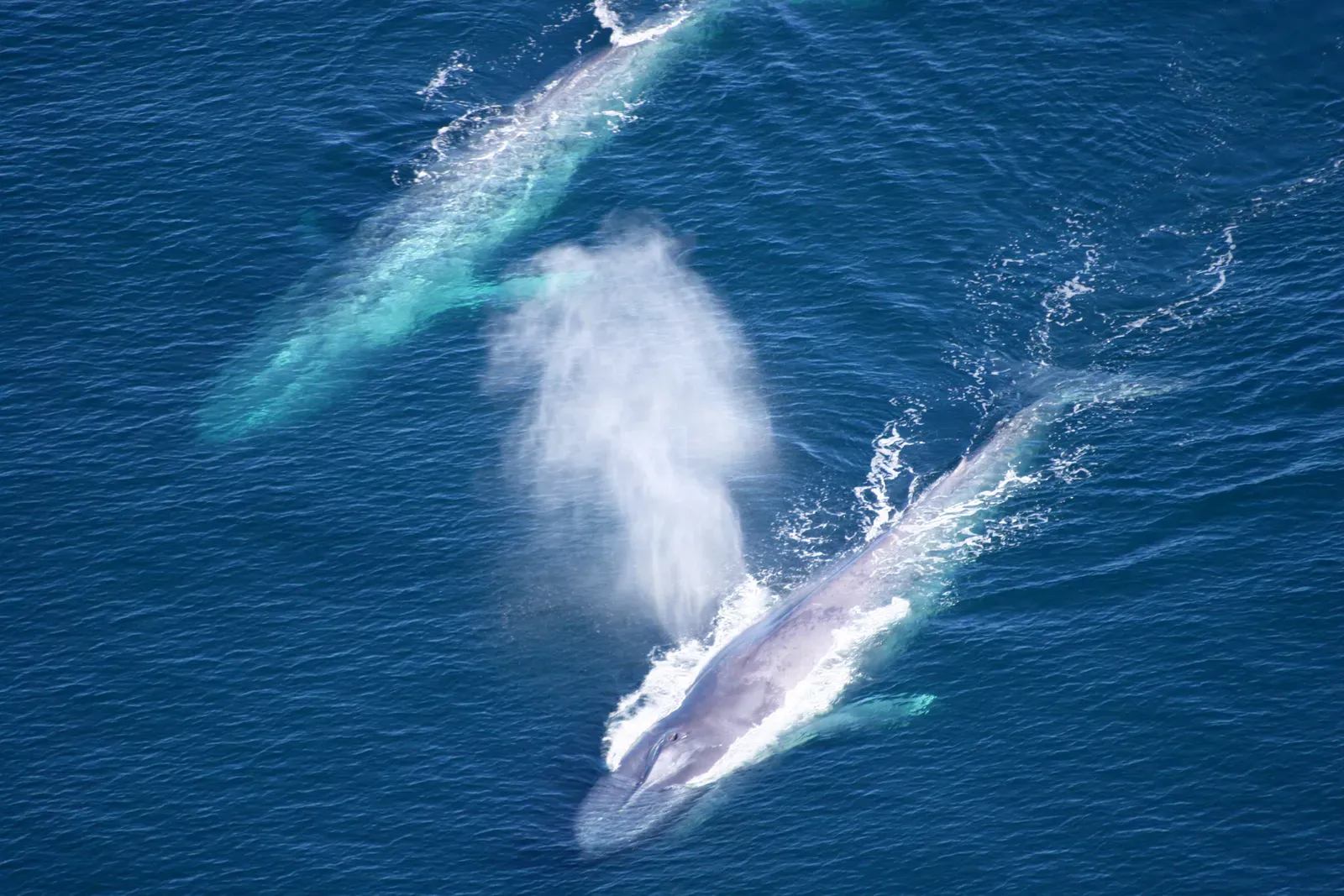
Imagine the biggest animal known to have lived slipping through dark-blue water, then opening its enormous mouth for a meal of creatures smaller than your finger.
A shadow bigger than a bus
Picture a cold, bright ocean morning. The waves are wrinkled like a rumpled blanket. Then a smooth blue-grey back rises beside them, followed by a breathy blow of air. Whoosh! For a moment, the sea seems to have grown a moving island.
This is a blue whale, Balaenoptera musculus: the largest animal known to have ever lived on Earth. Adults can reach roughly 24 to 30 metres long and weigh about 100,000 to 130,000 kilograms. That is a truly spectacular amount of whale—less “pet fish” and more “floating school bus with a tail.”
Yet a blue whale is not a scary sea monster. It is a mammal, like us, breathing air at the surface before diving back into its watery world. Its huge tail sweeps up and down, helping its long body glide through the ocean.
Evidence: IUCN Red List of Threatened Species: Balaenoptera musculus (Blue Whale) — IUCN Red List Assessment; NOAA Fisheries: Blue Whale | NOAA Fisheries; Wikipedia: Blue whale
How can a giant eat something so tiny?
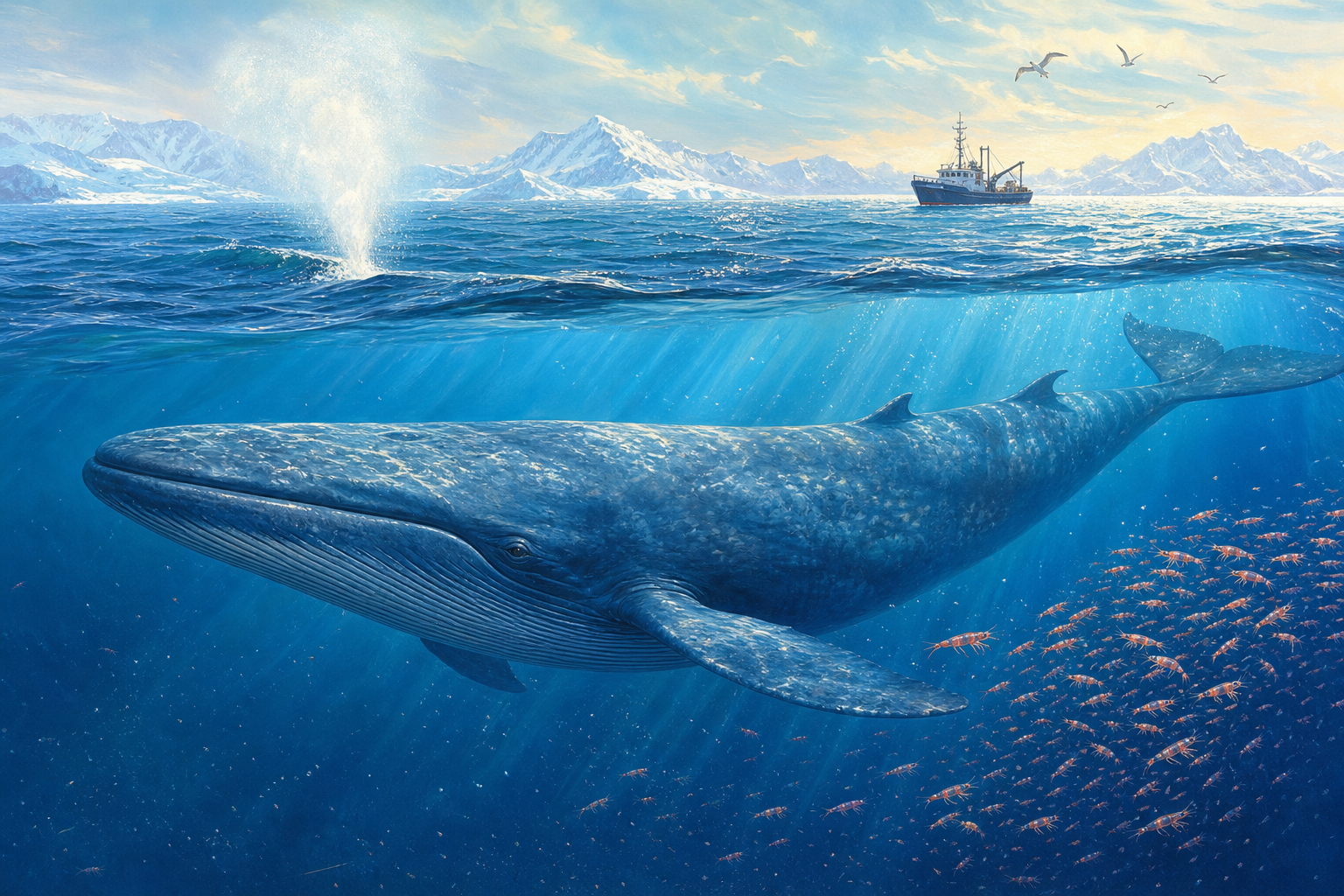
Here comes one of nature’s funniest surprises: this enormous whale feeds almost entirely on krill. Krill are tiny, shrimp-like animals. A blue whale’s favourite snack is so small that you might miss it in a scoop of seawater.
The whale opens its mouth around a crowded patch of krill and water. Then it presses the water back out. Instead of teeth, it has baleen: stiff, comb-like plates that work like a very giant strainer. Water slips away, while krill stay inside for the whale to swallow.
That means a blue whale is a filter-feeder. It does not chase dinner one krill at a time—thank goodness, because that would take forever. By feeding where krill are plentiful, blue whales link tiny plankton-powered ocean life with the much larger animals higher in the food web.
Evidence: NOAA Fisheries: Blue Whale | NOAA Fisheries; IUCN Red List of Threatened Species: Balaenoptera musculus (Blue Whale) — IUCN Red List Assessment; Wikipedia: Blue whale
A voice that can cross a watery world
The ocean can look quiet from a boat, but beneath the waves it can be full of sound. Blue whales make deep, low calls—pulses, groans, and moans. They are among the loudest animals on the planet.
Their calls can travel hundreds of kilometres through seawater, reaching other whales far away. Imagine trying to call a friend across a whole country, except your message travels underwater and sounds like a deep musical rumble. The exact job of every call is not simple; whales may use sounds in different ways. But the calls help make a vast ocean feel a little less empty.
Blue whales are often seen alone or in pairs. Where feeding is especially good, small temporary groups can gather. It is less like a permanent whale club and more like several hungry neighbours noticing the same excellent picnic spot.
Evidence: NOAA Fisheries: Blue Whale | NOAA Fisheries; Wikipedia: Blue whale
Where does a blue whale go?
Blue whales occur in all the major oceans except the Arctic. They live in the Pacific, Atlantic, Indian, and Southern oceans, travelling through open water and polar seas. But “all over the world” does not mean they are everywhere in equal numbers. Different populations use different places and may follow different seasonal routes.
Many blue whales feed in productive colder waters at high latitudes, where krill can be abundant. Some then make long seasonal journeys towards lower-latitude waters in winter. Think of it as travelling between a giant seasonal restaurant and another part of the ocean—but each whale population has its own map.
A blue whale can live for around 80 to 90 years. That is long enough for one whale to experience many changing ocean seasons, many journeys, and perhaps many far-away calls from other blue whales.
Evidence: NOAA Fisheries: Blue Whale | NOAA Fisheries; Wikipedia: Blue whale; IUCN Red List of Threatened Species: Balaenoptera musculus (Blue Whale) — IUCN Red List Assessment
Why does the biggest animal need help?
Blue whales are globally listed as Endangered. Long ago, commercial whaling caused a terrible crash in their numbers. Protection has helped, and the global population is thought to be increasing overall. That is hopeful news—but recovery is not finished, and it differs from place to place.
Today, a whale can still be harmed by a collision with a vessel or by becoming entangled in fishing gear. Ocean noise, pollution, damaged habitat, and climate change are also concerns. A giant body does not make an animal invincible. Even the biggest creature on Earth needs a safer route through its home.
People are working on whale-safer shipping, reducing the chance of entanglement, helping injured or entangled whales, lowering underwater noise, and monitoring populations. These efforts are like putting up better road signs, quiet zones, and rescue teams in a world made mostly of water.
Evidence: IUCN Red List of Threatened Species: Balaenoptera musculus (Blue Whale) — IUCN Red List Assessment; NOAA Fisheries: Blue Whale: Conservation Management
Try a blue-whale-sized kind thought
You do not need to sail across the Southern Ocean to care about blue whales. Start by noticing that ocean life is connected: tiny krill, giant whales, busy ships, fishing gear, and people on land all share one planet.
You could draw a blue whale and label its baleen, tail, and blowhole. You could ask a library for a book about ocean conservation. Or, when your family chooses meals, you might suggest trying a tasty plant-based dish together—perhaps beans, lentils, vegetables, whole grains, fruit, nuts, or seeds. Curiosity belongs at the table too.
One meal cannot solve every ocean problem, and nobody needs to be perfect. But choosing more plant-based foods can be a kind, practical way to care for animals and the planet while enjoying a varied diet. Ask a trusted adult if you want to explore new foods.
Evidence: World Health Organization: Healthy diet; Intergovernmental Panel on Climate Change: Climate Change 2022: Mitigation of Climate Change — Chapter 7; NOAA Fisheries: Blue Whale: Conservation Management
A gentler choice, from lunchbox to ocean
Caring about a blue whale can begin with a simple thought: every animal has a life that matters, whether it is a tiny krill drifting in the sea or a giant whale calling through the deep. We can meet that thought with kindness rather than with worry.
The World Health Organization describes healthy diets in general as varied and rich in foods such as whole grains, vegetables, fruit, pulses, nuts, and seeds. The IPCC reports that shifts toward sustainable, healthy, more plant-based diets can reduce food-system emissions and pressure on land and biodiversity. So a colourful plant-forward meal can be one small, cheerful choice for animals and the shared home we all depend on.
Trying a vegan meal does not have to be a grand announcement. It might be a lentil soup, a bean burrito, or a favourite vegetable dish shared with family. Let curiosity lead, be kind to yourself and others, and talk with a trusted adult about food choices that suit you.
Evidence: World Health Organization: Healthy diet; Intergovernmental Panel on Climate Change: Climate Change 2022: Mitigation of Climate Change — Chapter 7
Questions people ask
Is a blue whale a fish?
No. A blue whale is a mammal. It breathes air at the surface and belongs to the baleen-whale family Balaenopteridae.
Evidence: NOAA Fisheries: Blue Whale | NOAA Fisheries; Wikipedia: Blue whale
Do blue whales really eat krill?
Yes. Blue whales feed almost exclusively on krill. They take in water and krill, then strain the water out through baleen plates.
Evidence: NOAA Fisheries: Blue Whale | NOAA Fisheries
Are blue whales always travelling in groups?
Usually, blue whales are seen alone or in pairs. Small temporary groups can form when lots of food is gathered in one place.
Evidence: NOAA Fisheries: Blue Whale | NOAA Fisheries
Are blue whales safe now?
They are protected in many ways and their global numbers are increasing overall, but they remain Endangered. Ship strikes, fishing-gear entanglement, ocean noise, pollution, habitat damage, and climate change remain concerns.
Evidence: IUCN Red List of Threatened Species: Balaenoptera musculus (Blue Whale) — IUCN Red List Assessment; NOAA Fisheries: Blue Whale: Conservation Management
Read the evidence
Sources behind this story
- Balaenoptera musculus (Blue Whale) — IUCN Red List Assessment — IUCN Red List of Threatened Species
- Blue Whale | NOAA Fisheries — NOAA Fisheries
- Blue whale — Wikipedia
- Blue Whale: Conservation Management — NOAA Fisheries
- Healthy diet — World Health Organization
- Climate Change 2022: Mitigation of Climate Change — Chapter 7 — Intergovernmental Panel on Climate Change
Health information is general education, not personal medical advice. Young readers should make food choices with a trusted adult and qualified health professional.