Today's animal friend · 15 September 2026
The Garden Visitor With a Blue Surprise
A quiet rustle beneath a log can become a bright-blue lesson in surprising predators, sharing gardens, and giving wild neighbours room to roam.
A quiet rustle beneath a log can become a bright-blue lesson in surprising predators, sharing gardens, and giving wild neighbours room to roam.
Wait—was that a tiny dragon in the leaves?
On a warm day, dry leaves may whisper in an Australian garden. Something smooth and shiny nudges through the ground cover on short legs. It pauses in a sunlit patch, then heads towards a log or a clump of grass. Was that a tiny dragon? Not quite—but it was certainly a remarkable garden visitor.
Meet the blue-tongued skink, Tiliqua scincoides: a sturdy lizard in the skink family. Its long, rounded body and short legs give it a determined-looking waddle, as though it has an important appointment with a shady hiding place—or perhaps a snail.
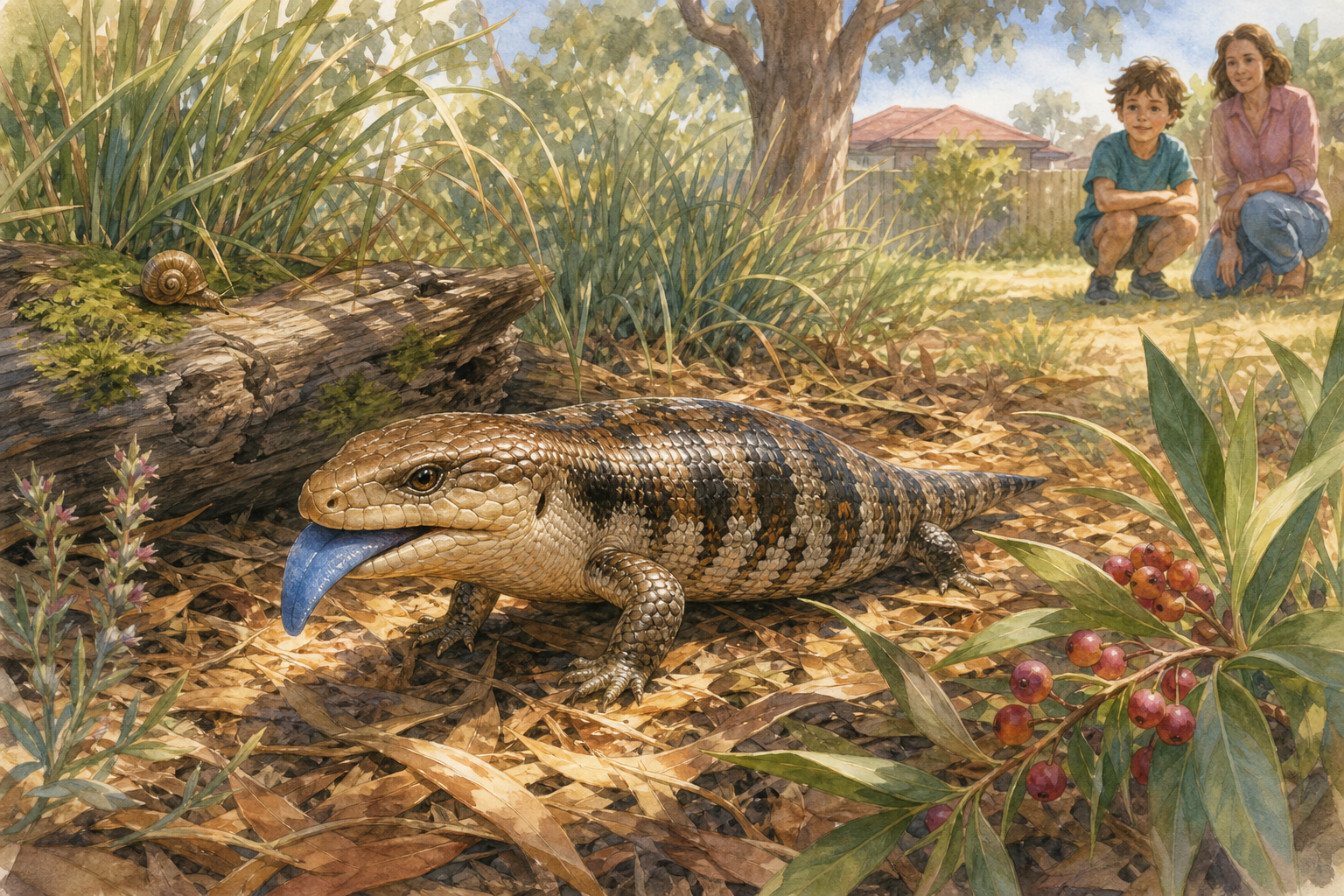
This species occurs in eastern and northern Australia, and a recognised form lives on Indonesia’s Tanimbar Islands. It uses open country, woodland, grassland and scrub. Eastern blue-tongues can also make homes in sheltered suburban gardens. At skink height, a log is a roof, tussock grass is a hallway, and leaf litter is both blanket and hiding place.
Evidence: Animal Diversity Web, University of Michigan Museum of Zoology: Tiliqua scincoides (Common Bluetongue, Eastern Bluetongue, Northern Bluetongue, Eastern Blue-Tongued Lizard); The Australian Museum: Eastern Blue-tongue Lizard; Wikipedia: Tiliqua scincoides
The tongue trick: a blue flag that says “Back off!”
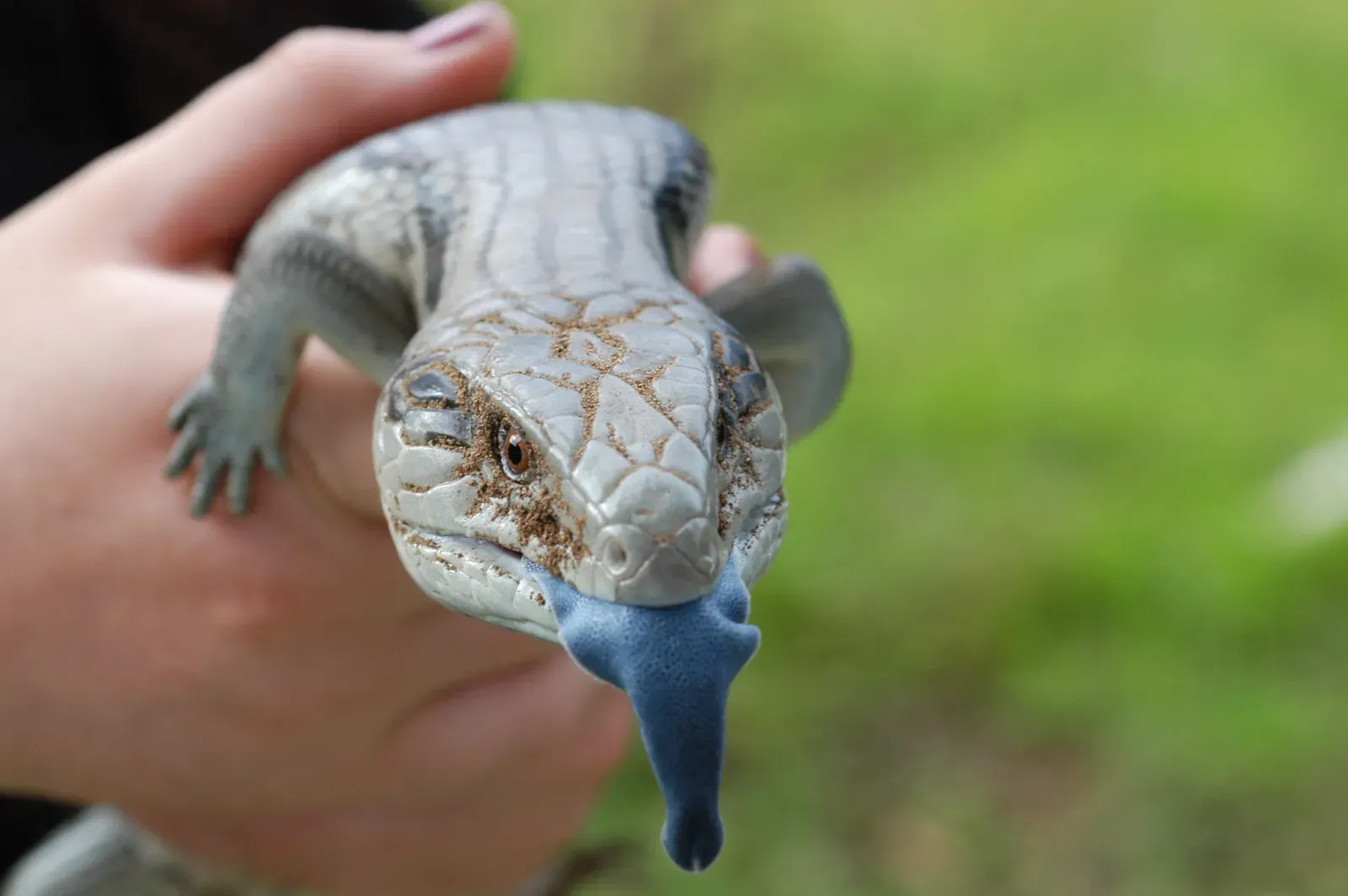
A blue-tongued skink often keeps close to shelter and would rather avoid a fuss. But when it feels threatened, this calm-looking reptile has a truly memorable stage trick. It can open its mouth wide, flash its bright blue tongue, puff up its body and hiss.
Imagine being a predator expecting an ordinary brownish lizard, then suddenly seeing a mouthful of dazzling blue. The surprise, combined with the skink’s bigger-looking body, may persuade the threat to move along. This display is designed to prevent a fight, not start one.
The blue tongue does not mean the skink is venomous. It is a dramatic warning. If you spot one, be a kind audience: stay calm, keep your distance, and leave it a clear route to cover. A skink that never has to perform its big blue show is having a safer day.
Evidence: Animal Diversity Web, University of Michigan Museum of Zoology: Tiliqua scincoides (Common Bluetongue, Eastern Bluetongue, Northern Bluetongue, Eastern Blue-Tongued Lizard); The Australian Museum: Eastern Blue-tongue Lizard; Wikipedia: Tiliqua scincoides
What is on a skink’s slow-food menu?
Blue-tongued skinks are daytime omnivores. During warmer parts of the day, they bask to warm themselves and then forage along the ground. Their meals include plant material and slow-moving animal prey, such as insects and snails. Flowers, fruits and berries can also be on the menu.
That is a mixed picnic, not a single favourite food. In gardens, eastern blue-tongues may eat snails, slugs and other invertebrates. They are not little gardeners hired for pest control, of course. They are wild animals following their senses and searching for lunch. Still, their feeding is one small thread in the busy web of soil, plants, insects and animals around a home.
Sunshine matters, too. Reptiles gain warmth from their surroundings, so a sunny patch can be an important warm-up stop before exploring. Think of a solar-powered adventurer: no batteries or charging cable, just a careful bask and a slow stroll through the leaves.
Evidence: Animal Diversity Web, University of Michigan Museum of Zoology: Tiliqua scincoides (Common Bluetongue, Eastern Bluetongue, Northern Bluetongue, Eastern Blue-Tongued Lizard); The Australian Museum: Eastern Blue-tongue Lizard; Wikipedia: Tiliqua scincoides
Small legs, a whole world to explore
An Animal Diversity Web account gives averages of about 33 centimetres in total length and about 493 grams in mass, though blue-tongued skinks vary with age, sex and form. Averages are not rules: each skink is its own particular size and shape.
They are described as shy and secretive, usually staying near shelter. In a world seen just above the ground, that makes perfect sense. A rock can be a cool hideout. Long grass can be a green tunnel. A heap of leaves is not simply untidiness—it may be a crinkly camouflage blanket.
A garden can become an adventure map: a route from a safe hiding place to a basking patch, then towards a possible snack among plants and leaf litter. Looking closely at a familiar backyard can reveal secret paths that were there all along.
Evidence: Animal Diversity Web, University of Michigan Museum of Zoology: Tiliqua scincoides (Common Bluetongue, Eastern Bluetongue, Northern Bluetongue, Eastern Blue-Tongued Lizard); The Australian Museum: Eastern Blue-tongue Lizard
A surprising family arrival
Many reptiles lay eggs, but reptiles are a wonderfully varied group. Eastern and northern blue-tongued skinks give birth to live young rather than laying eggs. Reported litters can contain from 5 to 24 young skinks.
That sounds like a very busy beginning for a family. The young are ready to begin looking after themselves soon after birth. It is a reminder not to assume every reptile, bird or mammal follows exactly the same family pattern.
Researchers do not yet have every detail about the usual social spacing and interactions of this species in the wild. That is not a reason to make up an answer. It is an invitation to stay curious, observe respectfully, and protect the places where animals can continue teaching us.
Evidence: Animal Diversity Web, University of Michigan Museum of Zoology: Tiliqua scincoides (Common Bluetongue, Eastern Bluetongue, Northern Bluetongue, Eastern Blue-Tongued Lizard); Wikipedia: Tiliqua scincoides
How can a backyard become a safer skink neighbourhood?
At species level, the blue-tongued skink is recorded as Least Concern on the IUCN Red List. That is encouraging, but one broad category cannot tell the story of every place or form of the species. Individual eastern blue-tongues living near people can still meet serious everyday hazards.
In settled areas, documented dangers include road traffic, lawn mowers, and secondary poisoning after a skink eats snails or slugs exposed to bait or pesticides. Happily, kindness can be practical. Keep safe ground shelter, check long grass before mowing, reduce harmful snail bait and pesticide use, and watch for basking lizards on roads and driveways.
You do not need to touch a skink to be its friend. Space is a gift. If one appears near a driveway or road, tell a trusted adult. Watch quietly from a respectful distance, let the animal choose its own path, and leave its little wild world beautifully wild.
Evidence: IUCN Red List of Threatened Species: Tiliqua scincoides (Eastern Blue-tongued Lizard) — Red List Assessment; Wikipedia: Tiliqua scincoides; The Australian Museum: Eastern Blue-tongue Lizard
One gentle choice can ripple outward
A blue-tongued skink’s day is made of small things: a sunny patch, a safe log, a quiet path through leaves and food found close to the ground. Our choices are connected to small things too, especially the food we eat and the spaces we share with other animals.
Meals built around vegetables, fruit, whole grains, pulses, nuts and seeds can be colourful and satisfying. The World Health Organization includes these foods in its general healthy-diet guidance. If your family is curious about more plant-based or vegan meals, turn it into an adventure with a trusted adult: bean tacos, lentil soup, or fruit and oats for breakfast can be delicious starting points. A qualified health professional can help with individual food needs.
Choosing more plant-based foods can also be a caring step for the planet. The IPCC reports that shifts toward sustainable, healthy, more plant-based diets can reduce food-system emissions and pressure on land and biodiversity. Nobody has to be perfect. A thoughtful meal, a safer garden corner, and a pause for a waddling neighbour can all make more room for other lives beside our own.
Evidence: World Health Organization: Healthy diet; Intergovernmental Panel on Climate Change: Climate Change 2022: Mitigation of Climate Change — Chapter 7; The Australian Museum: Eastern Blue-tongue Lizard
Questions people ask
Why is its tongue blue?
When frightened, a blue-tongued skink can gape, show its bright blue tongue, puff up and hiss. This surprise display may discourage a predator from coming closer.
Evidence: Animal Diversity Web, University of Michigan Museum of Zoology: Tiliqua scincoides (Common Bluetongue, Eastern Bluetongue, Northern Bluetongue, Eastern Blue-Tongued Lizard); Wikipedia: Tiliqua scincoides
Do blue-tongued skinks live only in wild places?
No. They use open country, woodland, grassland and scrub. Eastern blue-tongues can also adapt to sheltered suburban gardens with useful ground cover.
Evidence: The Australian Museum: Eastern Blue-tongue Lizard; Animal Diversity Web, University of Michigan Museum of Zoology: Tiliqua scincoides (Common Bluetongue, Eastern Bluetongue, Northern Bluetongue, Eastern Blue-Tongued Lizard)
What should I do if I find one?
Watch quietly from a distance and give it a clear path to shelter. Never try to make it show its tongue. If it is near a road or driveway, tell a trusted adult.
Evidence: The Australian Museum: Eastern Blue-tongue Lizard; Animal Diversity Web, University of Michigan Museum of Zoology: Tiliqua scincoides (Common Bluetongue, Eastern Bluetongue, Northern Bluetongue, Eastern Blue-Tongued Lizard)
Do they lay eggs?
Eastern and northern blue-tongued skinks are reported to give birth to live young rather than laying eggs.
Evidence: Wikipedia: Tiliqua scincoides; Animal Diversity Web, University of Michigan Museum of Zoology: Tiliqua scincoides (Common Bluetongue, Eastern Bluetongue, Northern Bluetongue, Eastern Blue-Tongued Lizard)
Read the evidence
Sources behind this story
- Tiliqua scincoides (Eastern Blue-tongued Lizard) — Red List Assessment — IUCN Red List of Threatened Species
- Tiliqua scincoides (Common Bluetongue, Eastern Bluetongue, Northern Bluetongue, Eastern Blue-Tongued Lizard) — Animal Diversity Web, University of Michigan Museum of Zoology
- Tiliqua scincoides — Wikipedia
- Eastern Blue-tongue Lizard — The Australian Museum
- Healthy diet — World Health Organization
- Climate Change 2022: Mitigation of Climate Change — Chapter 7 — Intergovernmental Panel on Climate Change
Health information is general education, not personal medical advice. Young readers should make food choices with a trusted adult and qualified health professional.