Today's animal friend · 14 September 2026
Blue Mussel: The Tiny Shore Builder Who Hangs On Through the Splash
At low tide, a blue-black crowd on a rock may look still as buttons. Look closer: these mussels are expert anchors, careful filter-feeders, and builders of shelter for many small seaside neighbours.
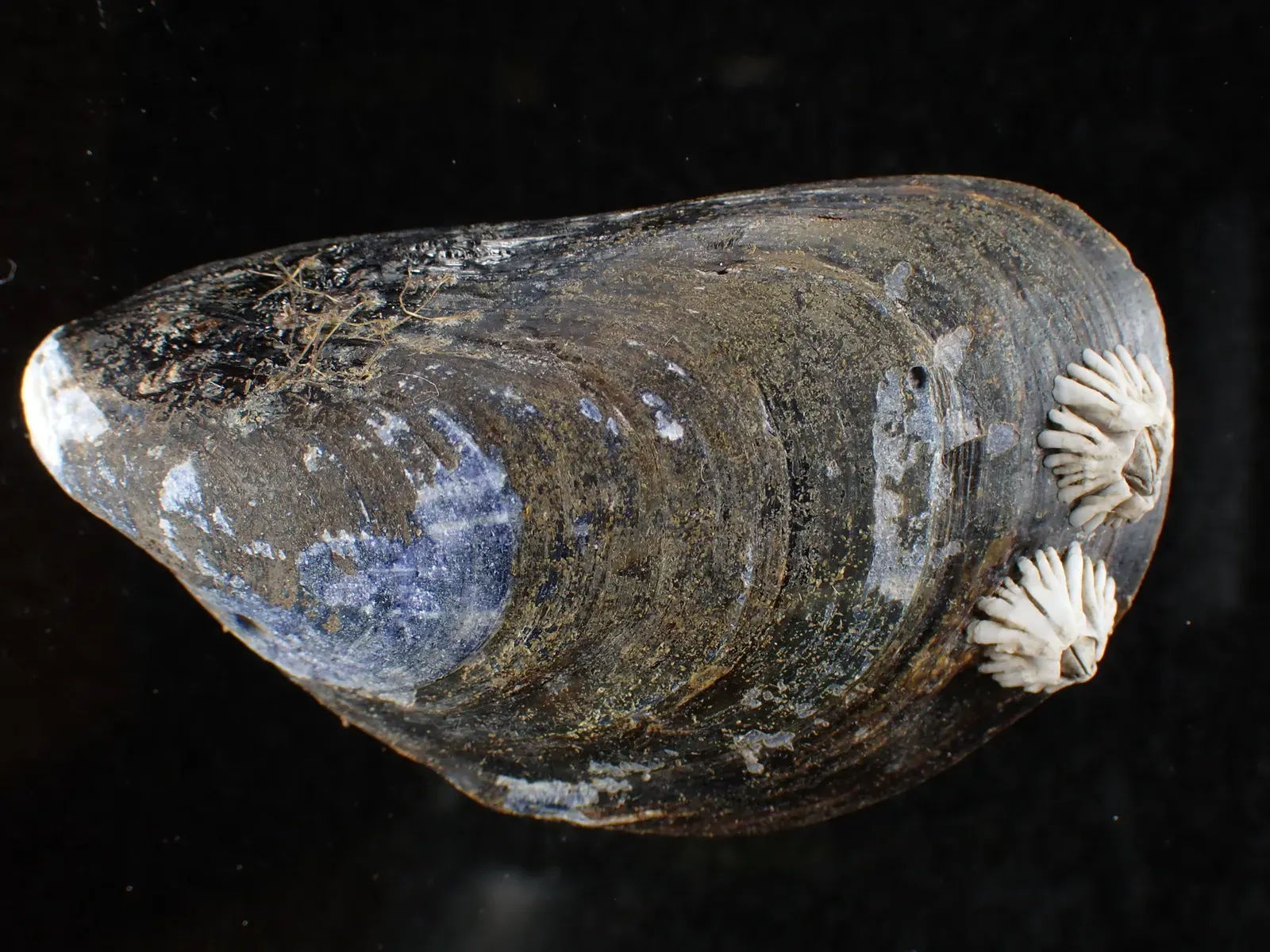
At low tide, a blue-black crowd on a rock may look still as buttons. Look closer: these mussels are expert anchors, careful filter-feeders, and builders of shelter for many small seaside neighbours.
A rock that seems to be wearing a blue-black coat
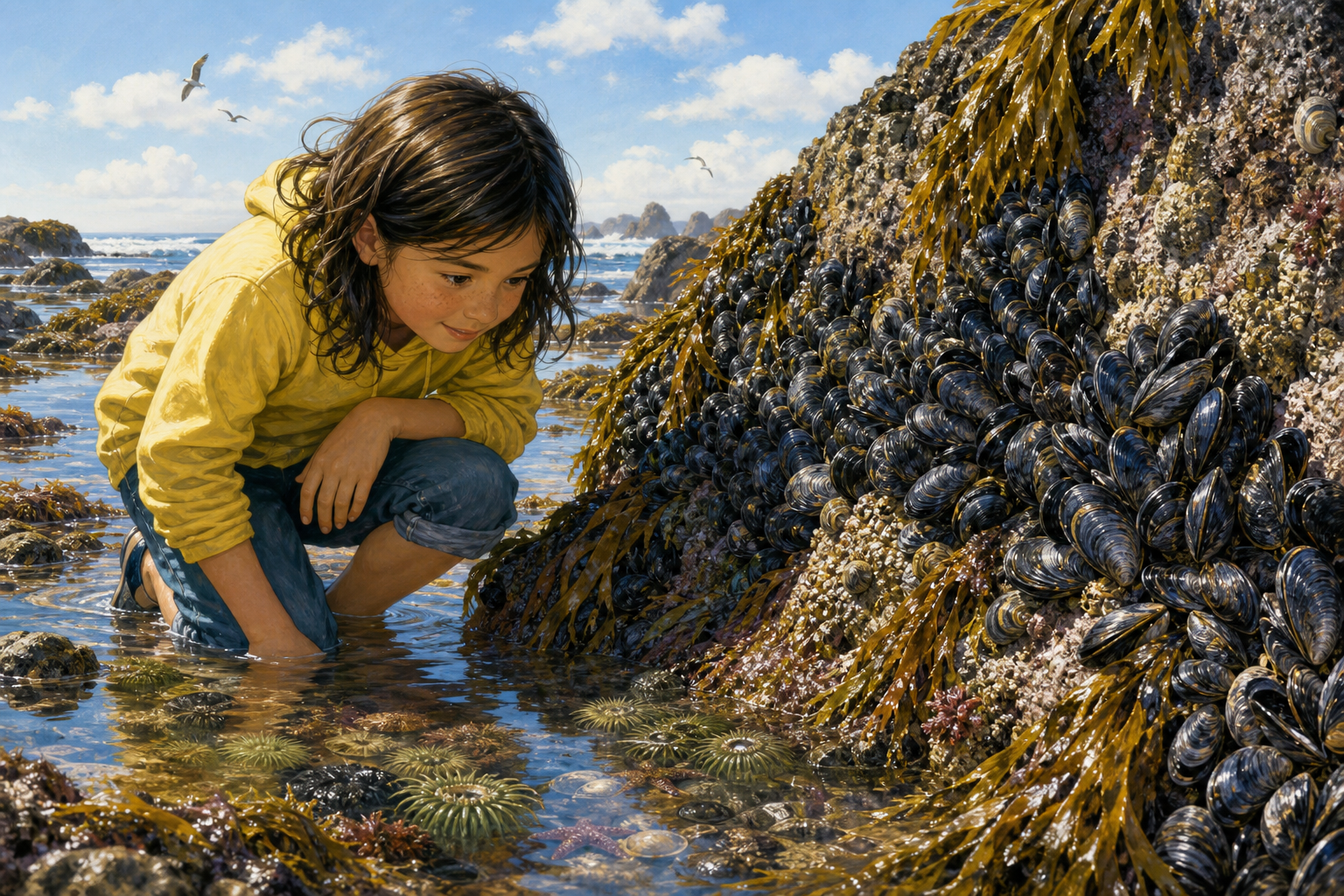
The tide has slipped away, leaving puddles that wobble in the sunlight. Waves go shhhhhh behind you. On a slippery rock, you spot a crowded patch of smooth, dark shells. At first they look like a pile of small, shiny pebbles—or perhaps the rock has dressed itself in a very fancy blue-black jacket.
But this is a living neighbourhood of blue mussels, also called common mussels. The scientific name for this particular animal is Mytilus edulis. It is a mollusc and a bivalve, which means its soft body lives inside two matching shell halves. Those shells can close like a protective little door when conditions are rough.
Blue mussels live on cool North Atlantic coasts around Europe and North America. You may find them where the sea meets the land: on rocky shores, in the intertidal zone that is covered and uncovered by tides, and in shallow coastal water. They can also attach to human-made surfaces such as piers or ropes. A fully grown shell may reach about 10 centimetres, though size changes with the place a mussel lives. Tiny? Yes. Ordinary? Not even slightly.
Evidence: IUCN Red List of Threatened Species: Mytilus edulis — IUCN Red List (no assessment found); MarLIN — The Marine Life Information Network (Marine Biological Association): Common mussel (Mytilus edulis) — Biology and Sensitivity Review; Wikipedia: Blue mussel
How does a mussel avoid being whooshed away?
Imagine trying to stay on a wet playground slide while someone sprays it with a hose. That is something like life on a wave-bashed rock. A blue mussel usually stays put, yet it does not use hands, glue sticks, or a tiny seat belt.
Instead, it uses a body part called a foot to make strong, silk-like threads called byssus. The threads fasten the mussel to rock and can fasten mussels to one another. They are tough little anchors, helping the animal hold on while water surges and splashes around it.
Being attached is not the same as being helpless. A mussel can adjust its attachment, and it opens its shell when conditions suit feeding. During exposure or stress, it can close its shell. Picture a patient neighbour quietly shutting the windows when the weather turns wild. That calm, close-up life is still full of decisions: hold tight, open a little, close again, wait for the sea.
Evidence: MarLIN — The Marine Life Information Network (Marine Biological Association): Common mussel (Mytilus edulis) — Biology and Sensitivity Review; Wikipedia: Blue mussel; IUCN Red List of Threatened Species: Mytilus edulis — IUCN Red List (no assessment found)
Lunch arrives in the water
What is on the menu when you cannot chase a snack? For a blue mussel, seawater itself brings the buffet. It is a suspension feeder, also called a filter feeder. When it opens its shells to feed, water passes through and the mussel sieves out plankton and other tiny organic particles floating in the water.
Plankton are small drifting living things. They may be far too tiny for us to notice, but to a mussel they are dinner. It is a bit like using a very fine strainer in a kitchen—except the strainer is part of the animal, and the kitchen is the whole sea.
As mussels feed, they trap some floating material, which can affect how clear the water looks nearby. But they are not magical ocean vacuum cleaners: filtering does not mean every unwanted substance is safely erased. Their real marvel is quieter and more interesting. Day after day, they link the moving water around them to the food they need to live.
Evidence: MarLIN — The Marine Life Information Network (Marine Biological Association): Common mussel (Mytilus edulis) — Biology and Sensitivity Review; Wikipedia: Blue mussel; IUCN Red List of Threatened Species: Mytilus edulis — IUCN Red List (no assessment found)
Not a crowd at a concert—a mussel bed
One blue mussel is impressive. A whole packed-together bed is an underwater-and-at-low-tide city. Mussels gather densely and bind among their neighbours with byssus threads. These beds can have layers, nooks, edges, and shell-shaped hiding places.
That busy structure matters. A mussel bed creates shelter and places to attach for many associated small invertebrates. In other words, the mussels are not simply sitting beside one another; their living arrangement changes the shore around them. They are known as a foundation species because their bed can provide a base for a wider community.
It would be easy to imagine the mussels planning a town meeting, complete with seaweed biscuits. We should not pretend they cooperate like people or dolphins do. Still, their close-packed lives bring physical benefits, and the result is real habitat. A place that looks like a simple patch of shells can be a wonderfully complicated home for creatures small enough to slip between them.
Evidence: MarLIN — The Marine Life Information Network (Marine Biological Association): Common mussel (Mytilus edulis) — Biology and Sensitivity Review; Wikipedia: Blue mussel; IUCN Red List of Threatened Species: Mytilus edulis — IUCN Red List (no assessment found)
A tide-timer’s life
The intertidal shore is a place of constant change. At high tide, water covers the mussels. At low tide, they may be left exposed to air on their rock. Blue mussels can close their shells during exposure or stressful conditions, then open when it is suitable to feed again.
Their habitat is not only natural rock. The species can occur on sediment and artificial surfaces too, from the intertidal into shallow coastal water. Yet a firm surface and the web of a well-established bed can be especially important pieces of their world. Remove or damage that physical home, and the neighbourhood may be much harder to rebuild.
Storms, heat, siltation, competition, and predators can shape what happens to a bed in a particular place. Physical habitat loss or removal of the surface mussels attach to, as well as replacement by some non-native species, are documented pressures. This does not tell one single story for every coast. It does tell us why looking after real, living shore habitats matters.
Evidence: MarLIN — The Marine Life Information Network (Marine Biological Association): Common mussel (Mytilus edulis) — Biology and Sensitivity Review; Wikipedia: Blue mussel; IUCN Red List of Threatened Species: Mytilus edulis — IUCN Red List (no assessment found)
Can we give this quiet neighbour a hand?
Yes—and the helping can begin with noticing. On a shore visit, watch from a respectful distance. Leave attached mussels where they are, tread carefully around beds, and remember that what looks like a hard, still carpet is a habitat made by living animals. A rockpool adventure is more fun when its residents get to keep their homes.
Protecting intact surfaces where beds grow, avoiding damaging disturbance, and helping prevent the spread of invasive competitors can support mussel beds. Recovery is not guaranteed to happen at the same speed everywhere: new young mussels must arrive and settle, and that can vary greatly. Some places may recover more quickly than others.
Blue mussels do not currently have a located global IUCN Red List assessment, so we should not guess at one worldwide population trend or label them ‘safe’ everywhere. Uncertainty is a reason to pay attention, not a reason to shrug. Each bed is a small coastal wonder: an anchor network, a feeding station, and a shelter-making patch of life.
Evidence: IUCN Red List of Threatened Species: Mytilus edulis — IUCN Red List (no assessment found); MarLIN — The Marine Life Information Network (Marine Biological Association): Common mussel (Mytilus edulis) — Biology and Sensitivity Review; Wikipedia: Blue mussel
Your next shore mystery
Next time you see a cluster of dark shells, pause before calling it scenery. Ask: is the tide coming or going? Where are the threads hidden? What might fit between the shells? You may not see the mussels travelling, roaring, or leaping. Their adventure is one of staying, filtering, fastening, and making room.
That is a useful reminder that animals do not have to be huge or fluffy to deserve our wonder. The blue mussel’s superpower is teamwork-shaped habitat without a single spoken word. In a place of crashing waves, it makes a stubborn little home—and, by living close together, helps make homes for others too.
Evidence: MarLIN — The Marine Life Information Network (Marine Biological Association): Common mussel (Mytilus edulis) — Biology and Sensitivity Review; Wikipedia: Blue mussel; IUCN Red List of Threatened Species: Mytilus edulis — IUCN Red List (no assessment found)
A kind choice can start with one curious pause
When we meet a mussel bed, it helps to see more than shells. Each mussel is an animal holding fast in a powerful tide, and together they make space for other coastal lives. Choosing to watch, protect shore habitats, and let wild animals remain part of their communities is a gentle way to show respect.
Food choices can be another chance to practise care. With a trusted adult, explore colourful meals built around vegetables, fruit, whole grains, pulses such as beans and lentils, nuts, and seeds. The World Health Organization includes these foods in guidance about healthy diets; it is general information, not a personal diet plan.
More plant-based, sustainable eating patterns can also help reduce food-system emissions and pressure on land and biodiversity, according to the IPCC. You do not have to be perfect to be kind. Trying a bean burrito, a lentil soup, or a seed-topped salad can be a cheerful vote for a world where shore neighbours—including mussels—have room to thrive.
Evidence: World Health Organization: Healthy diet; Intergovernmental Panel on Climate Change: Climate Change 2022: Mitigation of Climate Change — Chapter 7; MarLIN — The Marine Life Information Network (Marine Biological Association): Common mussel (Mytilus edulis) — Biology and Sensitivity Review; Wikipedia: Blue mussel
Questions people ask
Are blue mussels plants, rocks, or animals?
They are animals. A blue mussel is a marine bivalve mollusc with a soft body protected by two shell halves. Because it stays attached and often gathers in dense groups, it can look rather rock-like from a distance—but it is very much alive.
Evidence: MarLIN — The Marine Life Information Network (Marine Biological Association): Common mussel (Mytilus edulis) — Biology and Sensitivity Review; Wikipedia: Blue mussel; IUCN Red List of Threatened Species: Mytilus edulis — IUCN Red List (no assessment found)
Why do so many mussels live together?
Their byssus threads help them form dense beds. The packed shells create physical shelter and attachment space for other small creatures, while also helping make a stable structure in a changeable shore environment.
Evidence: MarLIN — The Marine Life Information Network (Marine Biological Association): Common mussel (Mytilus edulis) — Biology and Sensitivity Review; Wikipedia: Blue mussel; IUCN Red List of Threatened Species: Mytilus edulis — IUCN Red List (no assessment found)
Do mussels clean all pollution from seawater?
No. They filter plankton and suspended particles as they feed, and this can influence nearby water and sediment. But filtering does not mean every contaminant disappears or becomes harmless.
Evidence: MarLIN — The Marine Life Information Network (Marine Biological Association): Common mussel (Mytilus edulis) — Biology and Sensitivity Review; Wikipedia: Blue mussel; IUCN Red List of Threatened Species: Mytilus edulis — IUCN Red List (no assessment found)
Is every dark mussel a blue mussel, Mytilus edulis?
Not necessarily. Related Mytilus species can overlap and hybridise in some regions, so identifying every mussel by sight can be tricky. This feature is specifically about Mytilus edulis.
Evidence: MarLIN — The Marine Life Information Network (Marine Biological Association): Common mussel (Mytilus edulis) — Biology and Sensitivity Review; Wikipedia: Blue mussel; IUCN Red List of Threatened Species: Mytilus edulis — IUCN Red List (no assessment found)
Read the evidence
Sources behind this story
- Mytilus edulis — IUCN Red List (no assessment found) — IUCN Red List of Threatened Species
- Common mussel (Mytilus edulis) — Biology and Sensitivity Review — MarLIN — The Marine Life Information Network (Marine Biological Association)
- Blue mussel — Wikipedia
- Healthy diet — World Health Organization
- Climate Change 2022: Mitigation of Climate Change — Chapter 7 — Intergovernmental Panel on Climate Change
Health information is general education, not personal medical advice. Young readers should make food choices with a trusted adult and qualified health professional.