Today's animal friend · 12 September 2026
The Barn Owl’s Midnight Listening Trick
A quiet sweep over grass, a tiny rustle below, and—whoosh!—meet Tyto alba, the barn owl that turns listening into a superpower.

A quiet sweep over grass, a tiny rustle below, and—whoosh!—meet Tyto alba, the barn owl that turns listening into a superpower.
The field goes hush… then a pale owl floats by
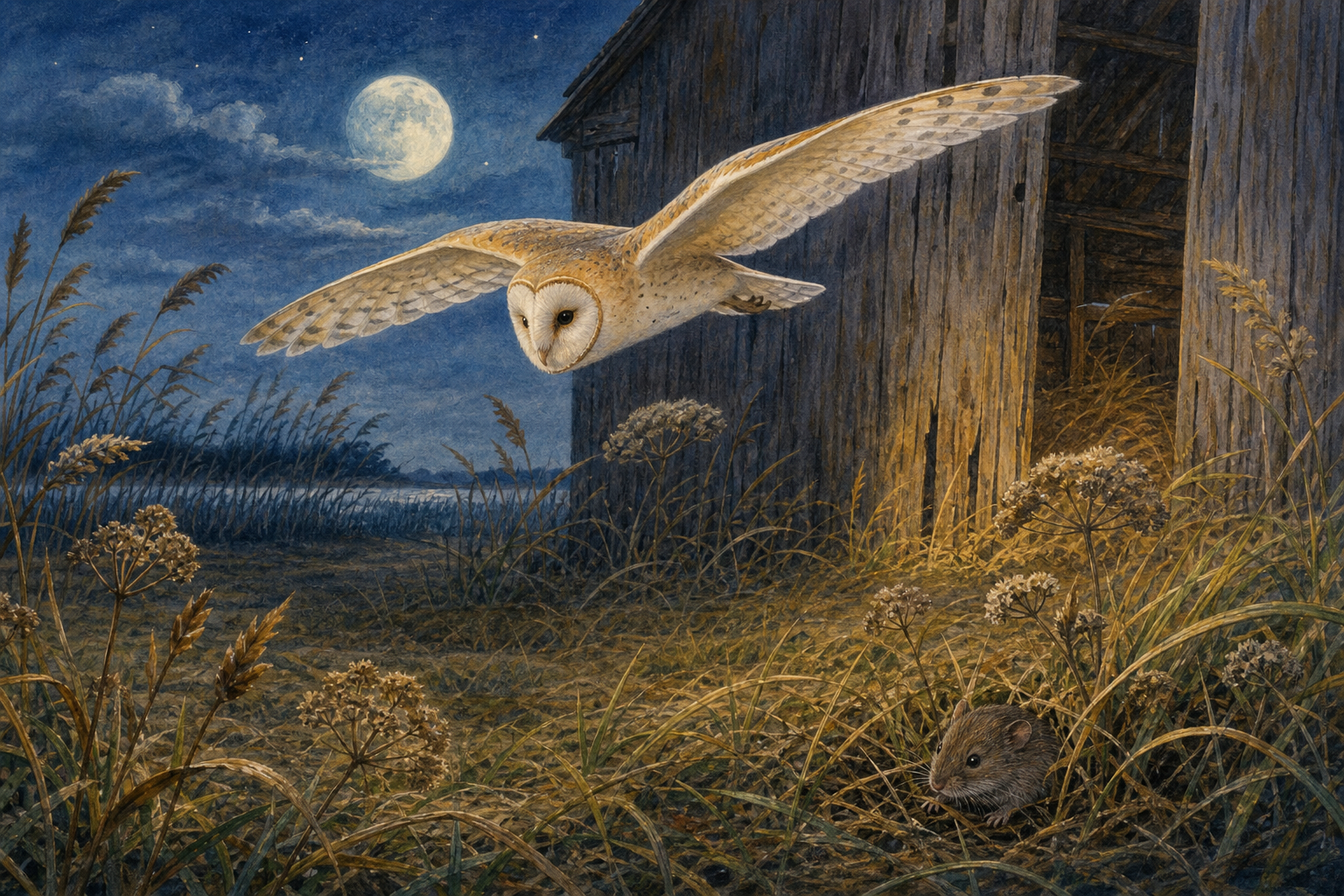
Imagine standing beside a grassy field as daylight turns blueberry-blue. A breeze brushes the seed heads. Somewhere, a mouse makes a quick scratchy sound under the grass. Then a barn owl glides past, low and slow, so quietly it seems to be wearing invisible slippers.
This is the western barn owl, Tyto alba. It is a bird of open country: grasslands, farmland, marsh edges, and other roomy places where small mammals scamper. It may rest or nest in a sheltered cavity, an old building, or—yes—a barn. That is how this owl earned its wonderfully straightforward name.
Western barn owls live across much of Europe, Africa, and parts of western and southern Asia. They are not identical to every bird once called a “barn owl” in older books, because scientists have separated some related groups into different species. Nature, like a family reunion, can be complicated!
Evidence: IUCN Red List of Threatened Species: Tyto alba (Western Barn Owl) — Red List Assessment; Cornell Lab of Ornithology — All About Birds: American Barn Owl Life History; Wikipedia: Western barn owl
Why does its face look like a heart?
That pale, heart-shaped face is not just a fancy feather frame. It helps gather sound, rather like a dish catching raindrops. The owl can aim its hearing toward a tiny rustle, helping it work out where prey is hiding.
Barn owls hunt mainly at night and around twilight. Their hearing is especially directional, and they also use low-light vision. Together, those senses help them find small animals in dim places. A mouse does not need to be seen in bright sunshine for a barn owl to notice it.
This does not mean every hunt is a magic trick that always works. Prey can escape, grass can whisper in the wind, and the owl must keep trying. But its sound-catching face gives it an astonishing advantage in the dark.
Evidence: Cornell Lab of Ornithology — All About Birds: American Barn Owl Life History; Wikipedia: Western barn owl; IUCN Red List of Threatened Species: Tyto alba (Western Barn Owl) — Red List Assessment
A hunter with a very particular menu
Barn owls are carnivores. Their meals are mostly small mammals, especially voles, mice, rats, and shrews. A vole is a small, round-bodied relative of a mouse; a shrew is even tinier and has a pointy snout. In open-country food webs, the owl is one of the predators that eats these animals.
It is tempting to call a barn owl a farm’s superhero, but real ecosystems are more like busy neighbourhoods than superhero films. What an owl eats depends on what lives nearby, and its hunting matters alongside many other parts of the landscape.
A western barn owl is about 33–35 centimetres long—roughly the length of a school ruler plus a little extra. Its feathers are remarkably soft, helping it fly with very little sound. For a small mammal below, that quiet approach is seriously unfair. Sorry, mouse.
Evidence: Cornell Lab of Ornithology — All About Birds: American Barn Owl Life History; Wikipedia: Western barn owl; IUCN Red List of Threatened Species: Tyto alba (Western Barn Owl) — Red List Assessment
The mysterious little bundle on the ground
Suppose you find a small, dry bundle of fur and tiny bones beneath an owl’s favourite perch. It might look a bit like a fuzzy pebble. That is likely an owl pellet—not owl poo, despite what a startled first guess might suggest.
After swallowing a meal, a barn owl digests the parts it can use. Fur and bones do not break down in the same way, so the owl brings them back up as a compact pellet. Scientists and curious nature detectives can carefully study pellets to discover clues about what an owl has eaten.
The best detective rule is look, don’t disturb. A pellet can be interesting, but owls need calm places to rest and nest. If you explore outdoors, leave nests, roosts, and wild animals peacefully alone, and ask an adult before handling anything you find.
Evidence: Cornell Lab of Ornithology — All About Birds: American Barn Owl Life History; Wikipedia: Western barn owl; IUCN Red List of Threatened Species: Tyto alba (Western Barn Owl) — Red List Assessment
Home is more than a building with a roof
A barn can offer shelter, but a barn owl also needs hunting ground nearby. Rough grassland and open fields can be full of the small mammals it searches for. Safe cavities, old buildings, and other sheltered nest places matter too.
Breeding adults form pairs around a nest site and share the work of raising young. Most hunting, however, is a solo mission. Picture one parent listening over the fields while the other stays nearer the nest: a team, but not a crowd.
People can help by valuing wild corners and protecting suitable grassy habitat. In places where nest sites are scarce, carefully designed nest boxes may help, but projects need local wildlife experts. The right action in one place is not automatically the right action everywhere.
Evidence: Cornell Lab of Ornithology — All About Birds: American Barn Owl Life History; Wikipedia: Western barn owl; IUCN Red List of Threatened Species: Tyto alba (Western Barn Owl) — Red List Assessment
“Least Concern” is good news—but not a permission slip to stop caring
The IUCN Red List record identifies the western barn owl as Least Concern. That is encouraging: it means the species is not currently listed in one of the highest global risk categories. Still, it does not mean every local group of barn owls is safe or doing exactly the same.
Barn owls can face loss of rough grassland and nest sites. Rodenticides and other pesticides are also a danger: an owl may be harmed after eating prey exposed to poison. Low flights over open ground can also bring owls close to roads and vehicles.
The hopeful part is that caring for habitat helps more than one creature. Grassy edges, safe nesting places, and choices that avoid harming wildlife can make a landscape friendlier for owls and for many smaller neighbours too. Protecting an owl begins with noticing what an owl needs.
Evidence: IUCN Red List of Threatened Species: Tyto alba (Western Barn Owl) — Red List Assessment; Cornell Lab of Ornithology — All About Birds: American Barn Owl Life History; Wikipedia: Western barn owl
A listening challenge for your next twilight walk
At dusk, pause with a trusted adult in a safe outdoor spot. Can you hear grass rubbing together? A bird calling from a hedge? Footsteps on gravel? Our ears collect a surprising amount when we stop filling the air with our own noise.
You probably will not spot a barn owl—and that is okay. Wildlife is not a treasure hunt where an animal has to appear on command. The adventure is learning that an ordinary-looking field can become a whole night-time world when the sun slips away.
If a pale owl ever does drift across your view, remember the heart-shaped face, the hush of its feathers, and the patient attention beneath that flight. It is not floating through an empty dark. It is reading the night with sound.
Evidence: Cornell Lab of Ornithology — All About Birds: American Barn Owl Life History; Wikipedia: Western barn owl; IUCN Red List of Threatened Species: Tyto alba (Western Barn Owl) — Red List Assessment
Kind choices can make room for owls—and everyone else
Barn owls remind us that every animal is somebody in the landscape: the owl listening above the grass, the vole tunnelling below, and the people deciding how to share a field. Choosing fewer harmful poisons around wildlife is one caring way to leave room for these lives.
Food choices can be part of that kindness, too. The World Health Organization describes healthy eating patterns that include plenty of vegetables, fruit, whole grains, pulses, nuts, and seeds. The IPCC reports that shifts toward sustainable, healthy, more plant-based diets can reduce food-system emissions and pressure on land and biodiversity.
You do not have to be perfect to be thoughtful. Perhaps try a bean-based meal with your family, taste a new vegetable, or ask where your food comes from. If you are thinking about changing how you eat, talk with a trusted adult and a qualified health professional. Gentle choices, made with care for animals and our shared home, can add up.
Evidence: World Health Organization: Healthy diet; Intergovernmental Panel on Climate Change: Climate Change 2022: Mitigation of Climate Change — Chapter 7; Cornell Lab of Ornithology — All About Birds: American Barn Owl Life History; Wikipedia: Western barn owl
Questions people ask
Can barn owls really find prey in darkness?
Their exceptional directional hearing and low-light vision help them locate small mammals in very dim conditions. The face acts like a sound-catching dish, but a hunt can still be tricky and prey can escape.
Evidence: Cornell Lab of Ornithology — All About Birds: American Barn Owl Life History; Wikipedia: Western barn owl
Why are barn owl flights so quiet?
Their soft feathers help make their flight almost silent. That quiet glide is useful when they are searching low over open ground for small mammals.
Evidence: Wikipedia: Western barn owl; Cornell Lab of Ornithology — All About Birds: American Barn Owl Life History
Should I put up a nest box?
Maybe—but only with local expert advice. Nest boxes can help where safe nest sites are scarce, yet their design and placement need to suit local owls and avoid creating new risks.
Evidence: Cornell Lab of Ornithology — All About Birds: American Barn Owl Life History; Wikipedia: Western barn owl
Read the evidence
Sources behind this story
- Tyto alba (Western Barn Owl) — Red List Assessment — IUCN Red List of Threatened Species
- American Barn Owl Life History — Cornell Lab of Ornithology — All About Birds
- Western barn owl — Wikipedia
- Healthy diet — World Health Organization
- Climate Change 2022: Mitigation of Climate Change — Chapter 7 — Intergovernmental Panel on Climate Change
Health information is general education, not personal medical advice. Young readers should make food choices with a trusted adult and qualified health professional.