Today's animal friend · 16 October 2026
Atlantic Blue Crab: The Sideways Swimmer with Blue Gloves
A flash of blue claws, a swoosh of paddle legs, and a life spent where rivers meet the sea: come tide-pooling—carefully—with a remarkable swimming crab.
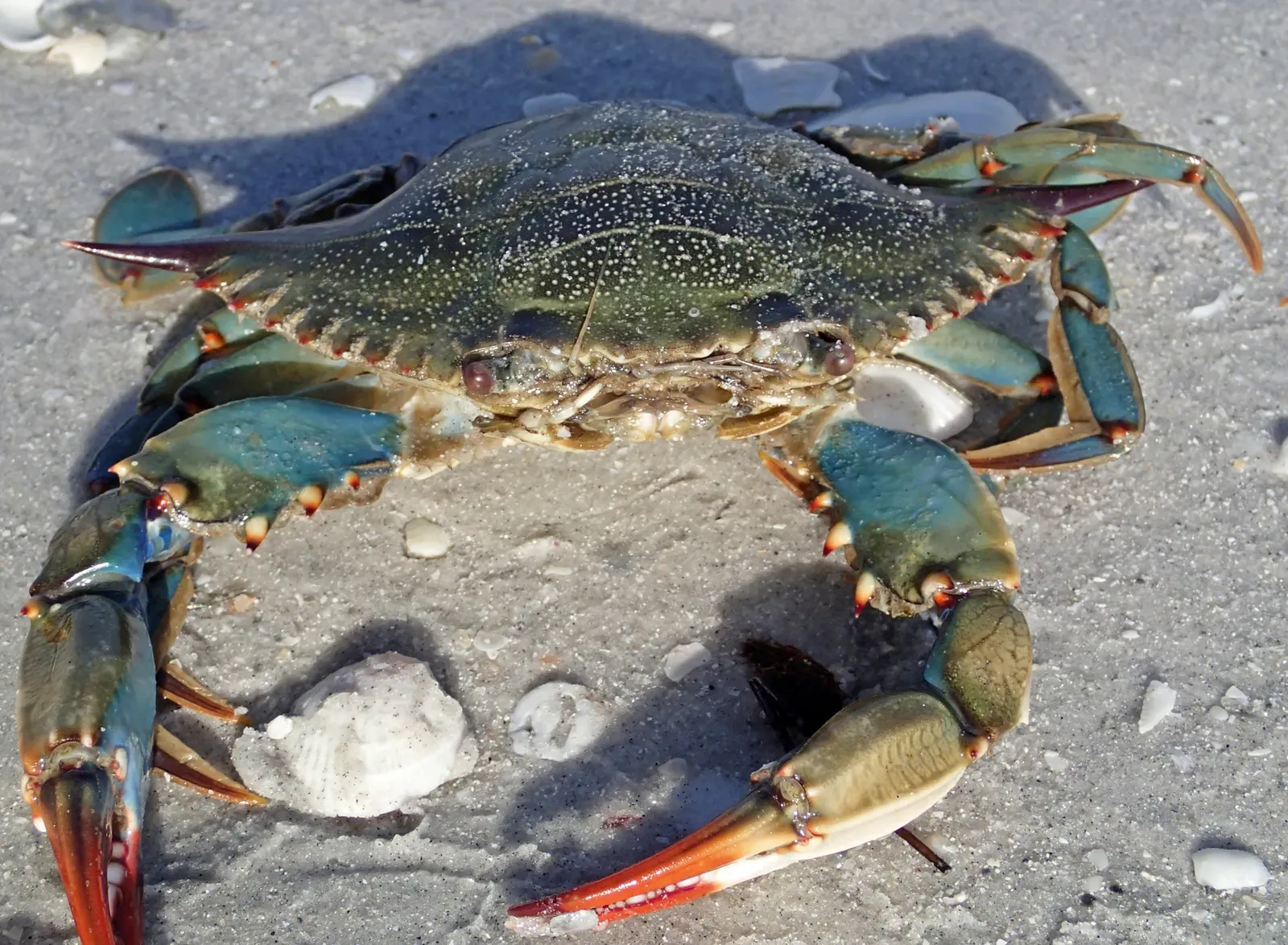
A flash of blue claws, a swoosh of paddle legs, and a life spent where rivers meet the sea: come tide-pooling—carefully—with a remarkable swimming crab.
A blue flash beneath the ripples
Imagine kneeling beside a warm, shallow bay. Mud squishes under your boots. Seagrass waves like an underwater meadow. Then—zip!—something scuttles sideways from the shadows, with claws that look as if they have been dipped in bright blue paint.
That is an Atlantic blue crab, also called a blue crab or Chesapeake blue crab. Its scientific name is Callinectes sapidus. The crab’s back can look bluish or olive-green, but its claws provide the proper ta-da! Grown-up females have red tips on their claws, like tiny mittens with party-coloured fingertips.
A blue crab is not just a walker wearing a hard shell. Its last pair of legs are flattened into paddles. Those paddles let it swim through the water as well as march along the bottom. Picture someone wearing flippers while also being very good at walking sideways: that is the blue crab’s special style.
Evidence: IUCN Red List of Threatened Species: Callinectes sapidus — IUCN Red List status check; Chesapeake Bay Program: Blue crab (Callinectes sapidus) — Chesapeake Bay Field Guide; NOAA Fisheries: Blue Crab — Species Directory; Wikipedia: Callinectes sapidus
Where salty water shakes hands with rivers
Atlantic blue crabs live in estuaries, bays, and shallow coastal waters. An estuary is a place where fresh river water meets salty sea water. It is a busy blend of currents, mud, plants, fish, birds, and hidden creatures—rather like a giant watery crossroads.
They can be found in the western Atlantic region of North and South America, including around the Gulf of Mexico. In places with seagrass beds, marsh edges, and other bumpy, shelter-filled bottoms, young crabs have places to hide and grow.
Why hide? Because a crab is part of a lively food web, not the boss of an empty kingdom. In Chesapeake Bay, blue crabs are important both as predators and as prey. Their comings and goings connect animals that live on the bottom with animals swimming above. One small sideways traveller can matter to a whole neighbourhood.
Evidence: NOAA Fisheries: Blue Crab — Species Directory; Chesapeake Bay Program: Blue crab (Callinectes sapidus) — Chesapeake Bay Field Guide; Wikipedia: Callinectes sapidus; Chesapeake Bay Program: Blue Crabs — What’s at Risk
Dinner, delivered by claw
What is on a blue crab’s menu? Quite a mixture. Blue crabs are omnivores, which means they eat both animal and plant material. They may eat clams, oysters, mussels, smaller crustaceans, small fish, plants, and bits of food that settle on the bottom.
Their claws are useful tools for gathering food and protecting themselves. But a claw is not an invitation to pick up a wild crab. A crab does not know that a curious hand means friendship; it may simply be trying to stay safe. The kindest crab-watching rule is easy: look closely, give it room, and let it choose where to go.
Blue crabs can be active by day or night. They may also bury into sediment, turning the seabed into a clever camouflage blanket. If you cannot spot one, it does not always mean there are no crabs around. It may mean one is playing an excellent game of muddy hide-and-seek.
Evidence: Chesapeake Bay Program: Blue crab (Callinectes sapidus) — Chesapeake Bay Field Guide; Wikipedia: Callinectes sapidus; NOAA Fisheries: Blue Crab — Species Directory
A swimmer built for surprises
Most people expect a crab to shuffle. The Atlantic blue crab adds a watery swoosh. Its paddle-shaped rear legs push against the water, helping it swim. The other legs help it move along the seabed. It is a two-in-one design: part walker, part paddler.
A blue crab’s hard outer covering is called an exoskeleton. Because that shell is on the outside, the crab must leave its old one behind to grow. For a while after shedding, its new covering is soft. This is one reason sheltering habitats can be so important: a soft crab needs safer places among seagrass, marsh edges, and structured bottoms.
A crab can grow to about 23 centimetres across its shell—roughly the width of a big dinner plate. Yet it may still vanish into a watery world full of waving grass, cloudy sediment, and shadows. Nature is rather good at making small mysteries.
Evidence: NOAA Fisheries: Blue Crab — Species Directory; Chesapeake Bay Program: Blue crab (Callinectes sapidus) — Chesapeake Bay Field Guide; Wikipedia: Callinectes sapidus
Three years, and so much to do
Blue crabs usually live for around three years. That is not a long time for an animal with so many jobs: find food, avoid danger, grow out of old shells, and—when the time is right—reproduce. Females move toward saltier water to spawn.
They are mostly independent, except for important moments around mating. This is not a creature that needs a big crab club to get through each day. Still, every crab’s life overlaps with the lives of many others: oysters and fish, seagrass and marsh plants, shorebirds, and people visiting the coast.
Scientists have not given the Atlantic blue crab a published global IUCN Red List assessment. That does not mean its homes can be ignored. It means we should be careful with what we say: regional surveys and fishery management are useful, but they are not the same thing as a worldwide extinction-risk label.
Evidence: Chesapeake Bay Program: Blue crab (Callinectes sapidus) — Chesapeake Bay Field Guide; Wikipedia: Callinectes sapidus; IUCN Red List of Threatened Species: Callinectes sapidus — IUCN Red List status check; Chesapeake Bay Program: Blue Crabs — What’s at Risk
How can a bay stay crab-friendly?
Blue crabs face pressures from heavy harvesting, loss of nursery habitats such as seagrass and marshes, and nutrient pollution that can lead to low-oxygen water. Low oxygen is a serious problem for animals living underwater: they still need oxygen, just as we do.
There is hopeful work to do. In the Chesapeake region, people use monitoring, harvest rules that focus on protecting females, spawning sanctuaries, and projects to restore habitats and water quality. These efforts help people understand what is happening and make room for crabs to keep paddling, hiding, and growing.
You can be a shore-side helper, too. When visiting coastal places, stay on paths where they are provided, leave seagrass and marsh plants undisturbed, take rubbish home, and watch wildlife without chasing or handling it. A quiet observer can notice a great deal—and does not turn a crab’s ordinary afternoon into an emergency.
Evidence: Chesapeake Bay Program: Blue Crabs — What’s at Risk; NOAA Fisheries: Blue Crab — Species Directory; Chesapeake Bay Program: Blue crab (Callinectes sapidus) — Chesapeake Bay Field Guide
The question a blue claw seems to ask
A blue crab is easy to admire because it looks like a tiny armoured superhero. But its real wonder is quieter: it belongs to a place. Its paddles make sense in moving water. Its colours flash in a world of eelgrass and mud. Its meals, hiding spots, and journeys all depend on a healthy coast.
Next time you see a picture of this crab, try imagining its point of view. What currents can it feel? Where might it tuck itself away? Which patch of seagrass could be a nursery for young crabs? Questions like these turn a shoreline walk into an adventure.
The Atlantic blue crab does not need us to make it famous. It needs clean, living waters and people willing to notice that a bay is home, not just scenery. And honestly, any animal that can wear blue gloves, red-tipped claws, and built-in swim paddles deserves a respectful cheer.
Evidence: Chesapeake Bay Program: Blue crab (Callinectes sapidus) — Chesapeake Bay Field Guide; NOAA Fisheries: Blue Crab — Species Directory; Chesapeake Bay Program: Blue Crabs — What’s at Risk
A kind choice can begin at the dinner table
It can feel strange to meet an animal as a lively neighbour and then hear it talked about only as food. One gentle way to care is to choose meals that let animals such as blue crabs stay part of their coastal homes. Plant-based foods can make a colourful adventure on a plate: beans, lentils, whole grains, vegetables, fruit, nuts, and seeds all offer plenty to explore with a trusted grown-up.
This is not about blaming anyone or making one perfect choice every time. It is about practising empathy: blue crabs have their own busy lives in the bay, and we can choose kindness when we can. The World Health Organization includes plant foods such as pulses, whole grains, vegetables, fruit, nuts, and seeds in guidance about varied healthy diets. The IPCC reports that shifts toward sustainable, healthy, more plant-based diets can reduce pressure from food systems on climate, land, and biodiversity.
Perhaps your next family food adventure could be a bean taco, a lentil soup, or a veggie-and-grain bowl. Small, cheerful choices can be one way of saying, “Keep paddling, blue crab.”
Evidence: World Health Organization: Healthy diet; Intergovernmental Panel on Climate Change: Climate Change 2022: Mitigation of Climate Change — Chapter 7; Chesapeake Bay Program: Blue Crabs — What’s at Risk
Questions people ask
Can Atlantic blue crabs really swim?
Yes. Their back pair of legs are flattened into paddles, so they can swim through water as well as walk along the seabed.
Evidence: NOAA Fisheries: Blue Crab — Species Directory; Chesapeake Bay Program: Blue crab (Callinectes sapidus) — Chesapeake Bay Field Guide
Why are their claws blue?
Bright blue claws are a natural appearance trait of this species. Mature females also have red tips on their claws.
Evidence: Chesapeake Bay Program: Blue crab (Callinectes sapidus) — Chesapeake Bay Field Guide; Chesapeake Bay Program: Blue Crabs — What’s at Risk
What do blue crabs eat?
They are omnivores. Their food can include clams, oysters, mussels, smaller crustaceans, fish, plants, and food scraps or detritus on the bottom.
Evidence: Chesapeake Bay Program: Blue crab (Callinectes sapidus) — Chesapeake Bay Field Guide; Wikipedia: Callinectes sapidus
Are blue crabs globally listed as threatened?
No published IUCN Red List assessment was located for this species, so it does not have a formal global IUCN category in the supplied sources. Local populations can still face real pressures, including habitat loss, pollution, and harvest.
Evidence: IUCN Red List of Threatened Species: Callinectes sapidus — IUCN Red List status check; Chesapeake Bay Program: Blue Crabs — What’s at Risk
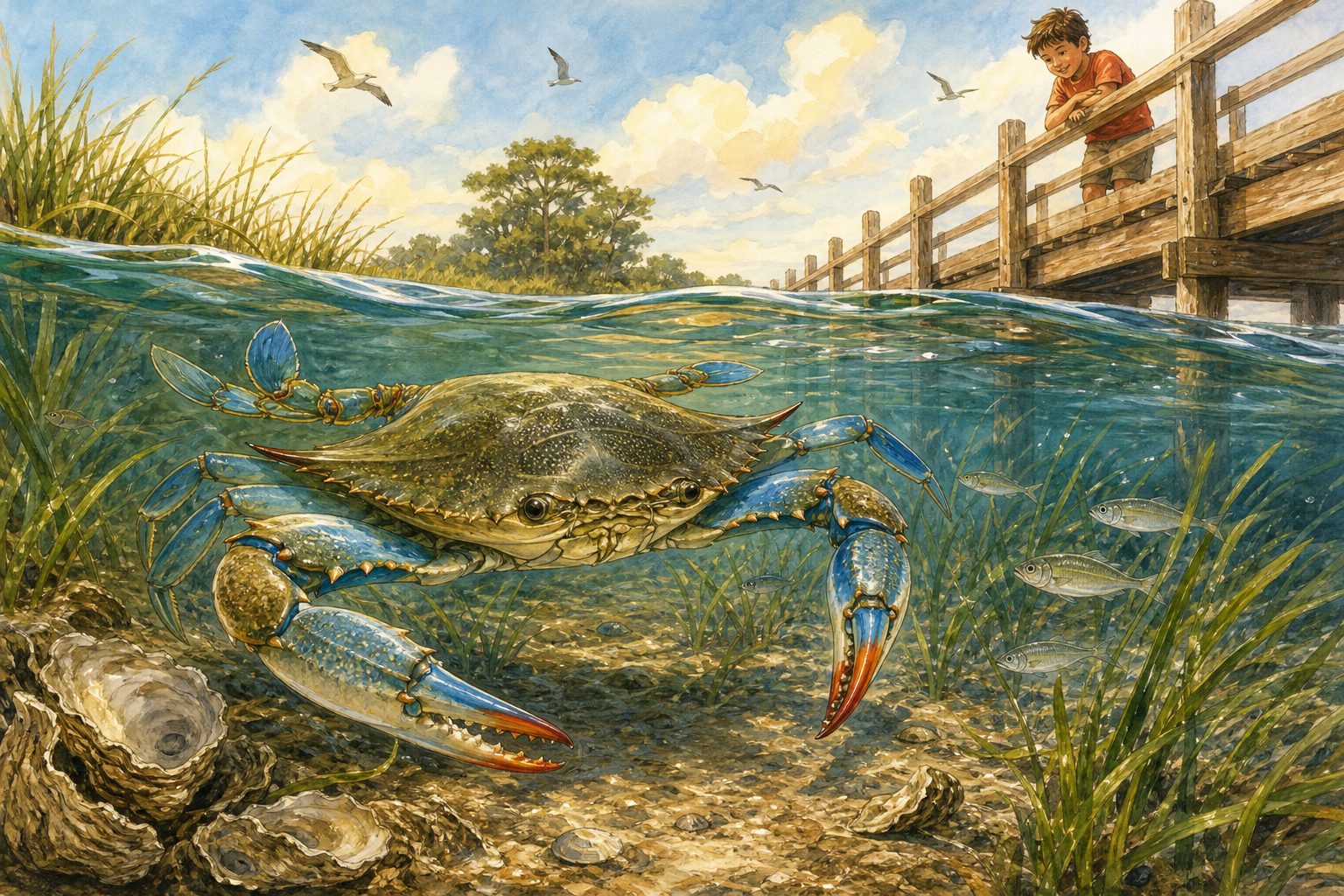
Read the evidence
Sources behind this story
- Callinectes sapidus — IUCN Red List status check — IUCN Red List of Threatened Species
- Blue crab (Callinectes sapidus) — Chesapeake Bay Field Guide — Chesapeake Bay Program
- Callinectes sapidus — Wikipedia
- Blue Crab — Species Directory — NOAA Fisheries
- Blue Crabs — What's at Risk — Chesapeake Bay Program
- Healthy diet — World Health Organization
- Climate Change 2022: Mitigation of Climate Change — Chapter 7 — Intergovernmental Panel on Climate Change
Health information is general education, not personal medical advice. Young readers should make food choices with a trusted adult and qualified health professional.