Today's animal friend · 17 August 2026
The Pond Has a Mooing Secret
At dusk, a still pond turns into a stage. Listen closely: that deep “jug-o-rum” sound may belong to North America’s biggest true frog.
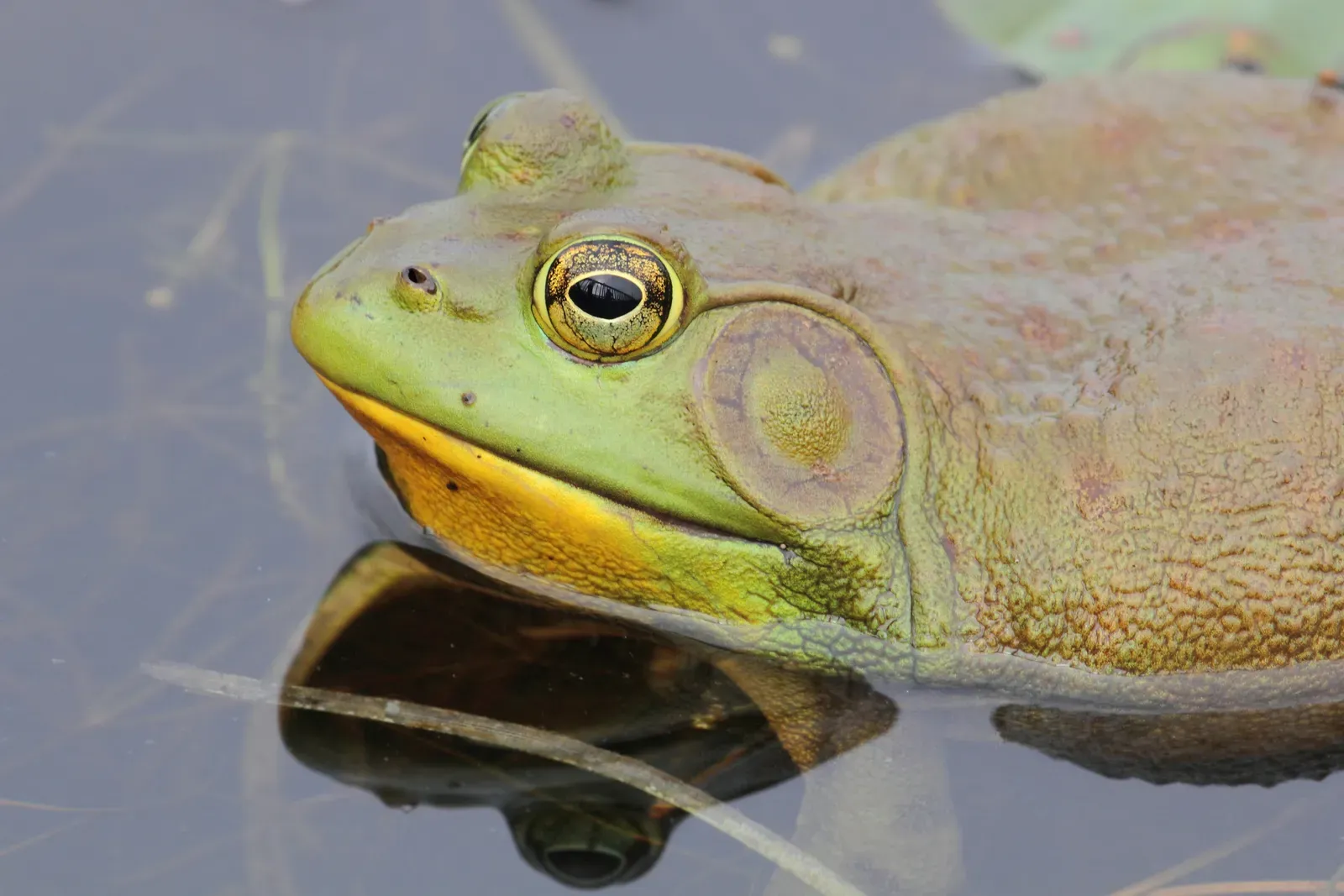
At dusk, a still pond turns into a stage. Listen closely: that deep “jug-o-rum” sound may belong to North America’s biggest true frog.
A splash, a blink, a boom!
Picture a pond at twilight. The water looks like dark glass. A mosquito zips past. A leaf gives a tiny rustle. Then—BOOM—comes a deep call from the reeds, a sound a little like a cow saying “jug-o-rum.” It is not a cow in a raincoat. It may be a male American bullfrog calling from the water.
The American bullfrog, also called the North American bullfrog, is Lithobates catesbeianus. It is the biggest true frog in North America. An exceptionally large adult can reach about 20 centimetres long and weigh around half a kilogram: about as long as a school ruler, and surprisingly hefty for a pond neighbour.
Bullfrogs are most active around twilight and at night, when their watery world becomes busy. In the daytime, a patient observer might spot one floating so quietly that only its eyes and nose seem to be above the surface. Blink, and—plop!—it may vanish below the water like a green-and-brown submarine with legs.
Evidence: IUCN Red List of Threatened Species / IUCN SSC Amphibian Specialist Group: Lithobates catesbeianus (American Bullfrog) — Red List Assessment; Animal Diversity Web, University of Michigan Museum of Zoology: Lithobates catesbeianus (American Bullfrog)
Where does a bullfrog keep its boots? Near water, of course
Bullfrogs belong close to persistent water: ponds, lakes, marshes, swamps, reservoirs, canals, and slow or backwater rivers. Their native home is eastern and central North America, stretching from southern Canada down to Florida and west toward the Great Plains.
Why choose a place where the water sticks around? A bullfrog’s early life happens there. Water is its nursery, its hiding place, its snack bar, and—when it grows up—often its hunting ground. Healthy wetlands do enormous work for many living things, even though they can look, at first glance, like a cheerful muddle of mud, reeds, puddles, and buzzing insects.
Bullfrogs have also been introduced to places beyond their native range, including parts of western North America and other continents. That is an important difference: in its native wetlands, a bullfrog is one part of a long-established community. In places where people moved it, it can compete with or eat local animals and disturb the balance. Same frog; very different neighbourhood story.
Evidence: Animal Diversity Web, University of Michigan Museum of Zoology: Lithobates catesbeianus (American Bullfrog); U.S. Geological Survey: American Bullfrog (Lithobates catesbeianus) — Nonindigenous Aquatic Species Profile
From comma-shaped tadpole to champion hopper
Every bullfrog begins as an egg in water, then hatches as a tadpole. A tadpole does not look much like the big frog it will become. It has a tail, lives fully in water, and has a different menu, feeding more on plant material and bits of detritus than adult bullfrogs do.
Here comes one of the bullfrog’s most amazing slow-motion changes: tadpoles can remain aquatic for months, sometimes for a year or more, before metamorphosis turns them into frogs with legs. The exact timing changes with climate and water conditions, so nature does not use one universal stopwatch.
That long wait helps explain why lasting water matters. A pond that disappears too soon can leave a young bullfrog’s growing-up journey unfinished. When legs finally arrive, though, the frog is ready for a new kind of life at the water’s edge—still strongly connected to the pond, but able to hop onto land.
Evidence: Animal Diversity Web, University of Michigan Museum of Zoology: Lithobates catesbeianus (American Bullfrog); U.S. Geological Survey: American Bullfrog (Lithobates catesbeianus) — Nonindigenous Aquatic Species Profile
What is that frog waiting for? Dinner to come by
An adult bullfrog is a carnivore and an opportunistic predator. In plain language: it waits, watches, and eats prey it can manage. Insects, worms, snails, small fish, tadpoles, and other frogs can all be on the menu. Larger bullfrogs may take other kinds of small animals when prey size allows.
This is not a frog that needs to chase every meal across a field. Adults often sit near the water margin and lunge when an opportunity comes close. It is a bit like waiting beside the cookie plate at a party—except the bullfrog has to be much more patient, and the cookie plate is a pond.
That powerful appetite makes bullfrogs important members of native wetland food webs. They are predators, but they can also be prey for larger vertebrates. In nature, being big does not mean being the only one with an appetite. A pond is full of connections: who eats, who hides, who grows, and who depends on clean water.
Evidence: Animal Diversity Web, University of Michigan Museum of Zoology: Lithobates catesbeianus (American Bullfrog); U.S. Geological Survey: American Bullfrog (Lithobates catesbeianus) — Nonindigenous Aquatic Species Profile
The booming pond concert
During breeding season, male bullfrogs call from aquatic territories. Their booming voices announce where they are, while females visit breeding sites to mate and lay large egg masses. The pond can become a temporary gathering place, full of calls and careful frog business.
Do bullfrogs have a best-friends club? Not in the stable, live-together way that some animals do. Adults do not form lasting social groups. Still, calling males and visiting females create a busy seasonal crowd, and males may defend their watery spots from rivals. Even a quiet pond can have quite a lot of neighbourhood drama.
If you hear a frog chorus, enjoy it as a sound of living wetland habitat—but give the performers space. Watch from the bank, keep voices low, and never try to catch a frog. For a bullfrog, a giant human hand swooping down would be less “friendly hello” and more “yikes, a flying mountain!”
Evidence: Animal Diversity Web, University of Michigan Museum of Zoology: Lithobates catesbeianus (American Bullfrog); U.S. Geological Survey: American Bullfrog (Lithobates catesbeianus) — Nonindigenous Aquatic Species Profile
A big frog needs thoughtful neighbours
Globally, the American bullfrog is listed as Least Concern, with an increasing population trend. But that headline needs a careful read: the increase partly reflects its spread in places outside its native range. It does not mean every wetland is safe, or that introduced bullfrogs are helpful to local wildlife.
In native parts of its range, clean, lasting wetlands are a wonderful thing to protect. Wetland alteration, pollution, harvest, and disease can affect local populations, although the available evidence does not show one major threat across the entire range. Protecting a pond helps far more than one frog; it supports a whole splashy, fluttery community.
Outside the bullfrog’s native range, scientists and wildlife managers may use monitoring, including listening for calls and testing water for environmental DNA, then carefully target removal where needed. This work should be legal, humane, and designed to protect local amphibians. The kindest answer is not to move animals from place to place in the first place: wild neighbours belong in the ecosystems where they evolved.
Evidence: IUCN Red List of Threatened Species / IUCN SSC Amphibian Specialist Group: Lithobates catesbeianus (American Bullfrog) — Red List Assessment; Animal Diversity Web, University of Michigan Museum of Zoology: Lithobates catesbeianus (American Bullfrog); U.S. Geological Survey: American Bullfrog (Lithobates catesbeianus) — Nonindigenous Aquatic Species Profile
A pond-friendly choice can begin at the dinner table
A bullfrog is not a product; it is a watchful animal with a watery home, a booming voice, and a life that begins as a tadpole. Caring about frogs can gently widen into caring about all animals—and choosing meals that leave more room for them to live their own lives.
With a trusted adult, explore delicious plant-forward foods such as beans, lentils, whole grains, vegetables, fruit, nuts, and seeds. The World Health Organization includes these foods in healthy diet guidance, while the IPCC reports that shifts toward sustainable, healthy, more plant-based diets can reduce pressure on land, biodiversity, and food-system emissions. It is not about being perfect. It is about trying kind, tasty choices: perhaps a bean burrito, lentil soup, or a colourful veggie wrap.
Then take that kindness outdoors. Keep litter out of drains and waterways, admire frogs without grabbing them, and let wetlands stay wild. Every thoughtful choice is like adding one small, clean drop to a much bigger pond.
Evidence: World Health Organization: Healthy diet; Intergovernmental Panel on Climate Change: Climate Change 2022: Mitigation of Climate Change — Chapter 7
Questions people ask
Is every big frog near a pond an American bullfrog?
Not necessarily. Many frogs live near water. A bullfrog is especially known for its large size, its close connection to ponds and other persistent waters, and the male’s deep booming call. It is best to observe without handling and let local wildlife experts help with identification.
Evidence: Animal Diversity Web, University of Michigan Museum of Zoology: Lithobates catesbeianus (American Bullfrog); U.S. Geological Survey: American Bullfrog (Lithobates catesbeianus) — Nonindigenous Aquatic Species Profile
Why do bullfrogs need water for so long?
Their young begin as tadpoles and stay aquatic while they develop. That can take months and sometimes a year or more, depending on conditions. Persistent ponds and wetlands give them time to complete metamorphosis.
Evidence: Animal Diversity Web, University of Michigan Museum of Zoology: Lithobates catesbeianus (American Bullfrog); U.S. Geological Survey: American Bullfrog (Lithobates catesbeianus) — Nonindigenous Aquatic Species Profile
Should someone move a bullfrog to a new pond?
No. Moving wildlife can disrupt the animal and can cause problems for the new ecosystem, especially outside the bullfrog’s native range. Enjoy frogs where they are, and tell a trusted adult or local wildlife authority if you have a concern.
Evidence: Animal Diversity Web, University of Michigan Museum of Zoology: Lithobates catesbeianus (American Bullfrog); U.S. Geological Survey: American Bullfrog (Lithobates catesbeianus) — Nonindigenous Aquatic Species Profile
Read the evidence
Sources behind this story
- Lithobates catesbeianus (American Bullfrog) — Red List Assessment — IUCN Red List of Threatened Species / IUCN SSC Amphibian Specialist Group
- Lithobates catesbeianus (American Bullfrog) — Animal Diversity Web, University of Michigan Museum of Zoology
- American Bullfrog (Lithobates catesbeianus) — Nonindigenous Aquatic Species Profile — U.S. Geological Survey
- Healthy diet — World Health Organization
- Climate Change 2022: Mitigation of Climate Change — Chapter 7 — Intergovernmental Panel on Climate Change
Health information is general education, not personal medical advice. Young readers should make food choices with a trusted adult and qualified health professional.