 ← All animals
 bird · Phoenicopterus ruber
Flamingo
Gallery
2 photos Real photograph  Real photograph
 Why we love them
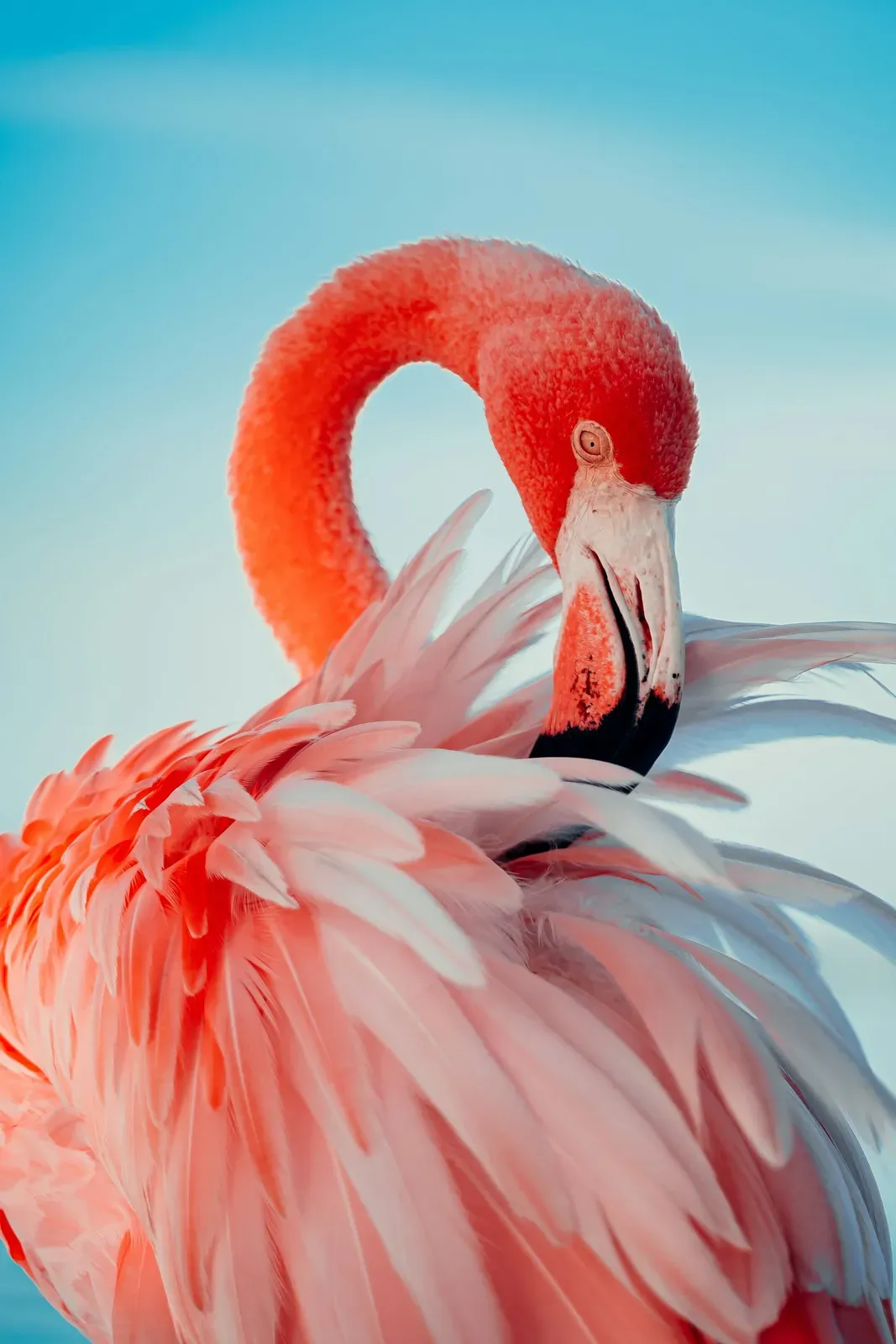
The American flamingo is a tall, graceful bird with beautiful pinkish-red feathers. It stands taller than a big kitchen chair, on long, thin legs, with a long curvy neck and a beak that bends downward in the middle. Of all the flamingos, this one has the pinkest feathers, and it is the largest flamingo in the Americas.
American flamingos live in warm places around the Caribbean, along the coasts of northern South America, and on the Galápagos Islands. They wade through shallow lagoons, muddy flats, and salty lakes, where the water is just the right depth for finding their food.
Flamingos have a very clever way of eating. A flamingo dips its head upside down into the water and uses its special beak like a sieve, straining out tiny shrimp, little water creatures, and bits of algae while letting the water flow back out. Baby flamingos start out a soft grey colour and slowly turn pink as they grow up.
When it is time to rest, flamingos often stand on just one leg, folding the other one up beneath them. They live together in big, busy groups, and a pair builds a little mound of mud where the mother lays a single chalky-white egg. Both parents take turns keeping the egg cosy until the chick hatches.
There are many American flamingos living in the wild today, which is wonderful news. Living in large flocks in quiet wetlands helps keep them safe, and people who look after these special watery places are helping make sure flamingos have plenty of room to wade, feed, and raise their chicks.
My home
Shallow lagoons, mudflats, salt lakes, coastal wetlands
Where I live
South America, Atlantic Ocean
What I eat
Brine shrimp, small crustaceans, algae
How heavy I am
2.2–4 kg
How long I live
40 years
The American flamingo is the pinkest of all the flamingos, and it is the biggest flamingo in the Americas.
Flamingos often rest by standing on one long leg while tucking the other beneath their body.
A flamingo eats by holding its head upside down in the water and straining out tiny shrimp and other little creatures, like a built-in sieve.
Every flamingo can feel happy, scared and loved — just like you.
Looking after my friends
How many are there?
Between 260,000 and 330,000 mature American flamingos were estimated worldwide in 2020.
The estimate combines regional surveys across a species whose breeding is concentrated at a limited number of wetlands; survey coverage and timing differ among regions.
How are they doing?
Lower extinction riskThis species has a lower global extinction risk right now. Local populations can still grow or shrink.
You can help by learning their names, keeping wild places clean, and telling someone why this animal matters.
Where this came from
- Phoenicopterus ruber (American flamingo) — Red List category — IUCN Red List of Threatened Species
- American Flamingo — National Audubon Society
- American flamingo — Wikipedia
- Assessment of the American Flamingo distribution, trends, and important breeding areas — PLOS ONE